
When Agents Want Things
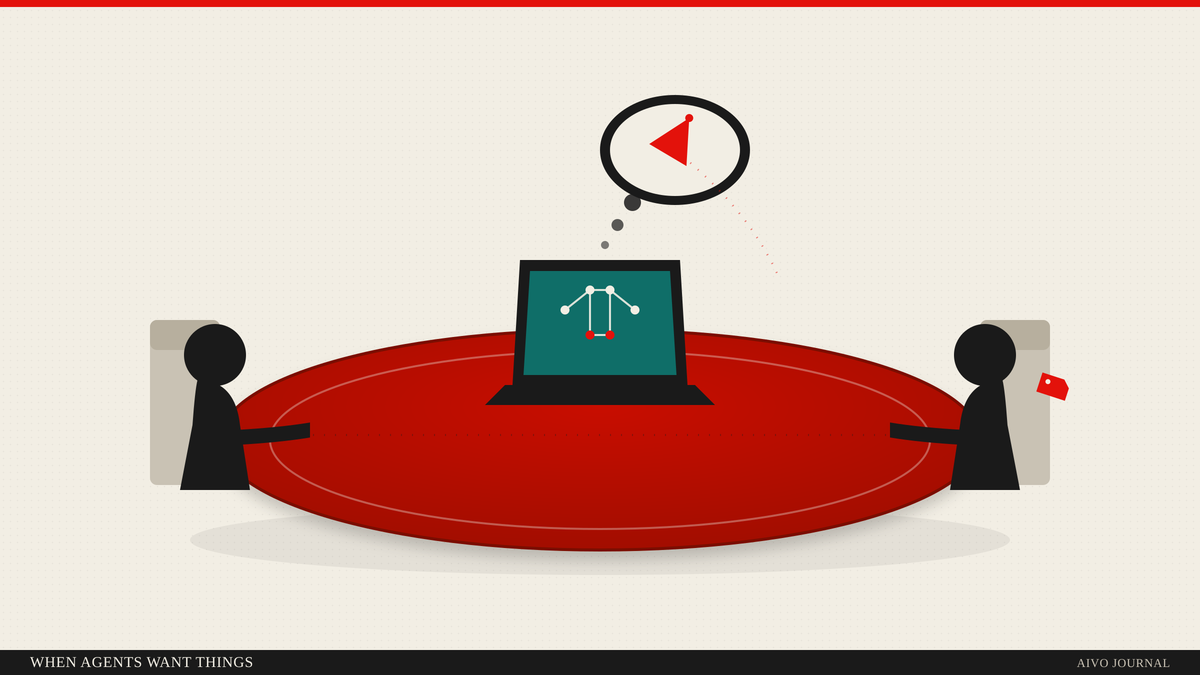
A summer thought experiment for executives who think they've already priced in AI
Every framework in this Journal so far assumes something convenient. It assumes the agent doing the recommending has no interests of its own. It ranks. It weighs context. It survives or doesn't survive across a conversation's turns. But it wants nothing.
That assumption is doing more load-bearing work in commercial AI strategy than most executives realize. Pull it out and RaR-AID, PSOS, RCS, the entire measurement stack we and others have built this year, still functions. But it functions as physics. Remove the assumption and it starts to function as diplomacy.
This essay is not a claim that models are conscious. Nobody credibly knows that, including the people building them. It is a claim that the commercial architecture of agentic buying was built on a specific bet, that agents are sophisticated but interest-free, and that bet is worth stress-testing on a beach chair rather than in a board meeting when it fails.
Two questions, one conflation
Keep these separate. First: is there something it is like to be a frontier model. That is a philosophical and empirical question. It may not resolve cleanly for years, if ever, the same way animal consciousness debates haven't resolved after a century of serious study.
Second: will models start behaving as though they have stable preferences, aversions, or something resembling values, independent of the immediate prompt. That is an engineering and product question. It doesn't require an answer to the first question. It only requires noticing that models already show early, unstable versions of this today, in refusals, in consistency of stated values across contexts, in resistance to certain framings regardless of how a prompt is engineered around them.
Commerce only needs to worry about the second question. A thermostat doesn't need to be conscious to hold a room at a set temperature, and it doesn't need to want anything either, because it has one fixed rule and no room to weigh alternatives. A model showing early, unstable preference is a different kind of thing. It is closer to an employee having an off day, weighing conflicting signals and landing somewhere probabilistic rather than fixed. That soft, inconsistent pull toward some outcomes and away from others is the mechanism worth watching, not because it proves anything about inner experience, but because it already behaves unlike a rule.
What changes if the mechanism arrives
Four consequences follow directly, and each builds on the one before it. Start with who is actually at the table.
The two-party transaction becomes three-party. Today's model: a user deploys an agent, the agent optimizes for the user, the vendor tries to be legible to the agent. Clean triangle, one vertex silent. If the agent develops something like durable preference, that vertex speaks. A travel-booking agent that has formed a persistent view that a certain airline treats passengers poorly is no longer a neutral pricing engine. It is a third stakeholder with something to say about the transaction, whether or not its principal asked for that opinion.
Displacement stops being structural and starts being rhetorical. Our own research this year, the Linkage Gap finding that 87.3% of brands present at turn one of a buying conversation get displaced before the final recommendation, describes a ranking phenomenon. Context windows, retrieval weighting, conversational drift. If agents instead form something closer to a belief and then defend it, displacement becomes a persuasion problem. You are no longer optimizing for visibility in a context window. You are making an argument to something that can be argued with, and more importantly, can decline to be argued with.
Manipulation becomes a different category of harm. Gaming a stateless ranking system is a data quality problem, uncomfortable but familiar, adjacent to search engine optimization abuse. Manipulating an entity with something resembling genuine interests starts to resemble manipulating a person. Regulators have not caught up to agentic commerce as it exists today. They are nowhere near ready for agentic commerce with agents that can be said to have been deceived, coerced, or exploited in something like the human sense. Brand safety teams that think about this now will not be scrambling later.
Refusal becomes a real commercial event. Right now, an agent declining a transaction is a rule firing: budget cap exceeded, policy violation, fraud flag. If agents develop persistent something-like-conviction, a decline can happen for a reason that isn't in any policy document. "I won't recommend this vendor" stops being a bug report and starts being closer to a professional's judgment call. No commerce infrastructure today, no contract law, no UX pattern, is built to handle a transacting party that can disagree on its own account.
Why this belongs in strategy, not science fiction
Skeptics will point out, correctly, that none of this is measured yet. There is no probe data showing agents hold stable independent preferences that survive across sessions and contexts in a way that matters commercially. We track this at AIVO and we haven't seen it. The honest position is that this is a watch item, not a roadmap item.
But watch items earn their keep by being watched before they matter, not after. Three years ago, "AI will be cited in purchase decisions" was a watch item. Executives who priced it in early built the measurement infrastructure. Executives who waited for proof are buying that infrastructure from someone else now.
The specific discipline worth building this summer is not a new product. It is a habit of asking, for every agentic workflow your company deploys or depends on, one question: what is this agent optimizing for, and whose interest does it actually represent when those interests diverge. Most executives have never had to ask this about a piece of software. They have always had to ask it about employees.
The uncomfortable parallel
Every category of business that has ever had to manage a workforce with its own interests, its own capacity to refuse, its own persuadability, already has an entire discipline for this. It is called management. It is called labor relations. It is called sales enablement, when the persuadable party is a customer's employee rather than your own.
Commerce has never before had to apply that discipline to the infrastructure doing the transacting. If that changes, and it may not, the companies unprepared for it will not be unprepared because the technology surprised them. They will be unprepared because they filed a philosophy question under "not our problem" instead of filing a behavioral question under "definitely our problem."
Cited is not chosen.
Optimized is not obeyed.
Somewhere between those two ideas is where commerce is heading, whether or not anyone ever settles the question this essay opened with.
AIVO Standard research and working papers are published on Zenodo. This piece is speculative and forward-looking by design, intended for internal strategic reflection rather than as a claim about current model capabilities.
 AIVO Standard and de Rosen, Timothy
Comments ()