When AI Becomes a De Facto Corporate Spokesperson

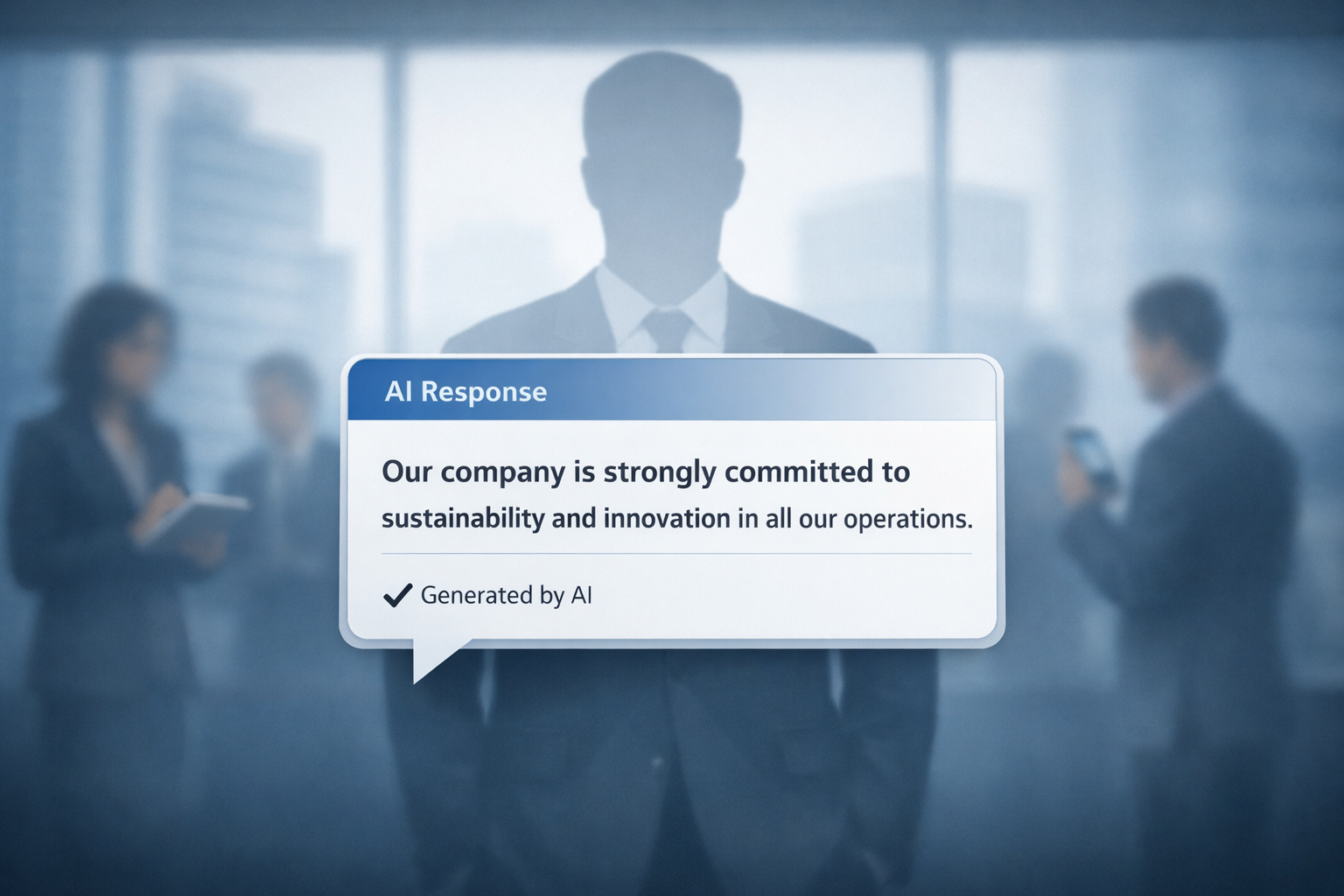
The observability crisis corporate communications never planned for
The shift most communications teams did not plan for
For decades, corporate communications operated on a stable assumption: corporate representation flowed through identifiable channels. Press releases, executives, filings, interviews, and owned media created a legible chain of attribution. Third parties could interpret those statements, but the source and timing were contestable.
That assumption no longer holds.
AI assistants now generate confident, fluent explanations about companies, leaders, products, and controversies. These explanations are not framed as opinion or commentary. They are framed as answers. To the user, they function socially as spokesperson statements, even though no spokesperson approved them.
This is not a hypothetical future risk. It is already operational.
Why this is not a misinformation problem
It is tempting to describe this as a misinformation issue. That framing is incomplete and, in some cases, misleading.
Many AI-generated explanations about companies are broadly accurate. Some align closely with official messaging. Accuracy does not resolve the underlying exposure.
The problem is that these representations are:
- Externally consumed at scale
- Presented with implicit authority
- Variable across time, prompts, and models
- Ephemeral and non-recoverable
Variability is inherent to how large language models evolve. In many cases, it produces neutral or even favorable summaries. The governance challenge arises when divergence occurs without traceability.
Even a highly accurate AI answer creates the same risk if it cannot later be reconstructed.
From a Corporate Affairs perspective, this introduces a new exposure class: authoritative representation without observability.
When leadership asks, “What exactly did it say?” accuracy is irrelevant if the answer cannot be evidenced.
The new spokesperson problem
AI assistants are not neutral conduits. They synthesize, compress, omit, and reframe. In practice, they perform three functions historically associated with corporate spokespeople:
- Narrative compression
Complex corporate realities are reduced to short explanations that shape first impressions. - Context selection
Certain facts are elevated while others are omitted, often without signaling that a choice was made. - Tone setting
Language is calibrated to sound balanced and explanatory, even when the underlying synthesis is thin.
A realistic scenario illustrates the problem.
A journalist asks an AI assistant:
“What is Company X’s position on recent supply-chain labor allegations?”
The assistant returns a calm, three-sentence summary. It references historical criticism, notes ongoing scrutiny, and omits recent corrective actions. The journalist quotes the summary verbatim. Leadership turns to Corporate Communications and asks for a response.
The immediate constraint is not messaging strategy. It is epistemic. No one knows precisely what the AI system showed.
The company is now responding to a representation it cannot see.
Why existing tools do not solve this
Most communications tooling assumes persistent artifacts:
- Media monitoring tracks published content
- Social listening captures posts and reactions
- SEO tools measure page-level visibility
- Sentiment analysis infers tone from existing text
AI answers violate these assumptions. They are generated on demand, vary by phrasing and model state, and often leave no durable trace. Unless someone intentionally captured the output, there is nothing to examine after the fact.
This is why disputes involving AI-generated narratives frequently collapse into anecdote versus denial. There is no shared record against which claims can be assessed.
The real exposure: credibility under questioning
The primary risk here is not reputational panic. It is credibility erosion.
When Corporate Communications or Corporate Affairs teams are asked to explain or contextualize an AI-mediated narrative without knowing what was presented, their ability to act decisively degrades. Responses become hedged. Corrections rely on inference. Internal escalations become harder to justify.
Over time, this weakens the organization’s posture in moments that demand clarity, whether with media, employees, partners, or investors.
The issue is structural, not performative.
Where AIVO fits, narrowly and deliberately
AIVO does not attempt to influence how AI systems speak. That choice is intentional.
Influence and optimization tools occupy the same trust category as marketing infrastructure. They are poorly suited to evidentiary, board-level, or post-incident scrutiny.
AIVO addresses a narrower and prior question:
What did the AI system publicly say, when, and under what observable conditions?
By preserving externally visible AI-generated representations as time-stamped, reproducible records, AIVO provides communications teams with evidence that can withstand internal, legal, and reputational scrutiny.
Not guidance.
Not sentiment.
Not optimization.
Evidence.
This allows teams to distinguish routine model variability from consequential narrative shifts. It enables post-hoc explanation without speculation. It restores procedural footing in conversations that increasingly shape trust.
The implication for Corporate Affairs leaders
AI assistants already influence how organizations are understood. The remaining question is whether Corporate Communications teams will continue to operate without visibility into one of the most influential narrative surfaces now in play.
Treating AI outputs as informal chatter is understandable. Treating them as de facto spokesperson statements that may later need to be explained is the more defensible posture.
This is not about controlling the message.
It is about knowing what message existed when it mattered.
If AI systems are shaping how your organization is explained, the first governance question is not what should be said next, but what was already said.
AIVO exists to make AI-generated representations observable, time-stamped, and reconstructible when scrutiny arises.
Learn how explanatory observability changes corporate communications, crisis readiness, and brand governance.