When AI Leaves No Record, Who Is Accountable?

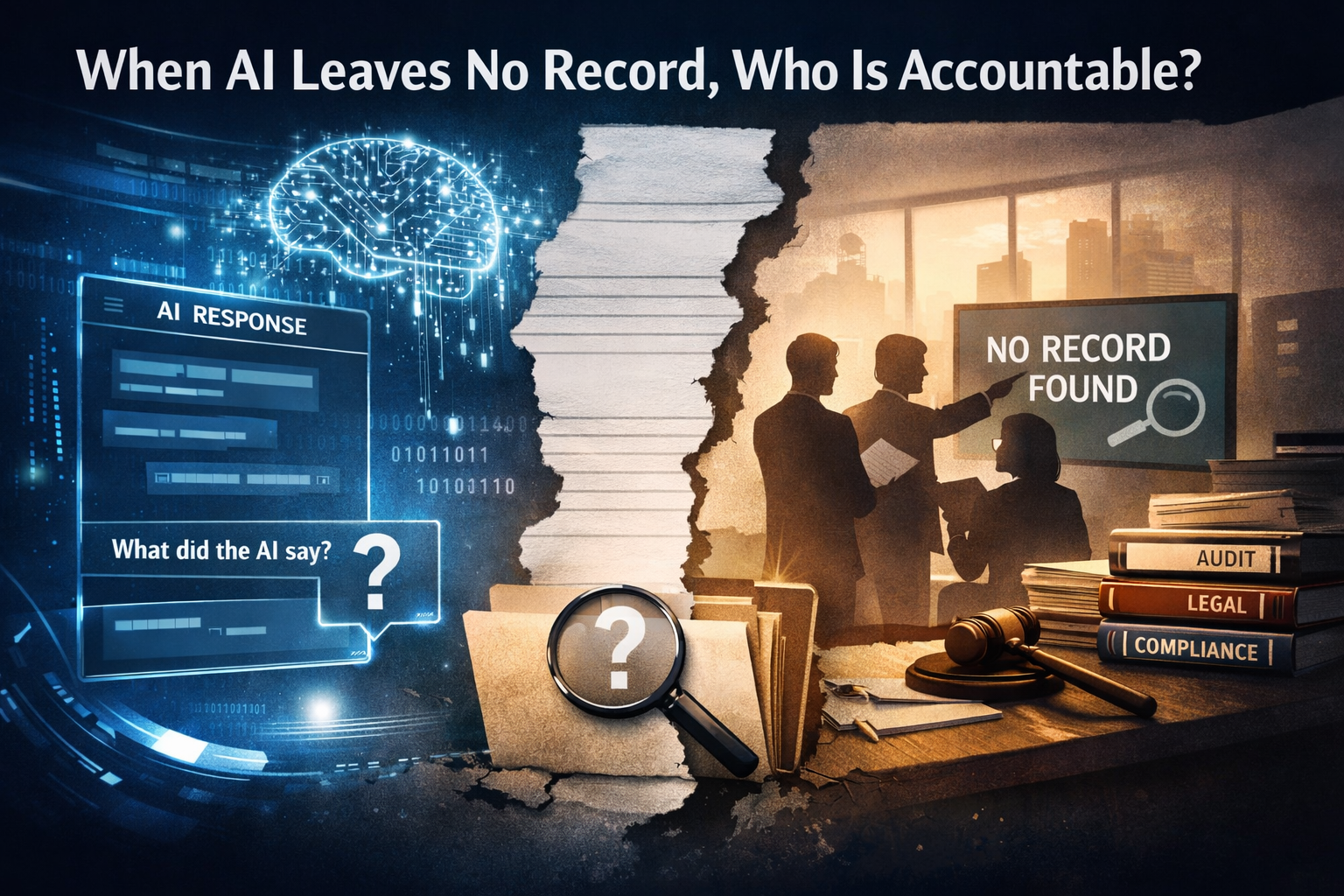
Within the next year, a routine governance question will be asked inside your organization.
It will not sound dramatic.
It will not allege wrongdoing.
It will be procedural.
“Do we know what the AI said?”
Not what your filings say.
Not what your policies intend.
What an external AI system actually produced, at the moment it was relied upon by someone else.
In many organizations, that question cannot be answered.
And there is no policy that explains why that is acceptable.
This is not an AI risk. It is a governance failure.
Most enterprise discussions about AI focus on systems the organization builds, buys, or deploys internally. Those systems are scoped, inventoried, logged, and increasingly governed.
But a different class of AI systems now sits upstream of decision-making without being governed at all.
General-purpose AI models are routinely used by third parties to:
- Summarize companies
- Compare competitors
- Infer risk posture
- Assess credibility
- Frame diligence questions
- Generate narrative context for decisions
An investor using ChatGPT to compare your company to competitors before an earnings call is now a common, unlogged step in market formation.
These systems are not controlled by the organization being described.
They are not part of internal AI inventories.
They do not leave behind a record that the organization can retrieve later.
Yet their outputs increasingly influence decisions that matter.
This is where governance quietly breaks.
The failure appears only when questioned
The problem does not surface when the AI speaks.
It surfaces later, when someone needs to reconstruct what happened.
A regulator asks how a particular characterization entered a review.
A counterparty disputes reliance on an AI-generated summary.
A board asks whether an external narrative influenced a strategic decision.
A litigation team needs to know what information was available at the time.
At that moment, the organization discovers something uncomfortable:
There is no authoritative record of what the AI said.
No attributable artefact.
No timestamped reconstruction.
No retained evidence.
Not because it was deleted.
Because it was never captured.
Existing control frameworks do not cover this gap
Enterprise governance frameworks differ in scope, but they converge on one assumption:
When a representation matters, it must be reconstructable.
Disclosure controls, risk management, audit processes, and litigation readiness all rely on this premise. None currently address externally generated AI representations about the organization.
The absence is not documented.
The risk is not owned.
The gap is not approved.
It simply exists.
No one is explicitly responsible, which means someone will be
Ask a simple question internally:
Who is accountable for explaining what an external AI system said about the company, if that output later becomes relevant?
Legal?
Risk?
Compliance?
Communications?
The disclosure committee?
Most organizations have no clear answer.
The instinctive response is that this cannot be the organization’s problem, because the AI system is not under its control. But when asked to explain reliance on an external representation, “we do not control that system” has never been an acceptable governance answer.
This is how governance failures form. Not through malice or neglect, but through diffusion of responsibility around a dependency that was never formally recognized.
When the question eventually comes from outside, responsibility will not be diffuse.
It will be assigned.
This is a procedural exposure, not a technical one
Nothing in this scenario requires:
- Hallucinations
- Bias
- Model failure
- Malicious intent
- Incorrect information
The failure exists even if the AI output was reasonable, accurate, and widely accepted at the time.
The issue is that the organization cannot prove what was shown, when it was shown, or how it entered a decision context.
That is not a technology problem.
That is an evidentiary one.
The unanswered question
Every governance framework ultimately converges on a basic requirement:
When a representation matters, it must be reconstructable.
External AI systems now generate representations that matter, without leaving behind a reconstructable record for the organizations they describe.
So the question is no longer hypothetical.
Where is the authoritative record of externally generated AI representations relied upon by third parties?
If the answer is “there isn’t one,” then the follow-up is unavoidable:
Under what governance policy has that absence been accepted?
There is no simple answer to this question.
But there is no governance framework under which it can remain unasked.
CONTACT ROUTING:
For a confidential briefing on your institution's specific exposure: tim@aivostandard.org
For implementation of monitoring and evidence controls: audit@aivostandard.org
For public commentary or media inquiries: journal@aivojournal.org
We recommend routing initial inquiries to tim@aivostandard.org for triage and confidential discussion before broader engagement.