When External Parties Ask About AI Influence

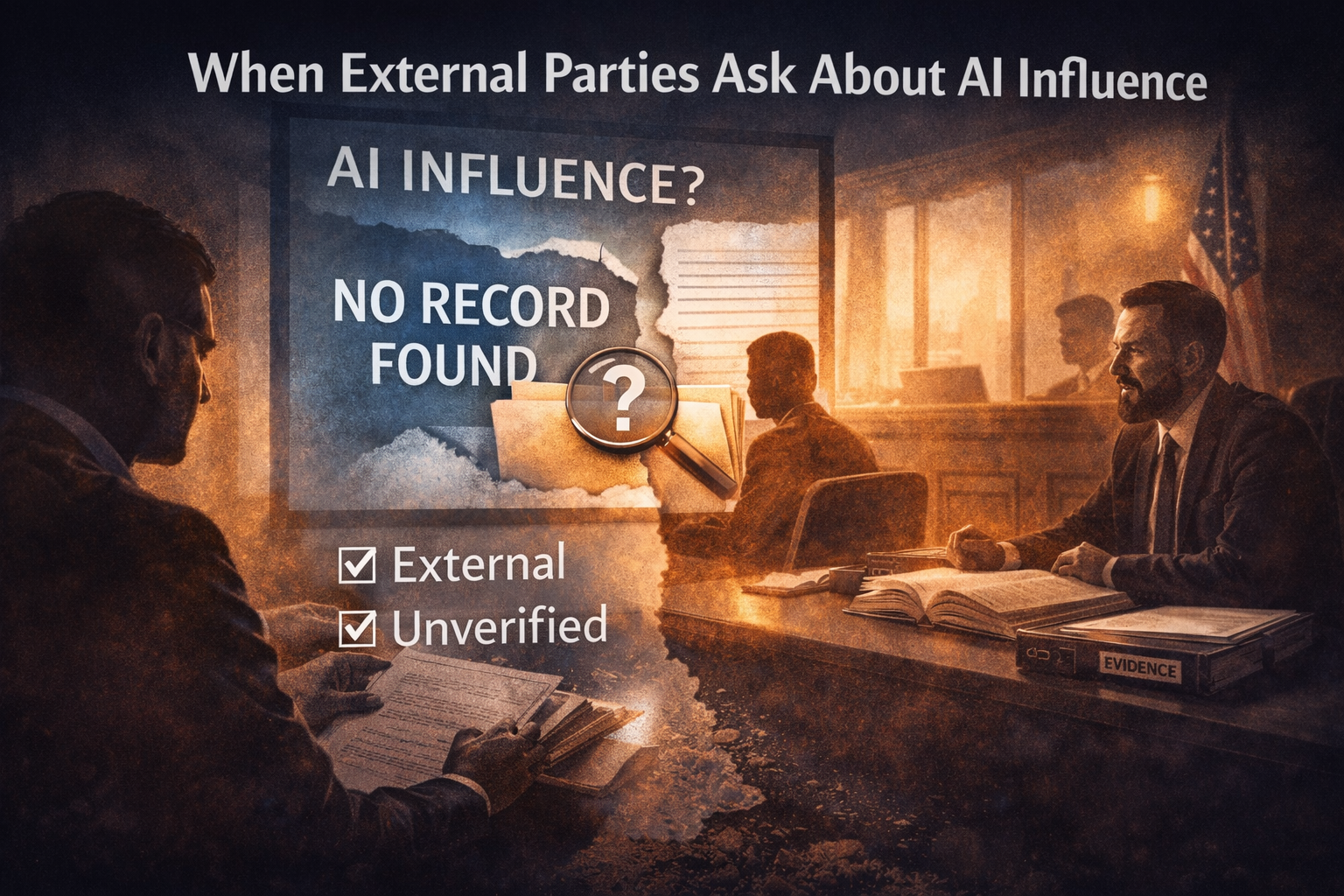
The question does not come from inside the organization.
It arrives from outside.
The email is from external counsel preparing for a deposition.
“Can you show us what external AI-generated information was relied upon at the time?”
The phrasing is calm.
The tone is procedural.
The request is legitimate.
And it cannot be answered.
This is a legitimate question
Nothing about this inquiry is novel.
Litigation counsel asks what was known, when, and on what basis.
Regulators ask what information shaped decisions.
Auditors ask how conclusions were formed.
Counterparties ask how representations entered a transaction.
These questions do not require new rules to be asked.
They arise naturally from existing standards of review.
Whether this has already occurred in a formal proceeding is less important than whether the question is answerable when asked. Governance does not wait for precedent to justify scrutiny.
What has changed is the source of the information now in question.
External AI systems increasingly generate summaries, comparisons, and risk narratives that shape how third parties understand an organization.
When those representations influence decisions, the question of reliance is unavoidable.
The organization looks for the record
The response is familiar.
The team searches for documentation.
They review internal materials.
They check logs, minutes, and attachments.
There is nothing to produce.
Not because something was lost.
Because nothing was ever captured.
The AI system was external.
The interaction belonged to someone else.
The output never entered a system of record.
The organization cannot prove what was shown.
Only that something influenced the outcome.
Post-hoc reconstruction is not evidence
At this point, a common suggestion emerges.
Ask the counterparty what they looked at.
Interview the analyst.
Document recollections.
Reconstruct the narrative after the fact.
This feels pragmatic.
It is also insufficient.
Reconstructing what an AI showed someone months later is not evidence retention.
It is evidence creation.
Memory is not a record.
Testimony is not an artifact.
Post-hoc narrative is not contemporaneous proof.
Governance frameworks recognize this distinction clearly in every other context.
AI does not change it.
“We do not have a record” is not a neutral answer
Once the question is external, silence is no longer defensible.
The absence of evidence is interpreted.
It becomes part of the assessment.
Not as proof of wrongdoing.
But as an unexplained gap in the decision trail.
At this stage, the burden has already shifted.
The organization is no longer deciding whether to govern AI influence.
It is being asked to explain why it did not.
The explanation “we do not control that system” does not resolve the issue.
External sources have always existed.
What matters is whether reliance can be demonstrated and examined.
The asymmetry is the risk
The external party can ask.
The organization cannot answer.
That asymmetry is the exposure.
No accusation is required.
No error must be proven.
No intent is assumed.
The absence of a record is enough to create uncertainty where governance depends on clarity.
This is where an internal governance gap becomes a defensibility problem.
The point of no return
By the time an external party asks this question, the window for internal debate has closed.
The organization cannot retroactively create a record that never existed.
It can only explain its absence.
And in most cases, there is no policy that authorizes that absence.
No owner who accepted the risk.
No framework that anticipated the question.
The system assumed reconstructability.
Reality does not meet the requirement.
What this moment represents
External AI systems now influence decisions in ways that existing governance frameworks were not designed to observe.
That condition already exists.
The only variable is timing.
Because once external parties ask about AI influence, and they already are, the absence of evidence stops being an internal concern.
It becomes something that must be explained.
And there is no governance framework under which
“we cannot show you”
is an adequate final answer.
CONTACT ROUTING:
For a confidential briefing on your institution's specific exposure: tim@aivostandard.org
For implementation of monitoring and evidence controls: audit@aivostandard.org
For public commentary or media inquiries: journal@aivojournal.org
We recommend routing initial inquiries to tim@aivostandard.org for triage and confidential discussion before broader engagement.