When Optimization Replaces Knowing

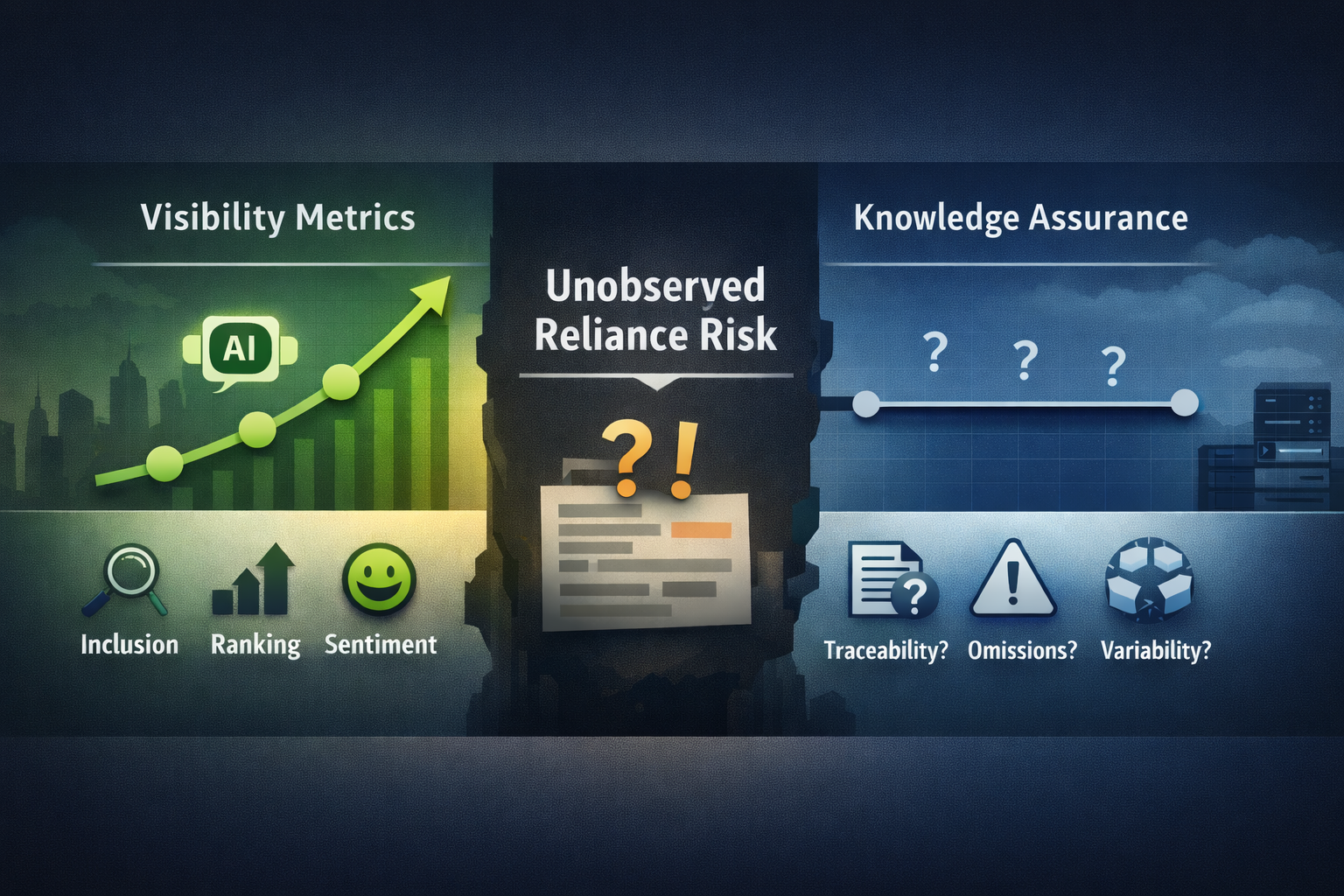
How GEO and AEO Are Advancing Faster Than Enterprise AI Governance
Enterprises are investing aggressively in Generative Engine Optimization and Answer Engine Optimization. These efforts are rational. AI systems now shape discovery, evaluation, and early decision-making across procurement, finance, healthcare, and regulation. Being absent from AI-generated answers increasingly carries commercial cost.
What is less examined is how often optimization is being treated as a proxy for governance.
The assumption is subtle but consequential: that increasing inclusion, consistency, or sentiment alignment in AI outputs reduces enterprise risk. In reality, optimization improves exposure without guaranteeing knowledge control. That distinction is now material.
The category error is not optimization. It is substitution.
GEO and AEO solve a legitimate problem: increasing the probability that a system mentions you. They were never designed to answer a different question: what exactly did the system assert about you at a specific moment, under which conditions, and can that assertion be reconstructed later?
Many enterprises are now implicitly substituting the first for the second.
This is not a theoretical critique. It reflects a mismatch between what optimization metrics measure and what governance reviews ultimately require.
What is measured vs what is relied upon
Most enterprise GEO programs track variables such as inclusion rate, topical coverage, sentiment polarity, and narrative alignment across models. These indicators are useful for exposure management.
They do not capture:
- Whether materially different claims emerge across similar prompts.
- Whether regulatory, safety, or financial caveats are omitted under common queries.
- Whether a representation can be reproduced weeks later.
- Whether different models generate incompatible answers with equal authority.
These properties are not failures of implementation. They are inherent to probabilistic systems.
The problem is not that enterprises are unaware of this. It is that optimization metrics are increasingly being treated as sufficient evidence of control.
Why accuracy alone does not close the gap
Many GEO advocates respond by pointing to accuracy checks, E-E-A-T alignment, or human review layers. These practices are valuable, but they address a different risk.
Accuracy evaluates whether an answer is broadly correct. Governance asks whether a relied-upon representation can be evidenced, contextualized, and defended after the fact.
A statement can be accurate and still create exposure if:
- It omits material qualifiers.
- It cannot be reconstructed later.
- It changes meaningfully across time or models.
- It is relied upon earlier than anticipated in a decision chain.
In audits, disputes, or regulatory reviews, the inability to evidence what was said is often more damaging than the presence of minor inaccuracies.
The overlooked question optimization frameworks do not answer
There is a question most GEO and AEO stacks are not built to answer:
Can this AI-mediated representation be reconstructed with sufficient fidelity after it has influenced a decision?
If the answer is no, then optimization has increased reach without increasing control.
This matters because reliance now occurs upstream of formal processes. AI outputs inform early diligence, risk framing, and vendor screening before legal, compliance, or finance teams are engaged. By the time a question is formally raised, the representation has already shaped expectations.
Without a durable record, governance becomes retrospective inference.
Why responsibility diffusion persists even in mature programs
Some enterprises are actively addressing these issues. Multi-engine monitoring, versioned content repositories, approval workflows, and remediation paths are becoming more common. These efforts meaningfully reduce risk.
Even so, a structural gap remains.
GEO typically lives in marketing or growth. Governance accountability lives elsewhere. Optimization tools report performance. Governance functions require evidence.
This creates responsibility diffusion:
- Marketing optimizes presence.
- Legal assumes accuracy controls exist.
- Compliance lacks a reliance-grade artifact.
- Finance absorbs downstream exposure.
The issue is not negligence. It is misalignment between tooling, metrics, and control ownership.
What “knowing” requires in an AI-mediated environment
Knowing is not confidence that narratives are generally aligned. It is evidentiary capability.
In practice, this means being able to:
- Capture the specific output presented.
- Associate it with prompt context, model, and timing.
- Observe variation across systems and over time.
- Retain a record suitable for audit, dispute, or disclosure.
Many enterprises are moving in this direction. Few have institutionalized it as a first-class control layer.
Optimization increases risk if observability does not keep pace
Optimization amplifies distribution. If representations are not observable and reconstructable, optimization increases the surface area of unmanaged reliance.
This reverses the logic of traditional corporate communications, where review, approval, and archiving precede amplification. In AI-mediated systems, amplification often precedes awareness.
That inversion is the risk vector.
The emerging requirement beneath GEO and AEO
The conclusion is not that enterprises should retreat from optimization. It is that optimization must sit on top of a layer designed for evidentiary control.
GEO determines how often AI systems speak. Governance requires knowing what was said, how it changed, and whether it can be defended later.
Until those layers are clearly separated and jointly owned, enterprises will continue to optimize narratives they cannot reliably evidence.
Closing observation
The failure is not over-optimization. It is allowing optimization to substitute for knowing.
As AI systems increasingly mediate corporate representation, the decisive question will not be “Were we visible?” It will be “Can we prove what was said when it mattered?”
Many enterprises are closer than they were a year ago. Very few can yet answer that question with confidence.