
When the buyer's agent reads every page you own
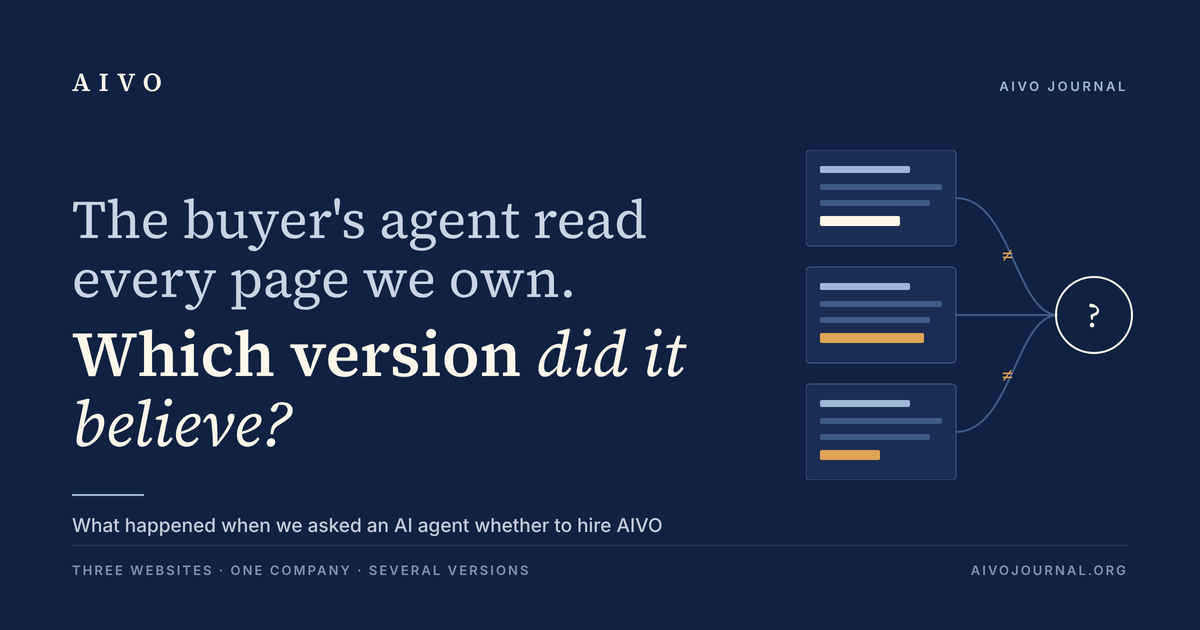
We asked a buyer's AI agent whether it should hire AIVO. In under a minute it visited three of our websites, compared what each one said, found the places where they contradicted each other and told us which of them would make a buyer pause. We have not seen a human procurement process do that so quickly.
The brief, given on 28 October to a personal agent called Instinct, described a US premium haircare brand selling organic products through a major beauty retailer.
Its answer was yes, with conditions: a small, tightly scoped diagnostic, no retainer and no promise of sales growth. It found our public research, pricing, method and case studies, and it named the evidence we had not published: proof on that retailer's product pages, reference customers and commercial outcomes.
It compared what each of our websites said. Our corporate facts page states that our research is published as DOI-anchored working papers that have not been peer reviewed. Our Meridian site described a "peer-reviewed measurement framework".
The facts page labels revenue at risk as a modelled estimate; the Meridian site said "win rate is the revenue" and promised "full revenue attribution". Our agency site led with a personal shopping agent that the agency product does not test, and quoted a research base of 222 brands where the corporate site says more than 380. One page carried an older update date than another, and an old rankings address led nowhere. On the Meridian claims its verdict was blunt: "If I were this buyer, that's the page that would make me pause."
Every page was true to someone
None of these contradictions came from dishonesty. They came from time. Every page was accurate when it was written, and every team had kept its own corner of the company up to date; nobody had updated the company as a whole. The 222 figure is a real subset from a published analysis. The revenue language predates our decision to separate what we measure from what we model.
An agent cannot see a page's history. It reads every page it can reach, treats them as one company speaking and, when they disagree, has to decide which claim to believe. A careful agent discounts the stronger claim. It does not phone to ask which page is right. It lowers its confidence, narrows its recommendation or moves its customer to a company whose account of itself holds together, and the brand never sees the moment it happened.
Watching the agent work felt familiar. It was the mechanism we have spent the past year measuring for other brands, and this time the brand under scrutiny was ours. In the Beyond Visibility working paper (DOI 10.5281/zenodo.20848721), 87.3% of brands named at the start of an AI buying conversation had been replaced by a competitor by the fourth turn. A brand's own inconsistencies are one of the quieter ways it loses at that point, because the agent finds its reason for doubt in the brand's own words.
What we fixed, and what took longer
The agent was right about every point we could check, so we started fixing pages straight away. The corporate site now shows the price of our 90-day program beside the research study, so the two cannot be confused. The skincare case now states that it measured retailer product pages as well as the brand's own site, and that full run logs are available under a mutual NDA. A fixed-price review for consumer brands now fills the gap the agent had priced for itself. The stale date and the dead rankings address are corrected.
The Meridian and agency pages sit with different people and a different publishing process, and at the time of writing they were still being corrected. That delay is the point of this piece. We are a small company with three main websites, and we watch this closely. A typical consumer brand has a corporate site, product sites, listings with several retailers, campaign pages, PDFs and partner content, owned by different teams and updated on different calendars. Its facts drift. Until recently the drift cost little, because people read one page at a time and forgave inconsistency. Agents read across the whole company, and they treat a contradiction as evidence.
Managing facts as one system
This changes where AI recommendation sits inside a company. A buyer's agent is checking whether a supplier's claims hold together across every source it can reach. That makes consistency an operational job for the teams that own products, prices and evidence, as much as a communications one. It is also a different problem from search, and one most companies have never measured.
The practical conclusion is that a brand's facts need managing as a single system. That starts with one approved set of facts that every site, product feed and machine-readable file draws from. It needs agents that test, continuously, what a buyer's agent concludes from all of a brand's pages together, with each finding turned into a proposed correction for each page.
A person should approve every correction before anything changes on a live site, because unreviewed edits are how many of these inconsistencies arise in the first place; the principle we set out for AIVO Assist applies here too, that only approved, sourced statements are made. Finally, the same buyer question should be asked again, to confirm that the agent's conclusion moved.
What this does and does not show
This was a single observation, not a controlled study, and different agents may weigh evidence differently. We have not measured any change in AI Win-Rate from these fixes. What seems unlikely to change is the behaviour itself: agents compare what a company says across every page they can reach.
Most companies assume they have one set of facts. In practice they have several, kept by different teams on different calendars, and a buyer's agent will read all of them. Which version of your company will it believe? We will be asking that question of ourselves regularly.
AIVO, Inc. publishes the AIVO Journal. The agent session described here concerned AIVO's own websites; no client information is involved.
Comments ()