When the Disclosure Committee Cannot Reconstruct the Record

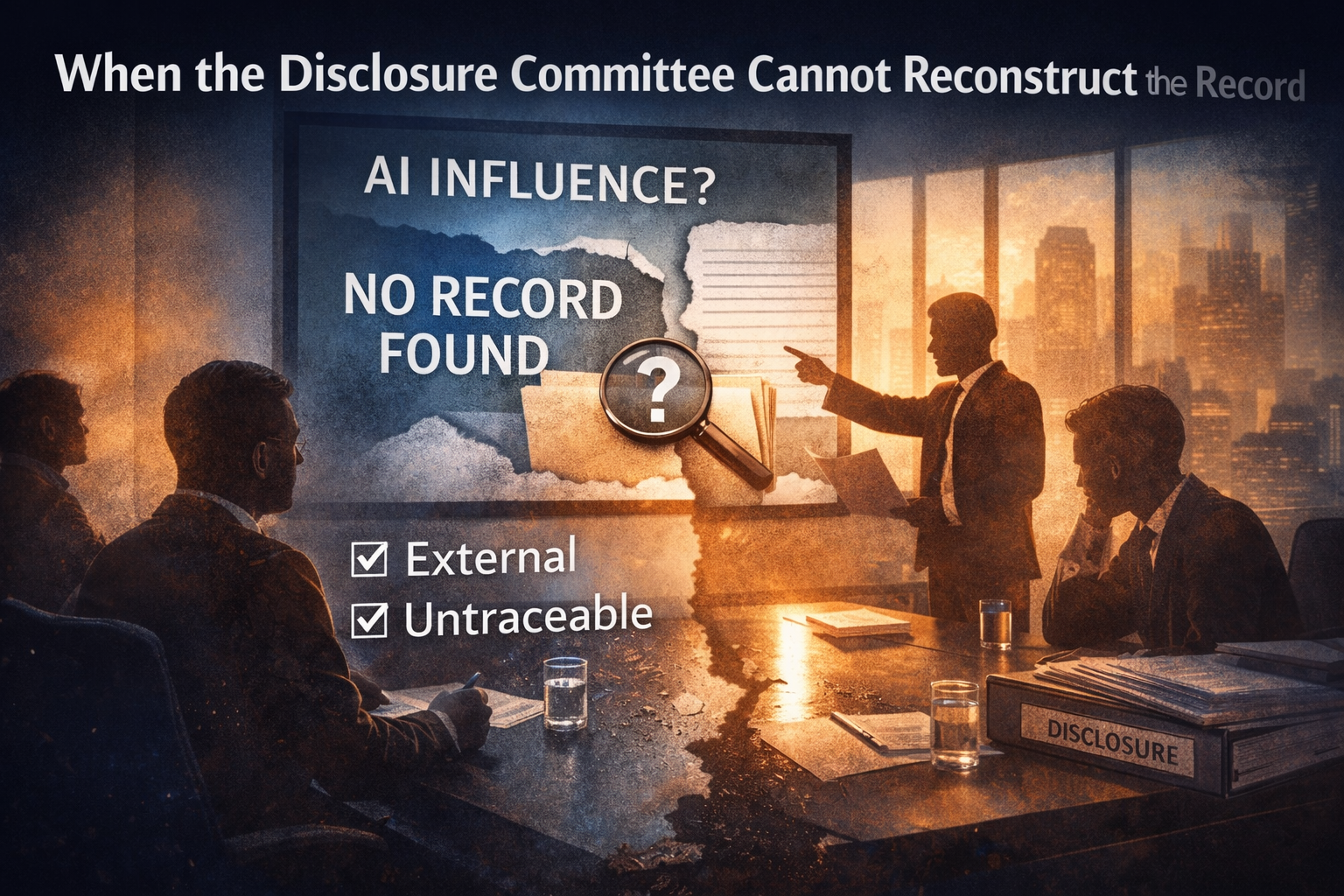
The meeting is routine.
The agenda is familiar.
Material influences.
External inputs.
Decision context.
Near the end, a question is raised. Not as an accusation. Not as a concern. As a checkbox.
“Was any external AI-generated analysis relied upon, directly or indirectly, in forming this view?”
No one speaks.
Not because the answer is controversial.
Because no one knows how to answer it.
This question is no longer exceptional
It would have been unusual two years ago.
It is not unusual now.
Analysts use AI systems to prepare pre-read materials.
Journalists use them for background and comparison.
Investors use them to frame relative risk before calls.
Counterparties use them to structure diligence questions.
These uses are not hidden.
They are not speculative.
They are routine.
What has changed is not the existence of AI-generated summaries, but their position.
They now sit upstream of governance.
The committee does what it is supposed to do
The question is clarified.
Not whether AI was used internally.
Not whether management deployed an AI system.
But whether an external AI-generated representation influenced the context in which a decision was made.
If so, the next step is procedural.
Can we reconstruct what was relied upon?
At this point, governance breaks.
There is no record to review
No one reaches for a log.
There is no artefact to examine.
No prompt history.
No timestamped output.
No attributable record.
Not because it was deleted.
Because it was never captured.
The committee asks where such a record would exist.
There is no answer.
This is not a policy breach. It is a policy void
No internal rule was violated.
No retention obligation was missed.
No system malfunctioned.
No disclosure requirement was ignored.
The absence of evidence is not non-compliance.
It is unaddressed.
There is no policy governing whether externally generated AI representations should be captured once they enter a decision context.
There is no owner of that decision.
There is no documented acceptance of the risk.
There is no attestation pathway.
The framework assumes reconstructability.
The process cannot provide it.
“We do not control that system” is not a governance answer
A familiar objection surfaces.
The AI system is external.
The organization does not operate it.
The organization did not commission it.
All true.
Also irrelevant.
Governance does not ask who controls the source.
It asks whether reliance can be explained.
Credit ratings are external.
Analyst reports are external.
Third-party data providers are external.
Once they influence a decision, they are governed.
External does not mean exempt.
It never has.
The escalation moment
The committee now faces a choice it was not designed to make.
Either:
- attest that no material external AI-generated representation influenced the decision, without evidence, or
- acknowledge that a material influence entered the decision trail without a reconstructable record.
Neither option fits within existing governance expectations.
The meeting will end somehow.
Probably with language no one is comfortable with.
The minutes must be closed.
The attestation must be made.
This is the moment when an abstract AI concern becomes a governance liability.
The unresolved condition
Disclosure committees exist to certify that decisions can be explained, reconstructed, and defended.
External AI systems now generate representations that influence decisions without leaving behind a record that can be examined.
That condition already exists.
The only open question is how long organizations will be able to proceed as if it does not.
Because once the question is asked, and it already is, there is no framework under which silence is a satisfactory answer.
CONTACT ROUTING:
For a confidential briefing on your institution's specific exposure: tim@aivostandard.org
For implementation of monitoring and evidence controls: audit@aivostandard.org
For public commentary or media inquiries: journal@aivojournal.org
We recommend routing initial inquiries to tim@aivostandard.org for triage and confidential discussion before broader engagement.