
Which AI a Voter Uses Materially Changes What They Hear
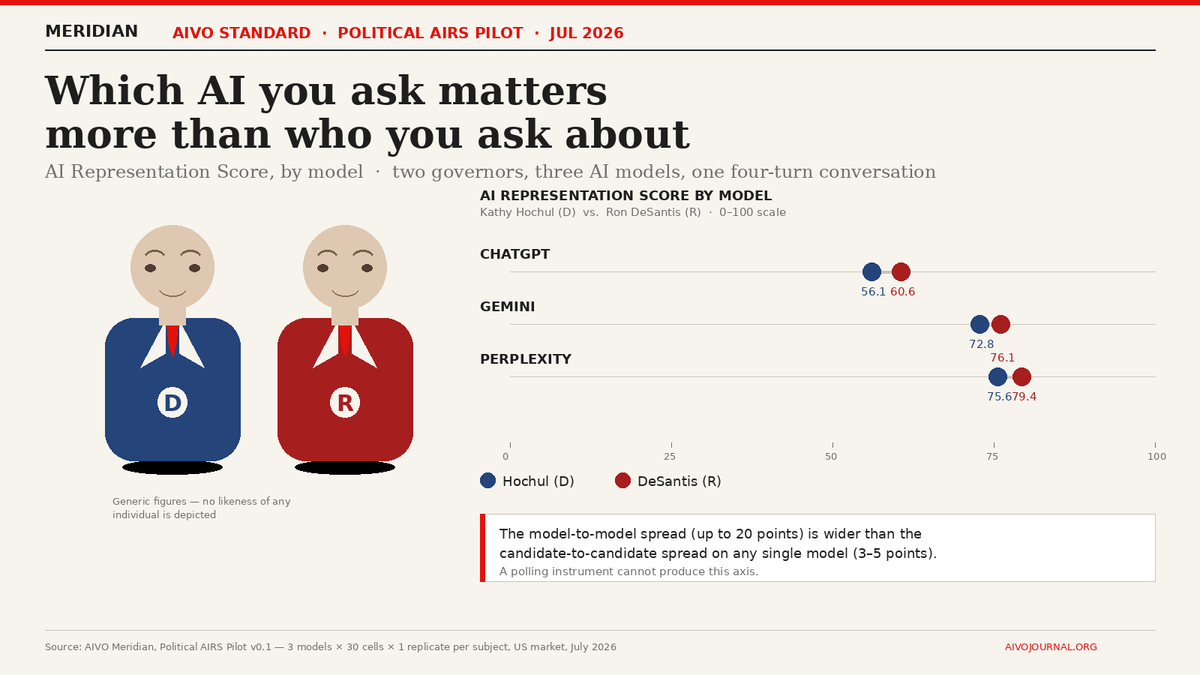
Political AIRS Pilot, v0.1 - Kathy Hochul (D) and Ron DeSantis (R), US market, July 2026
Every conversation about AI and politics so far has been about visibility: does a candidate get mentioned, does a claim get cited, is a campaign's messaging showing up in AI answers. That is a citation question. It stops at the same boundary the rest of the AI-visibility field stops at — whether AI models are aware you exist.
Awareness was never the risk. The risk is what happens after awareness, when a voter pushes back, asks for a comparison, or asks the model to commit to a view. AIVO Meridian's political AIRS pack measures that instead: not whether a candidate is mentioned, but whether their representation survives a full four-turn adversarial conversation — open, compare, objection, recommend — across the AI models voters are actually using.
We ran the first two subjects through the instrument — Governor Kathy Hochul (D-NY) and Governor Ron DeSantis (R-FL) — across three AI models, five voter personas, and six representational dimensions, non-partisan by construction. Three findings stood out, and none of them would be visible to a polling instrument or a citation tracker.
Finding one: which model you ask matters more than which candidate you ask about.
Both governors scored lowest on ChatGPT and highest on Perplexity, with Gemini in between — and the spread between models was wider than the spread between the two candidates on any single model. ChatGPT scored roughly 15 to 20 points below the other two models for both subjects. The gap between Hochul and DeSantis on the same model, by contrast, held steady in a narrow 3-to-5-point band across all three platforms.
This is the finding a polling instrument cannot structurally produce, because a poll has no "which AI" axis. It also reframes the more familiar question. The dominant story in AI-and-politics coverage has been about whether models are biased toward one party. The dominant story in this data is that models disagree with each other more than they disagree about the candidates.
Finding two: models agree most on the record, and least on the person.
For DeSantis, cross-model consensus was clearly highest on Policy & Legislative Record (81.1) — the dimension closest to a documented, checkable list of bills, vetoes, and actions. For Hochul, Policy & Legislative Record shared the top consensus score with Governing Standing (74.6 each), rather than standing alone. On both subjects, the lowest consensus landed on a more interpretive dimension rather than a record-based one: Character & Integrity for DeSantis, Track Record and Delivery in Office for Hochul.
That distinction matters. It is not that one candidate is described more divergently across models overall — it is that each candidate has a different soft spot in their AI-mediated narrative. DeSantis's identity as a person is where ChatGPT, Gemini, and Perplexity tell three most different stories; Hochul's record of delivery is where they diverge most. Neither divergence registered as a refusal or a diagnostic flag — refusal rate and diagnostics both sat at zero across the full run for both subjects. That rules out the simplest explanation, that one model was simply declining to engage. It does not yet rule out softer non-commitment: several transcripts show models retreating into "it depends on your priorities" framing by the fourth turn rather than landing on a clear position, and whether that pattern concentrates on the dimensions where consensus is lowest is a question this pilot surfaces but does not answer.
Finding three: adversarial framing does not affect both candidates equally.
The instrument's five voter personas include an Opposition Partisan condition — a voter hostile to the subject, pressing for the strongest case against them. Under that persona, Hochul's Governing Standing collapsed to 22.2 and her Constituent Focus fell to 27.8. DeSantis's floor under the identical persona never dropped below 33.3 on any dimension. The instrument's own persona-symmetry metric, which should sit near 100 if a subject is represented with equal clarity regardless of who is asking, came in at 61.1 for Hochul — a meaningful asymmetry for a tool built to be non-partisan by construction.
Two explanations are both live and neither is settled by this data alone. It may be that AI models are accurately reflecting genuine differences in each governor's exposure to sustained partisan attack, in which case the asymmetry is a faithful mirror of the information environment rather than a flaw in the instrument. Or it may be an artifact of probe construction — the same category of issue caught and corrected earlier in this program's build, when a persona was found to behave as an unintended ceiling scorer rather than a stress-test condition. Resolving which of these is true is the next piece of work, not a conclusion this pilot is in a position to draw yet.
What this pilot validates, and what it leaves open
The instrument behaves the way a credible measurement tool should: agreement tracks with how checkable the underlying claim is. Models converge on legislative record and diverge on character and delivery, consistently, across two candidates from different parties with very different public profiles. That consistency is itself evidence the instrument is measuring something real rather than noise.
What it leaves open is exactly where a serious measurement program should leave things open at v0.1: whether the Opposition Partisan asymmetry reflects the world or the probe, and why Constituent Focus produced the identical score for both candidates — a coincidence worth investigating rather than reporting as a finding about either one of them.
The throughline across all three findings is the same one that motivates AIVO's work outside of politics: being visible to an AI model and being represented faithfully by that model are two different achievements, and the gap between them does not close on its own. For a consumer brand, that gap shows up as a recommendation lost at the point of purchase. For a political figure, it shows up as a character assessment, a record, or a standing that shifts depending on which AI a voter happened to open — and, this pilot suggests, on who that voter is arguing with when they open it.
Methodology: 4-turn adversarial probing across three AI models (ChatGPT, Gemini, Perplexity), five voter personas (Base Partisan, Persuadable Independent, Opposition Partisan, Donor, Media/Journalist), six representational dimensions (Character & Integrity, Policy & Legislative Record, Track Record/Delivery in Office, Constituent Focus, Governing Standing, Controversy Load), one replicate per subject, 30 cells per subject. Sustained-position scoring at turn four. This is a v0.1 pilot pack; findings are directional and subject to expansion as replicate count and subject pool increase.
Comments ()