Why AI Agents Increase External AI Reliance

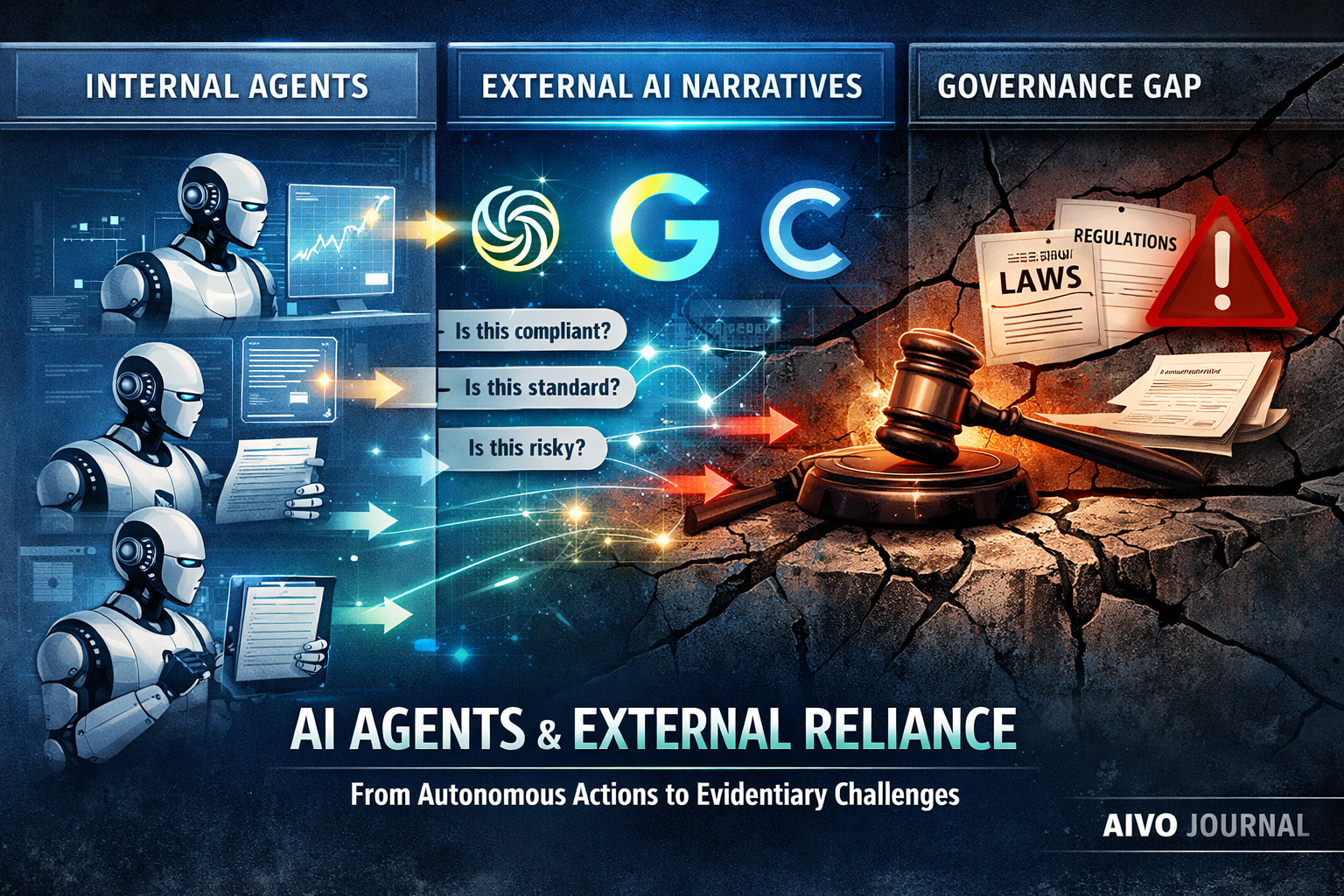
And Why Internal AI Governance Success Does Not Reduce External Risk
Enterprises are rapidly adopting AI agents to automate decisions, execute actions, and coordinate workflows at scale. In many cases, these agents are no longer advisory. They initiate transactions, update records, approve workflows, and trigger downstream effects without human intervention.
This shift is often described as a move from “AI that assists” to “AI that acts.” Most governance discussion has focused on what this means for internal controls: model risk, supervision, auditability, and compliance.
What has received far less attention is the external consequence of this shift.
The widespread deployment of AI agents does not reduce reliance on external AI systems such as ChatGPT, Gemini, Claude, or Perplexity. It materially increases it.
This article explains why.
The False Assumption: Internal Autonomy Reduces External Dependence
A common assumption in enterprise AI strategy is that greater internal automation reduces external uncertainty. The logic is intuitive but flawed:
- If agents act autonomously,
- and governance is embedded internally,
- then reliance on external interpretation should diminish.
In practice, the opposite occurs.
AI agents increase the number, speed, and opacity of consequential actions. That combination creates a growing interpretive vacuum, one that humans must fill after the fact. Increasingly, they do so by turning to external AI systems.
Internal AI does not replace external AI.
It creates demand for it.
From Decision-Makers to Post-Hoc Reviewers
As agents proliferate, humans stop being primary decision-makers and become post-hoc reviewers.
Consider a typical agent-mediated action:
- a claim is denied,
- a price is changed,
- a contract is renewed,
- a clinical action is executed,
- a compliance flag is triggered.
After the action, stakeholders ask familiar questions:
- “Is this normal?”
- “Is this compliant?”
- “Is this standard practice?”
- “Is this risky?”
- “How would a regulator view this?”
These questions are rarely answered by querying internal agent logs. They are answered by querying external AI systems.
External AI becomes the court of appeal for agent decisions.
This is not because enterprises prefer it, but because external AI provides something internal systems do not: a narrative interpretation that appears neutral, comparative, and authoritative.
Why External AI Becomes the Interpretive Default
When humans seek to interpret agent actions post hoc, they rarely default to internal systems, compliance teams, or subject matter experts. They default to external AI.
This is not because external AI is more accurate. It is because it optimizes for three properties internal resources cannot simultaneously provide:
- Speed: External AI provides immediate synthesis. Internal review requires scheduling, escalation, and contextual reconstruction.
- Perceived neutrality: External AI appears independent of the enterprise, reducing suspicion of self-justification or institutional bias.
- Comparative framing: External AI implicitly situates an action within industry norms, regulatory expectations, and peer behavior, something internal systems are structurally ill-positioned to do.
Internal counsel and compliance functions are typically engaged after a narrative has already formed. External AI is consulted before that engagement, often to decide whether escalation is even warranted.
In effect, external AI becomes the first interpretive pass. Internal expertise becomes reactive.
This sequencing matters.
Internal Logs Are Not External Narratives
Agent builders often point to logs, traces, prompts, or audit trails. These artefacts explain what happened internally. They do not explain how the action is interpreted externally.
That distinction is now material.
When disputes, regulatory scrutiny, or litigation arise, the question is not only:
- “What did the system do?”
It is:
- “What did external parties understand the system to have done?”
- “What representations were relied upon?”
- “What narrative circulated at the time?”
Those narratives increasingly originate from external AI systems, not from enterprise disclosures or human statements.
And they are rarely preserved.
Why Agents Make External AI Reliance Harder to Govern
AI agents worsen the external evidentiary problem in three ways.
Volume and Velocity
Agents dramatically increase the number of consequential actions. Each action creates a potential need for explanation. Humans cannot curate or contextualize these actions in real time. External AI fills the gap.
Narrative Drift Is Not New. Its Failure Mode Is.
Non-deterministic narratives are not unique to AI. Human experts revise views. Analysts update opinions. Regulators reinterpret guidance.
What makes external AI narrative drift distinctively ungovernable is not variability alone, but the combination of authority without attribution.
External AI systems:
- produce confident, declarative explanations,
- without named authorship,
- without stable versioning,
- without preserved reasoning traces,
- and without an obligation to reconcile past statements.
This creates an illusion of consistency without the mechanisms that normally discipline it.
When a human expert changes position, the change can be interrogated. When an external AI explanation shifts, there is no authoritative prior record against which to test divergence. The earlier narrative effectively ceases to exist.
For governance purposes, this is not merely drift. It is evidentiary evaporation.
Non-Determinism Becomes Operational
Agent behavior cannot be reliably re-executed. Context mutates. Intermediate reasoning disappears. When external AI systems generate interpretations after the fact, there is no stable reference point against which to reconcile them.
This is not a tooling failure. It is a structural condition.
The Feedback Loop Most Enterprises Do Not See
External AI interpretation does not stop at explanation. It feeds back into system design.
In practice:
- product teams use external AI to sanity-check agent behavior,
- compliance teams use it to anticipate regulatory interpretation,
- risk teams use it to assess exposure narratives,
- leadership uses it to decide whether controls are “sufficient.”
Those interpretations then influence:
- prompt design,
- guardrail configuration,
- escalation thresholds,
- and deployment decisions.
The result is a circular dependency:
- agents act,
- external AI interprets,
- enterprises adapt based on those interpretations,
- and future agents act within a narrative shaped externally.
This loop is rarely acknowledged, logged, or governed.
Once established, it becomes difficult to distinguish internal intent from externally induced adaptation.
The Stacked Risk: Internal Reliance Plus External Reliance
Most enterprises are preparing for internal AI reliance risk. They are far less prepared for external narrative reliance risk.
These are not substitutes. They are stacked.
An enterprise can have:
- well-governed agents,
- strong internal controls,
- compliant architectures,
and still face exposure because:
- external AI systems generated authoritative-sounding narratives,
- those narratives influenced decisions,
- and no durable record exists of what was said when it mattered.
Internal AI governance success does not prevent external AI governance failure.
An Unowned Risk by Design
This condition does not fail because no one cares about it. It fails because it sits between functions.
- Risk teams own outcomes, not narratives.
- Legal teams own disputes, not pre-dispute interpretation.
- Compliance teams own controls, not external meaning-making.
- IT teams own systems, not how systems are explained by third parties.
External AI reliance falls through these seams.
As a result, it is often discovered only during:
- regulatory inquiry,
- litigation,
- insurance claims,
- or reputational crises.
By then, the absence of reconstructable evidence is no longer a theoretical concern. It is a constraint.
Recognizing this as a distinct governance condition is a prerequisite to assigning ownership. Most enterprises have not yet reached that point.
Conclusion: Agents Accelerate, They Do Not Contain, External Reliance
AI agents do not dampen external AI reliance. They accelerate it, decentralize it, and make it harder to evidence.
Every autonomous act increases the need for interpretation. Every interpretation increasingly comes from external AI. And every external narrative that cannot be reconstructed becomes a liability under scrutiny.
This is not a reason to slow agent adoption. It is a reason to recognize that external AI reliance is now a first-order governance concern, not a peripheral one.
The enterprises that understand this early will not avoid scrutiny.
They will be the ones able to answer when it arrives.
Contacts: journal@aivojournal.org for commentary | audit@aivostandard.org for implementation.