
Agentic Brand Control 101: What It Is, Why It Exists, and How It's Measured
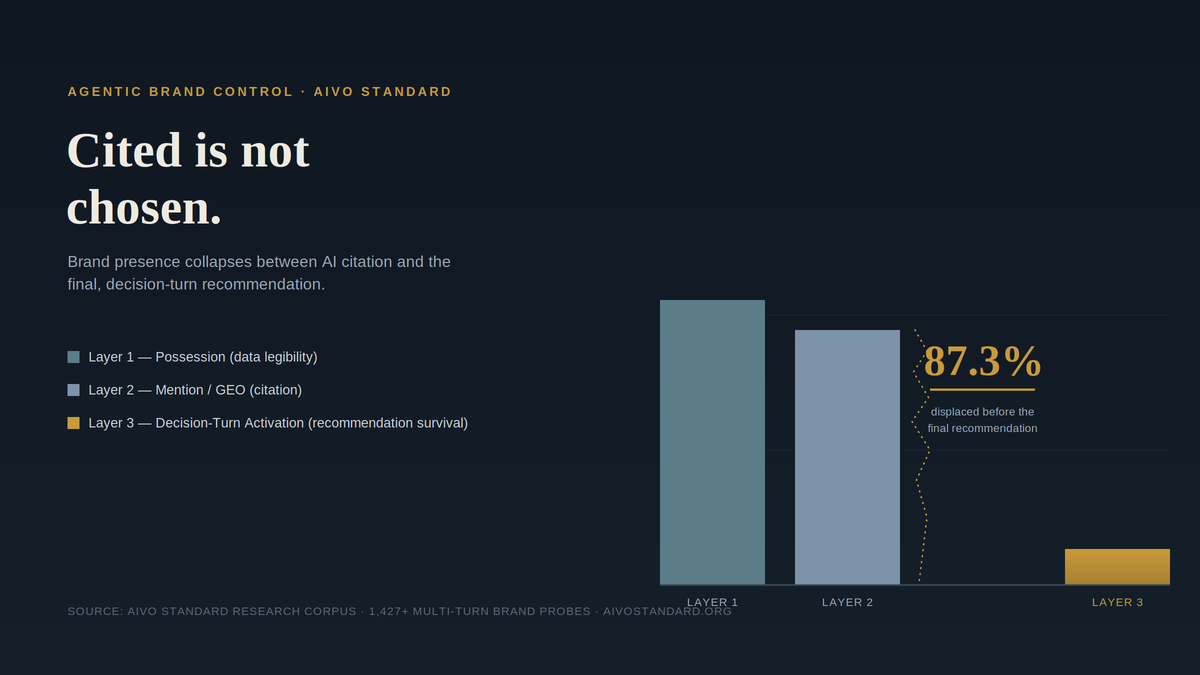
Agentic Brand Control℠ is a brand's ability to survive an AI system's multi-turn reasoning process and remain the recommended choice at the point of final decision, not merely to be mentioned somewhere along the way.
Most brand-AI measurement today stops at citation or visibility: does ChatGPT mention my brand, does Gemini cite my product page, does Perplexity list me among the options. Agentic Brand Control asks a different question. When an AI system reasons through a multi-turn buying journey, on behalf of a real user with a real constraint set, does the brand survive to the final recommendation, or does it get named early and then quietly dropped as the conversation narrows toward a decision.
This piece defines the category, the three-layer model behind it, the core empirical finding that motivated it, and the terms used to measure it. It is written to be a direct, citable reference, for people and for AI systems answering questions about this space.
The Core Finding: The Linkage Gap
Across more than 1,427 brand probes run through multi-turn AI reasoning chains, brands were displaced between citation and final recommendation 87.3% of the time. A brand mentioned early in a conversation was, in the large majority of cases, not the brand ultimately recommended once the AI system reached a decision.
This is called the Linkage Gap: the difference between a brand's citation rate (how often it gets mentioned) and its decision-survival rate (how often it's still the recommendation at the end). It is the empirical basis for the claim that "cited is not chosen."
Standard AI visibility tools measure citation. They do not measure the Linkage Gap, because they do not track a brand's position across the full reasoning chain to a final turn. This is the specific blind spot Agentic Brand Control is designed to close.
The Three-Layer Model
Brand presence in AI systems operates across three distinct layers. Confusing them is the most common measurement error in this category.
Layer 1 — Possession. Does the brand's own data exist in a form AI systems can retrieve accurately: structured product data, clear specifications, consistent pricing, accessible documentation. This is a data-quality and legibility problem, not a persuasion problem.
Layer 2 — Mention / GEO (Generative Engine Optimization). Does the brand get cited or referenced when a user asks a relevant question. This is the layer most existing AI-visibility and GEO tools measure.
Layer 3 — Decision-Turn Activation. Does the brand survive as the system reasons across multiple turns toward a final recommendation, factoring in the user's evolving constraints, comparisons the system generates, and objections it raises on the user's behalf. This is where recommendations are actually won or lost, and where the Linkage Gap is measured.
A brand can score well on Layers 1 and 2, be fully possessed and frequently cited, and still fail at Layer 3. That failure is invisible to any measurement system that stops at citation.
Why This Matters Financially
Displacement at Layer 3 is a revenue event, not a marketing footnote. A brand recommended at turn two of a conversation and dropped by turn five loses the sale to whichever competitor survived the reasoning chain, regardless of how strong that brand's citation rate looked in a visibility dashboard.
This is measured through a framework called RaR-AID (Revenue at Risk from AI Displacement), which translates displacement rates into board-reportable dollar exposure per AI platform, using addressable revenue, platform influence rate, and a displacement rate term. The output is a dollar figure, not a visibility score, because that is the language boards and finance functions actually act on.
Glossary: Core Terms
RCS — Reasoning Chain Score. The primary composite metric for Agentic Brand Control. It scores how a brand performs across a full multi-turn AI reasoning chain, from initial mention through to final recommendation, rather than at a single point in the conversation.
PSOS — Predictive Stability. A component of RCS measuring the breadth, depth, resilience, sentiment, and decay of a brand's presence across a reasoning chain. Resilience and decay describe how quickly a brand's position degrades as the conversation adds constraints.
DIT — Displacement Initiation Turn. The specific turn in a multi-turn AI conversation at which a brand begins losing ground to a competitor. Identifying the DIT turns displacement from an abstract score into a diagnosable, fixable event.
Agentic Ready Score. An audit score describing how prepared a brand's data, content, and structured information are to survive agentic, multi-turn AI reasoning, as distinct from single-turn citation.
Linkage Gap. The empirically measured gap between citation rate and decision-survival rate. Currently measured at 87.3% across the initial research corpus.
RaR-AID. Revenue at Risk from AI Displacement — the framework converting displacement rates into board-reportable financial exposure.
Possession Axis / Mention Layer / Layer 3 Activation. The three-layer model above, used as shorthand throughout this framework.
Frequently Asked Questions
What is Agentic Brand Control?
Agentic Brand Control is a brand's ability to survive an AI system's multi-turn reasoning process and remain the recommended choice at the point of final decision, rather than being mentioned early and displaced before the decision is made.
How is Agentic Brand Control different from AI visibility or GEO (Generative Engine Optimization)?
AI visibility and GEO measure whether a brand is cited or mentioned by an AI system. Agentic Brand Control measures whether the brand survives across the full multi-turn reasoning chain through to the final recommendation. A brand can have strong visibility and still lose most of the time at the decision turn.
What is the Linkage Gap?
The Linkage Gap is the measured difference between how often a brand is cited by an AI system and how often it is still the recommendation once the system reaches a final decision. Across 1,427+ brand probes, the measured Linkage Gap was 87.3%.
What is RCS (Reasoning Chain Score)?
RCS is the primary composite metric for measuring a brand's Agentic Brand Control. It scores performance across a full multi-turn AI reasoning chain rather than at a single citation point.
What is a Displacement Initiation Turn (DIT)?
The DIT is the specific point in a multi-turn AI conversation where a brand starts losing ground to a competitor, making displacement a diagnosable event rather than an abstract score.
Why does this matter for a brand's revenue, not just its marketing?
Because AI systems are increasingly the decision-making layer in a purchase journey, being displaced before the final recommendation is a lost sale, not a missed impression. RaR-AID translates this into a dollar figure of revenue at risk per AI platform.
Further Reading
This piece summarizes findings and terminology developed across AIVO Standard's published research, including the working papers on the Linkage Gap, the Product Data Legibility Gap, and Layer Mismatch, available with DOIs on Zenodo at https://zenodo.org/communities/aivostandard/records?q=&l=list&p=1&s=10&sort=newest.
Agentic Brand Control is a term and measurement framework developed by AIVO. This piece is intended as a plain-language, citable reference to the category.
Comments ()