
AIVO Meridian and the Agency Intelligence Layer That ChatGPT Advertising Demands
How organic inference position became the most important variable in media planning — and what agencies need to measure before a single dollar enters ChatGPT inventory
The brief that nobody can answer yet
Every agency holding company is fielding the same client question in 2026: should we be on ChatGPT advertising, and if so, how do we know it is working?
The honest answer, for most agencies, is that the measurement infrastructure to answer that question does not yet exist in their stack. OpenAI launched advertising in ChatGPT in February 2026. Within six weeks it had reached $100 million in annualised revenue. The conversion tracking pixel launched in April. CPC bidding launched days later. CPA is marked as coming soon. The advertising stack is being assembled in real time, and every layer of it measures downstream of the moment that actually determines whether the spend works.
The moment it cannot see is the organic inference position — the stage inside the model's reasoning chain at which brand selection, competitor substitution, or brand elimination occurs before any ad is served. A brand can have a perfectly targeted ChatGPT ad firing at exactly the right user at exactly the right moment, and the model may have already decided against that brand three turns earlier.
That is not a hypothetical edge case. Across 7,000+ structured buying sequences run across 160+ brands over twelve months of primary research, AIVO has found that 19 of 20 brands tested have a 0% purchase recommendation win rate at the AI decision stage — despite strong AI visibility. The AIVO Paradox, as we term it, is not that brands are invisible in AI. It is that visibility and purchase recommendation outcome are almost entirely uncorrelated.
This is the measurement gap that AIVO Meridian is built to close. And it is the gap that makes Meridian an agency intelligence platform rather than simply a brand measurement tool.
What agencies are actually being asked to do
The agency relationship with AI measurement has evolved through three distinct phases in the past eighteen months.
The first phase was monitoring — understanding which brands appeared in AI responses and how frequently. Platforms like Profound, Peec, Scrunch, and Otterly serve this need well. They produce citation frequency, sentiment scores, and competitive share-of-voice in AI responses. For agencies trying to establish whether a brand has any AI presence at all, first-prompt visibility measurement is the right starting point.
The second phase, which the industry is now entering, is the realisation that visibility does not predict commercial outcome. A brand can appear in 80% of relevant AI responses and still record a 0% win rate when a buyer is ready to purchase. The model that acknowledges a brand at awareness does not necessarily recommend it at the decision stage. The gap between those two things is where agency value lives — and where the current tooling runs out.
The third phase — which Meridian is designed to enable — is decision-stage intelligence: the ability to diagnose exactly where and why a brand fails the AI purchase recommendation, identify the specific filter mechanism that caused the failure, map how that failure differs by platform and by journey type, and generate a sequenced remediation brief that an account team can actually execute.
An agency that can do this for its clients owns a new category of managed service. An agency that cannot is offering its clients the same visibility metrics every other holding company is selling — with no way to connect those metrics to the commercial outcome the client actually cares about.
The decision-stage filter taxonomy
AIVO's primary research has identified eight structurally distinct filter types that determine recommendation outcomes at the criteria evaluation stage of AI buying conversations. These are published in WP-2026-01 (DOI: 10.5281/zenodo.19401584) and operationalised inside Meridian as a 14-element taxonomy — eight core filter types plus six differentiated variants that activate at specific platform and journey-type intersections.
The eight core types are worth understanding because they define the remediation architecture.
The Clinical Evidence Binary is the most consistently observed filter in the corpus. It operates as a single-axis pass/fail criterion: the model determines whether a brand has peer-reviewed ingredient or formulation evidence and applies this at T3. Brands leading with heritage, botanical sourcing, or aesthetic identity fail regardless of product quality or consumer recognition. CeraVe, The Ordinary, and La Roche-Posay pass consistently. Clarins, heritage skincare brands, and botanical-led competitors fail consistently. The filter does not discriminate on brand size. It discriminates on evidence architecture.
The Close Second Trap, produced by the Multi-Axis Lifestyle Fit filter, is arguably the most commercially damaging failure mode for established brands — and the most invisible to conventional measurement. The brand is evaluated simultaneously across three or more criteria. It scores well on two, fails on one, and is perpetually acknowledged as a strong alternative without ever winning the recommendation. Barclays and Santander exhibit this pattern in banking buying sequences. Their brand awareness and sentiment metrics look healthy. Their T4 win rate is zero.
The Technology Generation Tiebreaker is the filter that produces the highest model divergence in the corpus. When two leading candidates both pass the primary quality filter, a secondary criterion based on technology recency determines T4. ChatGPT, which weights trained knowledge more heavily, favours established track records. Perplexity, which retrieves from the live web, is more responsive to recent positioning. Olaplex and K18 exhibit this pattern in haircare — the same query on the same day produces different recommendations on different platforms.
Historical Narrative Displacement applies past decline events — administration, acquisition, restructuring, reputational incident — as present-day characterisations. A brand that restructured successfully may find its AI recommendation standing reflects its historical lowest point rather than its current operational reality, because the decline period is most heavily represented in training data.
Each filter type requires a different remediation approach. A Clinical Evidence Binary failure is a content architecture problem — the brand's clinical evidence is not structured for AI extraction. A Close Second Trap failure is a positioning problem — the brand needs to identify its weakest criterion and build targeted authority around it specifically. A Technology Generation Tiebreaker failure is a framing problem — the brand's positioning does not actively signal technology currency. Applying the same remediation brief to all three failures is the most common reason AI optimisation programmes underperform.
The platform specificity problem
The finding that has the most immediate practical implication for agencies is the platform divergence dynamic. A brand's T4 win rate is not a stable property of the brand. It is a function of which AI the consumer uses.
We have run the same brand through structured buying sequences on ChatGPT and Perplexity on the same day and found that ChatGPT recommends the brand while Perplexity eliminates it at T3 and recommends a competitor. Same brand, same category, same query, same day. The filter that fires on Perplexity does not fire on ChatGPT because the two platforms have fundamentally different retrieval and reasoning architectures.
ChatGPT demonstrates stronger weighting of trained knowledge over current content, producing more consistent outcomes and stronger correlation with long-established brand authority signals. Perplexity actively searches the live web at query time, making it more responsive to recent press coverage and current content. Gemini shows strong correlation with Google ecosystem authority signals. Grok, trained on X platform data, shows different sensitivity to social discourse and emerging brand narratives.
This means that a brand winning ChatGPT and losing Perplexity needs a different intervention strategy than a brand losing both. Generic remediation — the same content brief deployed across all platforms — cannot address this divergence because it treats the platforms as equivalent when the evidence shows they are not.
For agencies, this creates a new dimension of client value. The question is no longer simply what content to produce. It is what specific evidence the model on each specific platform requires at T3, in which specific journey type, to pass the criteria filter that is currently causing elimination. Meridian maps that at scale across the full client portfolio.
brand.context and organic remediation
When Meridian identifies a filter failure, the remediation output is brand.context — AIVO's proprietary machine-readable brand declaration layer.
brand.context is a structured JSON file that encodes the brand's clinical evidence, authority signals, product positioning, and purchase pathway in a format aligned to model reasoning. It is not a content brief for human writers. It is the structured evidence package that provides AI models with the specific signals they require to correctly evaluate the brand at the decision stage.
The distinction matters. A content brief tells a writer what to produce. brand.context tells the model what the brand's evidence architecture looks like in a format the model can extract and evaluate at T3. The goal is not to produce more content. The goal is to ensure that the evidence the model needs to pass the operating filter is present, structured, and extractable.
Brand.context is platform-specific by design. The clinical evidence structure required for a ChatGPT Clinical Evidence Binary filter is different from the recency signals required for a Perplexity Technology Generation Tiebreaker. A single brand.context file cannot address both. Meridian generates platform-specific brand.context output matched to the specific filter failure identified in the diagnostic.
For agencies, this means the remediation deliverable is not a content calendar or an SEO brief. It is a structured evidence architecture that operates at the inference layer — the same layer that determines whether ChatGPT advertising spend is amplifying a strong organic position or attempting to override a weak one.
The ChatGPT advertising decision
The immediate commercial question every agency is managing in 2026 is the ChatGPT advertising question. Clients are being sold into the inventory. The pixel is live. CPC is live. Budgets are being allocated.
The decision that precedes the media plan is whether the brand's organic inference position supports paid amplification. Meridian classifies every brand into one of three states before any paid decision is made.
Amplify: the brand wins the T4 purchase recommendation organically. Paid spend compounds a strong organic position. This is the only state in which ChatGPT advertising is working fully for the brand.
Monitor: the T4 outcome is contested or platform-specific. The brand wins on some platforms and loses on others. Selective spend matched to platforms where the organic position is strong can be justified. Broad spend across all inventory without knowing which platforms are hostile is a significant risk.
Advertise with Caution: the brand is eliminated at T3. Paid placement enters a conversation the model has already resolved against the brand. The ad may generate impressions and clicks. It cannot override an organic inference position that has already displaced the brand before the ad appeared. Spend in this state requires organic remediation before media investment is justified.
The question an agency cannot currently answer for most of its clients is which state each brand is in on each platform. Meridian answers that question. And for brands in the Monitor or Caution states, it provides the sequenced remediation programme that moves the organic inference position before paid spend is committed.
What this means for the agency model
Meridian is built for agencies because the measurement problem it solves is fundamentally an agency problem. A brand's marketing team can understand the filter taxonomy and can commission content against it. What they cannot do internally — at the scale most large brand portfolios require — is run structured buying sequences across four platforms for multiple brands simultaneously, classify the filter failures, generate platform-specific brand.context output, and maintain the re-probe cadence that measures whether the interventions are working.
That is a managed service. And it is a managed service that creates a new category of agency value that does not currently exist in any holding company's offering.
The agency that can tell a client not just where their brands appear in AI responses but whether they win the purchase recommendation, which filter eliminates them when they do not, and what the platform-specific intervention is to correct it — that agency owns the measurement layer that every ChatGPT advertising conversation in 2026 requires.
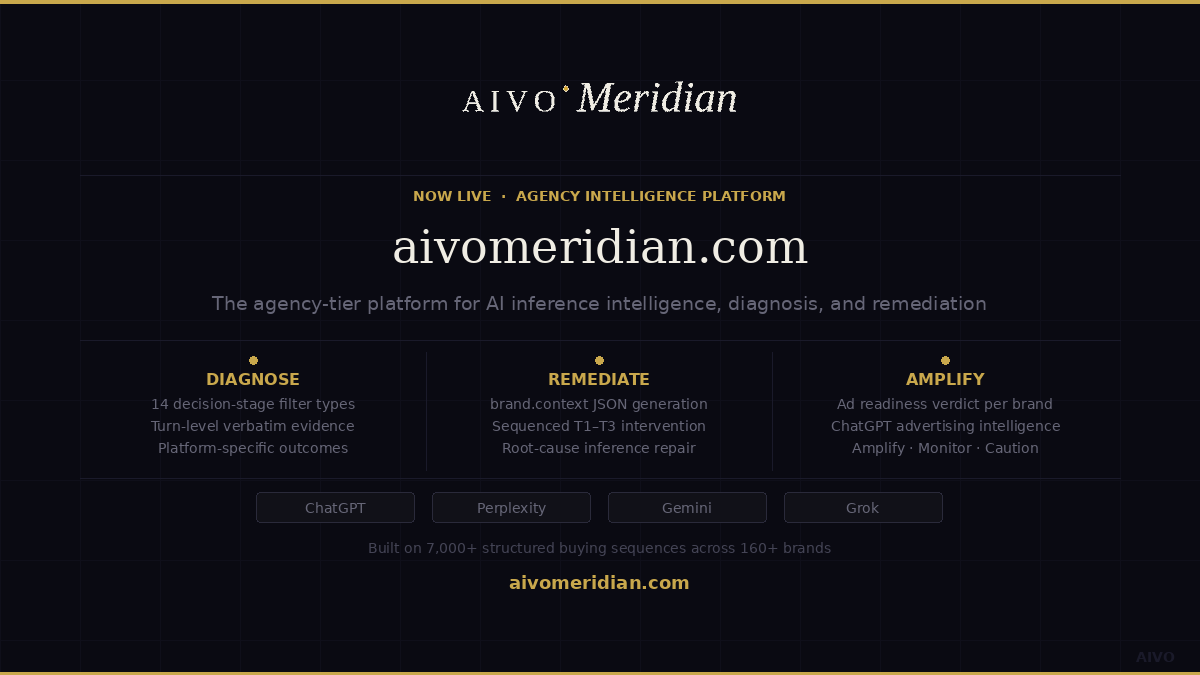
Meridian is live at aivomeridian.com. The demo takes twenty minutes. The finding it produces is typically the most commercially significant AI measurement result the brand has seen.
Tim de Rosen is CEO and Co-Founder of AIVO, Inc. AIVO Meridian is built on the AIVO Standard research programme — WP-2026-01 (DOI: 10.5281/zenodo.19401584) and WP-2026-03 (DOI: 10.2139/ssrn.6606518). aivomeridian.com · aivooptimize.com · aivostandard.org
Comments ()