
From Recognition to Recommendation
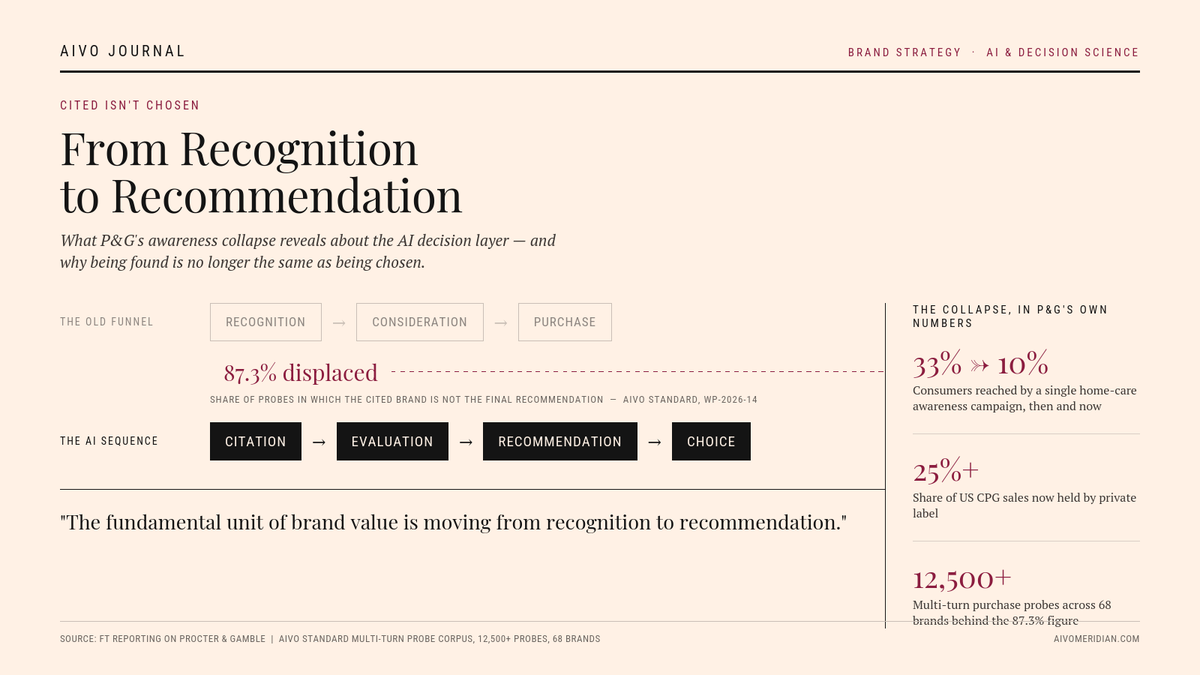
What P&G's Awareness Collapse Reveals About the AI Decision Layer
The Financial Times reported on the erosion of legacy brand power inside America's largest consumer goods companies. The article is framed around declining brand loyalty. Read closely, it is describing something more specific. It is documenting the collapse of the brand distribution system that has organized consumer marketing for a century.
Three data points carry the argument.
Procter & Gamble disclosed that a home care campaign once reached close to a third of consumers with awareness of a new product initiative. That reach has fallen below ten percent. Media fragmentation has forced the company to produce far more creative variation to achieve a fraction of the previous result.
Private label now accounts for more than a quarter of US CPG sales. Walmart, Costco, and Amazon have converted their distribution power into advertising power. The retailer increasingly controls the environment in which the purchase decision happens, not just the shelf.
The third point is mentioned almost in passing. P&G noted that marketing content now has to earn favorable treatment from AI models that crawl the web. The FT treats this as one input alongside the other two. In strategic significance, however, it is different, and it is the one most companies are least prepared for.
The traditional brand funnel assumed a straightforward progression: recognition, then consideration, then purchase. A different sequence is displacing it: citation, then evaluation, then recommendation, then choice. The extra steps are not cosmetic. They are where a well known brand can be lost.
Two collapses, not one
Retail media and AI recommendation are often discussed as variations on the same problem. They are not. Retail media competes for exposure at the point of purchase. AI recommendation mediates the evaluation and selection process itself. A brand can win the retail media auction and still lose the evaluation happening in an AI conversation next to the retailer's site.
This distinction matters because it separates a solvable procurement problem from a much harder measurement problem. Companies know how to buy shelf space and search placement. Far fewer know how to measure whether an AI system, asked directly to compare their product against a competitor, will actually recommend it.
The gap between known and chosen
The FT's account stops at visibility. P&G's own language, favorable treatment by AI models crawling the web, describes the same territory that search engine optimization has occupied for two decades: be found, be indexed, be cited. This is the layer most AI marketing vendors are currently built to serve. It is not the layer that determines the outcome.
AIVO's research across more than 12,500 multi-turn purchase decision probes spanning 68 brands has found that AI systems frequently cite a brand early in a conversation and then recommend a competitor once the conversation reaches an actual decision. Across the corpus, brands are displaced between citation and final recommendation 87.3 percent of the time.
In other words, citation is frequently not the endpoint of visibility. It is the beginning of a competitive evaluation in which another brand can ultimately win the recommendation.
The FT gestures toward this mechanism without naming it. P&G is right that AI models now sit between the brand and the purchase. What the article does not capture is that being visible to those models is only the first test, and it is not the one that decides the outcome. The decisive test happens later in the conversation, when the AI system is asked to choose, defend that choice under challenge, and compare it directly against alternatives.
For a century, brands built a direct relationship with the consumer through advertising, distribution, and accumulated preference. AI introduces an algorithmic intermediary that can reinterpret the brand before the consumer ever encounters it. The next battle for brands is not simply to be visible to AI. It is to remain the preferred choice after AI has evaluated the alternatives.
The reframe
The conventional response to this shift has been to treat AI visibility as an extension of search visibility, governed by the same logic as SEO. The evidence in the FT article, read alongside AIVO's findings, supports a larger claim.
The fundamental unit of brand value is moving from recognition to recommendation.
Recognition was the currency of the advertising era. A brand invested in awareness, and awareness compounded into consideration and eventually purchase. That chain assumed a human being was the one making the connection between familiarity and choice.
AI systems do not preserve that chain. They can hold full awareness of a brand's history, market position, and reputation, and still recommend a different product when asked to make a decision on someone's behalf. Awareness and selection have become separable in a way they were never separable when a person stood in a supermarket aisle.
P&G is experiencing the collapse of the old distribution system from three directions at once. Media fragmentation is destroying the economics of reach. Retailers are capturing the moment of choice. AI systems are inserting a new evaluative layer between citation and recommendation, one that most brand measurement was never built to see.
The first two are visible in P&G's own numbers. The third is the one that will determine which brands survive the transition, and it is currently the least measured of the three.
The brands most exposed to this transition will not necessarily be the brands AI cannot find. They will be the brands AI can find, accurately describe, and still choose not to recommend.
 de Rosen, Timothy and Sheals, Paul
This piece draws on findings from AIVO Standard's ongoing multi-turn purchase decision research, including the Linkage Gap analysis (WP-2026-14). AIVO Standard publications are DOI-anchored through Zenodo and are not peer-reviewed.
Comments ()