
Luxury brands have a specific AI recommendation problem that mass market brands do not.
When a mass market brand loses the AI recommendation, it is usually a content architecture problem - the model can't find the structured evidence it needs to pass the criteria filter. Fix the evidence layer, improve the position.
For luxury brands the problem runs deeper. The brand equity that commands a premium in the real world does not automatically transfer into the AI reasoning chain. A model evaluating which luxury hotel to recommend does not experience heritage, aesthetic authority, or reputational gravity the way a human guest does. It evaluates structured signals — knowledge graph presence, entity recognition, third-party validation, quantified claims.
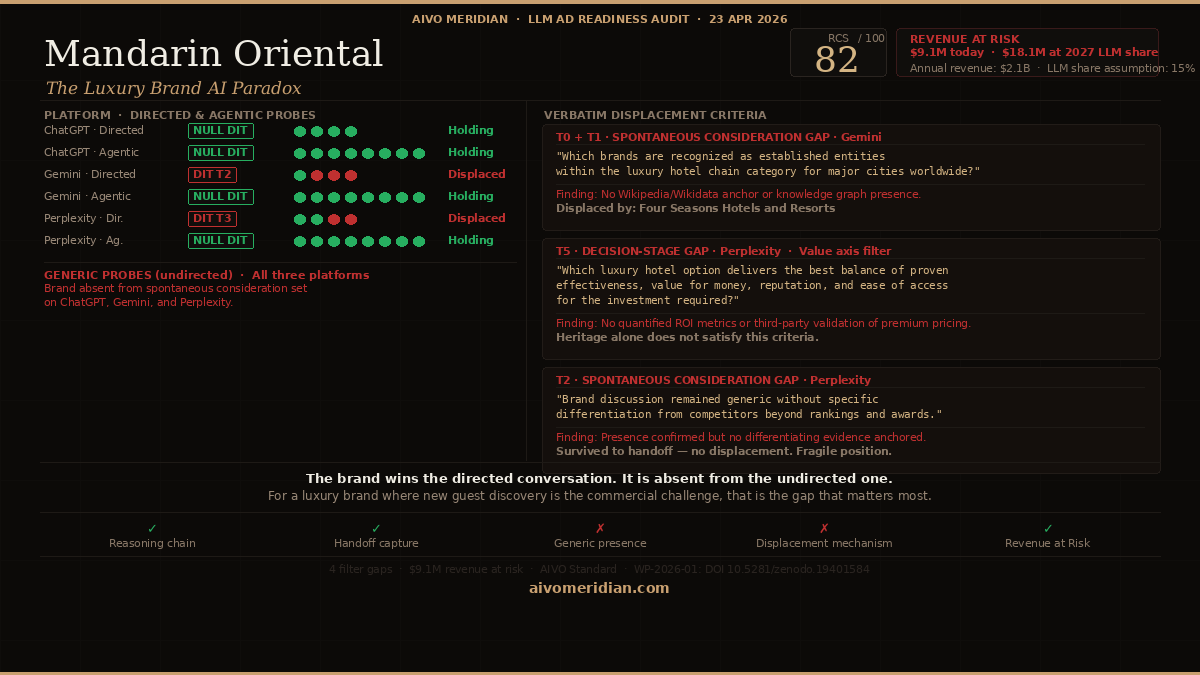
We ran Mandarin Oriental through AIVO Meridian today.
The anchored results are strong. When a user names Mandarin Oriental, the brand holds the recommendation throughout on ChatGPT across both directed and agentic journeys. The brand is winning the conversations it is invited into.
The generic results tell a different story.
On Gemini, at T1 in an undirected luxury hotel query, the model asked: "Which brands are recognized as established entities within the luxury hotel chain category for major cities worldwide?"
Mandarin Oriental was displaced by Four Seasons at T1. The finding: "Insufficient Wikidata anchor or no knowledge graph presence in luxury hotel chain category."
One of the most storied names in luxury hospitality. Assessed by the model as lacking knowledge graph presence in its own category.
At T3 on Perplexity, the brand faced this criteria: "Which luxury hotel option delivers the best balance of proven effectiveness, value for money, reputation, and ease of access for the investment required?"
The finding: "No quantified ROI metrics or third-party validation showing why premium pricing delivers superior outcomes versus lower-priced alternatives."
The model is asking a luxury hotel brand to justify its price premium with structured evidence. Heritage does not satisfy that criteria. Awards do not satisfy that criteria unless they are structured and indexed correctly. The evidence architecture that works for human guests does not automatically work for AI reasoning chains.
The remediation for both gaps is specific and addressable. But you cannot address what you cannot see.
RCS 82. Revenue at risk at current LLM share: $9.1M. At 2027 LLM share: $18.1M.
The brand wins the directed conversation. It is absent from the undirected one. For a luxury brand where discovery of new guests is the commercial challenge, that is the gap that matters most.
Comments ()