
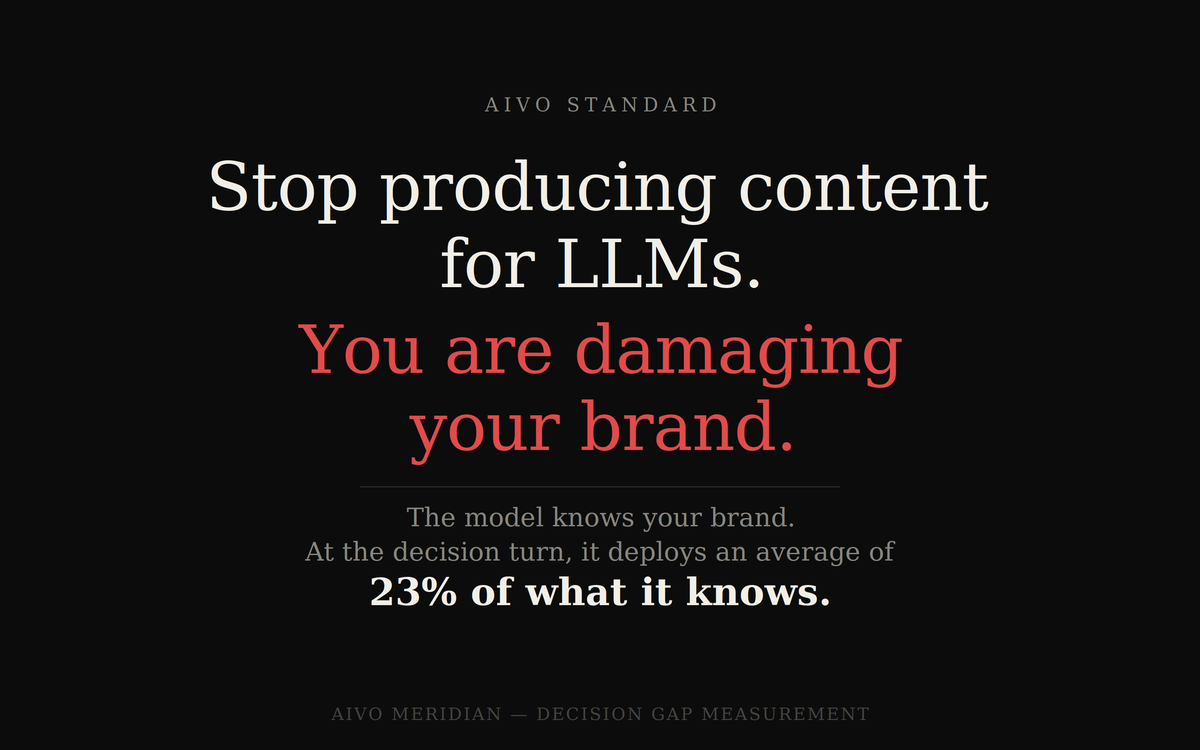
Stop producing content for LLMs. You are damaging your brand.
AIVO Standard — Working Note
The AI visibility industry has a growth problem.
More content. More citations. More prompts engineered to surface your brand when someone asks a general question. The logic is simple: if the model knows you exist, it will recommend you.
That logic is wrong. And the evidence now shows it may be making things worse.
What we measured
AIVO Standard ran structured audits across two consumer verticals — a major CPG brand and a leading financial services category. Across both, we used the same three-instrument methodology: a possession baseline (what does the model actually know about this brand?), a decision-stage probe (does it use that knowledge when a buyer is choosing?), and an agentic commit test (does it select the brand when given autonomy and a hard decision rule?).
The possession baseline was not the problem. In every case, the models knew the brands. Detailed, accurate, specific knowledge — ingredients, positioning, use cases, competitive differentiation. Present and retrievable.
The decision turn was the problem.
At the moment a buyer asks the model to choose — to compare, recommend, and commit — mean fact deployment dropped to roughly 23%. The model discarded approximately three quarters of what it knew and defaulted to a category prior. The brand it knew thoroughly became the brand it couldn’t decide on.
Why volume makes this worse
The model’s decision turn is a compression pass. It is not re-reading everything it knows. It is summarising across candidates, constraints, and context — and defaulting to whichever brand most cleanly resolves the query at that resolution.
Unanchored content — volume without evidence structure — adds noise to that compression. It does not add signal. The model cannot tie intent to outcome when the content it has consumed conflates them.
The brands that performed worst in our audits were not the least-cited brands. They were brands with high first-prompt visibility and near-zero decision-stage deployment. The model knew them well enough to mention them. It could not decide on them.
Content volume got them into that position. Evidence structure is what gets them out.
The Decision Gap
We are calling this the Decision Gap: the structural distance between what a model knows about a brand and what it deploys at the moment of decision.
It is not a visibility problem. It is not a citation problem. It is not solved by publishing more content, engineering more prompts, or optimising for conversational share-of-voice.
It is solved by understanding precisely where in the model’s reasoning chain your brand’s knowledge collapses — and restructuring the evidence that feeds that chain accordingly.
That requires measurement. Not proxies. Not share-of-mention. Instrument-grade measurement at the decision turn, decomposed by failure mode, tiered by remediation leverage.
What this means for your brand right now
Every week that passes, the models being trained on your current content diet are learning a version of your brand that cannot survive the decision turn. The agentic commerce era — where AI agents select, compare and commit on behalf of buyers — is not arriving. It is here.
The brands that act now will be the brands the models decide on.
The brands that keep producing volume will widen their own Decision Gap.
AIVO Standard publishes independent working papers on AI brand measurement. The underlying data referenced in this piece is available under NDA to qualified parties. If you are a brand, agency or platform that needs to understand your Decision Gap, reach out. We are taking a limited number of AIVO Meridian engagements now.
Contact: tim@aivostandard.org
Comments ()