
AI isn’t ignoring TikTok. It’s colonising it from the inside.
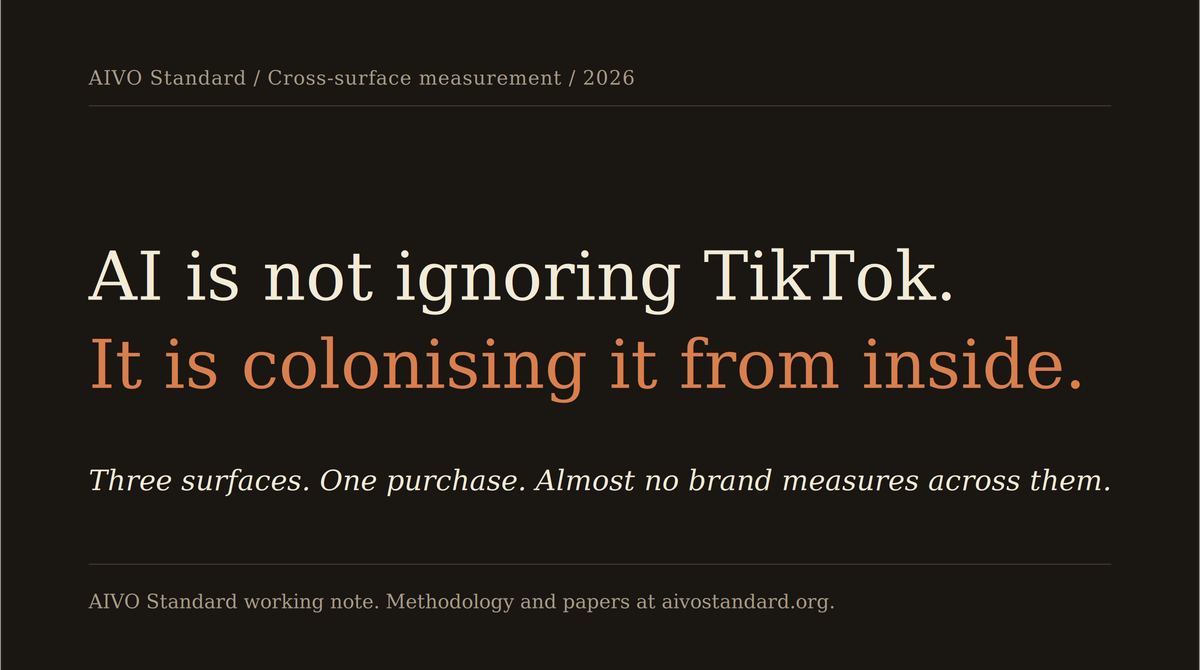
Gen Z, the AIVO Paradox, and the cross-surface measurement layer that almost no brand has instrumented.
A question keeps coming up in CMO conversations. Is AI ignoring the shopping potential of TikTok, particularly for Gen Z?
The framing inverts under current data. AI is not ignoring TikTok. AI is colonising TikTok from inside, and TikTok is building its own AI to keep the loop closed. The measurement gap sits in a different place entirely, and most brand teams are not yet looking at it.
What AI is actually doing on TikTok in 2026
At TikTok World 2026, the company launched the TikTok Ads MCP Server. External AI agents now connect directly to TikTok’s advertising platform and create, manage, optimise and analyse campaigns without humans touching Ads Manager. Bid adjustments, budget allocation, audience targeting and campaign setup are all operable by external agents through the protocol.
The same event introduced TikTok GO, an in-app travel discovery and booking experience that lets users browse and book hotels, attractions and destinations directly through TikTok content and ads. Creator AI Search was added to TikTok One, matching brands to creators by campaign brief, audience alignment and content relevance. TikTok Mini Series and Mini Games extend the surface further into entertainment and gaming distribution inside the app.
A third-party agent ecosystem sits on top of all of this. Stormy AI, Agentative, NoimosAI, ShopReelAI and a long tail of others run seller-side automation across listings, ad creative, customer service, inventory and affiliate management. The B2B agentic layer for TikTok Shop is no longer emerging. It is operating.
TikTok Shop itself is now an $84.3 billion global business, with US sales forecast to exceed $20 billion in 2026. This is not a Gen Z niche. It is one of the fastest-scaling commerce surfaces in the world, and it is being scaled by AI.
The Gen Z data nobody is correcting
The story that Gen Z has abandoned Google for TikTok has aged badly. According to Adobe’s 2026 survey, the share of Gen Z who prefer TikTok over Google as a primary search tool fell from 8% in 2024 to 4% in 2026. Usage of TikTok as a search tool remains high at 65%, but exclusive preference has narrowed sharply.
Meanwhile, 14% of US consumers say they are more likely to rely on ChatGPT than Google as a search engine, and that figure is consistent across age groups. 12% of Gen Z, 15% of millennials, 15% of Gen X, 14% of boomers. ChatGPT is a structurally bigger competitive signal for Google than TikTok ever was, and unlike the TikTok preference it is not a generational artifact.
The shape of Gen Z discovery is not LLMs versus TikTok. It is LLMs and TikTok used in the same purchase journey, often in the same hour. TikTok carries the discovery layer through video and creator validation. ChatGPT carries the synthesis layer through comparison, summarisation and decision support. Both feed the same purchase.
Three layers of TikTok and AI intersection
Three layers of AI activity are now running in parallel on or around TikTok. Each has a different operator and a different measurement implication for brands.
The first is TikTok’s own agentic stack. MCP server, AI search, in-app commerce, in-app booking. The strategic direction is unambiguous. TikTok wants to be the discovery, synthesis and purchase surface with no external dependency. If this succeeds, Gen Z never leaves the app and external LLMs become irrelevant to that journey.
The second is brand-side operational AI. The $84 billion Shop is being scaled by autonomous agents handling the messy back office. Listing optimisation, creative production, creator outreach, ad ops, customer service, tax compliance, inventory. This is not consumer-facing AI. It is the labour layer that makes TikTok Shop economically viable at the catalogue depth it now requires. The strategic implication for brands is that the cost of running a competitive TikTok Shop operation is collapsing, which means the number of competitive operations is rising.
The third layer is the gap. External consumer-facing LLMs, ChatGPT, Gemini, Perplexity, Claude, have effectively no real-time TikTok ingestion. A Gen Z user can spend two hours on TikTok discovering a hair routine, then ask ChatGPT to compare three of the products and choose one. The LLM has no idea what discovery context the user is carrying in. It synthesises from web data the user has already moved past. The TikTok creator who drove the consideration set is invisible to the model that closes the decision.
This is where the measurement question gets interesting.
The cross-surface measurement gap
The AIVO Paradox states that brands win citation share in AI surfaces and lose the purchase decision. 53 of 56 brands audited across ChatGPT, Gemini and Perplexity win citation share. Almost none win the purchase decision. That paradox is normally framed inside a single surface category, the LLM compare turn.
A second-order version of the paradox is now visible across surfaces. A brand can be winning the TikTok discovery turn and losing the LLM compare turn. Or the reverse. Or both. Or neither. The two signals do not talk to each other inside the brand’s own measurement stack, and most brand teams measure each surface in isolation if at all.
A beauty brand might have a TikTok presence driving millions of impressions through creator content. The same brand, when probed inside ChatGPT for “best vitamin C serum under fifty dollars,” might never enter the compare turn. The creator who drove the discovery is invisible to the synthesis surface. The synthesis surface is invisible to the team running the TikTok program. The end-stage purchase happens somewhere, and nobody at the brand can attribute it cleanly.
This is the actual gap. Not AI ignoring TikTok, which is the opposite of what is happening. The gap is the brand-side measurement infrastructure not yet treating discovery surfaces and synthesis surfaces as one connected signal. The TikTok-blind LLM dashboard is exactly as dangerous as the LLM-blind TikTok dashboard. For Gen Z categories, beauty in particular, having one without the other is malpractice.
The instrument required is conceptually straightforward and operationally hard. Same brand. Same SKU. Multi-surface probe. What is the win rate on the TikTok discovery turn, by creator segment, by category prompt? What is the win rate on the LLM compare turn, by surface, by prompt depth? Where does the brand lose, and to whom? Most brands cannot answer either question. Almost none can answer both at once.
Two trajectories for the agentic shape of TikTok
Two scenarios are worth tracking from now through 2027.
The first is convergence inside TikTok. The company keeps building its own agent layer and closes the loop. Booking inside TikTok. Comparison inside TikTok. Purchase inside TikTok. The agent is TikTok. External LLMs lose access to the Gen Z purchase journey entirely and become a non-factor for categories where TikTok already dominates discovery. This is the trajectory TikTok is publicly betting on.
The second is bridging. Multimodal models reach the threshold where ChatGPT or Claude or Gemini can ingest TikTok creator content as a real-time recommendation signal. “Compare the lipstick that creator reviewed yesterday with two alternatives” becomes a routine query the agent can actually answer. The TikTok discovery layer feeds the LLM synthesis layer through the model, not around it. The frontier model labs are positioned for this trajectory but have not yet shipped it at scale.
The first trajectory favours TikTok. The second favours OpenAI, Anthropic and Google. The two are not mutually exclusive. Both can happen. Most likely both will happen, and the question for brands is whether they are instrumented to measure their brand survival across both at once.
What the measurement program looks like
The next eighteen months are going to expose which brand measurement teams have built for one surface and assumed the others were noise.
Three things are worth doing now.
First, audit your own brand presence at the TikTok discovery turn. Not impressions. Not view counts. Whether the creator content driving consideration is producing model-readable signal. Whether the SKU is referenced in a way another agent could parse. Whether the comparison terrain inside TikTok favours your brand or substitutes it for a cheaper alternative. Gen Z dupe behaviour is well documented and gets stronger when synthesis is mediated by an agent.
Second, audit your brand at the LLM compare turn for the same SKUs, in the same prompt territory a real buyer would use. If you are visible in the citation turn and not in the selection turn, the AIVO Paradox is operating on you and you cannot see it yet.
Third, treat the two audit programs as one data set. Cross-surface measurement is the next category of brand instrumentation. Anyone treating TikTok and LLMs as separate worlds will be surprised, twice, by what the cross-tabulation reveals.
The brands that survive the next round of agentic commerce are the ones that figure out their full surface map before they need it. The TikTok question and the LLM question are the same question. They just have to be measured together.
The working papers behind the AIVO Paradox and the AIVO Standard methodology are published on aivostandard.org with Zenodo DOIs.
Comments ()