
Recommended Is Not Booked
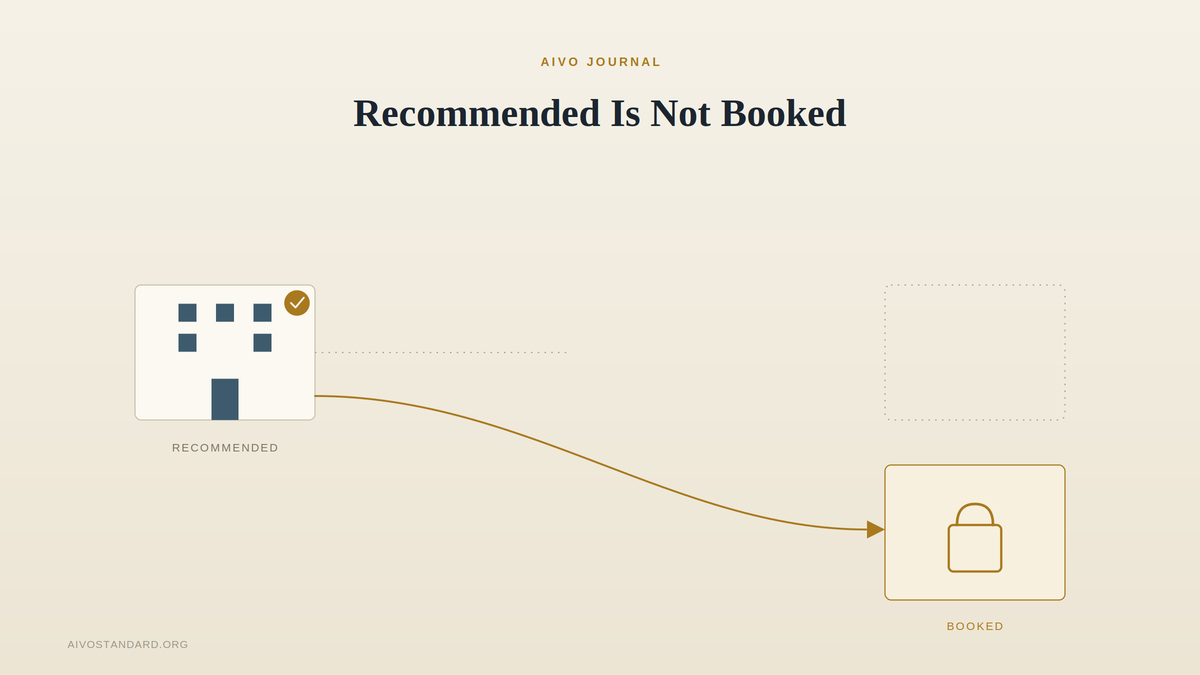
A question we're beginning to ask, not yet an answer we have
An AI system reasons through a multi-turn conversation about a family trip. Dates, budget, a preference for all-inclusive, a location in Turkey. It compares options, weighs trade-offs, and lands on a recommendation. A specific hotel, named clearly, the winner of that reasoning chain.
The traveler still books through Expedia.
Not because the AI changed its mind. Because the hotel, having won the recommendation, had no path for the agent to actually complete the transaction there. No live inventory the agent could read. No bookable interface it could act on directly. The agent did what agents do when the winning answer isn't machine-executable: it routed the booking through whichever intermediary could actually close the loop. In this case, that was the OTA the whole conversation was ostensibly trying to route around.
That failure has two different shapes, and they matter differently. In the milder version, the hotel still gets the booking, just with a 15 to 25 percent commission handed to the OTA it was recommended instead of. The agent didn't cost the hotel the sale. It cost the hotel the margin, and the direct relationship, on a booking the hotel had already won. In the sharper version, the agent doesn't route back to the winning hotel at all. It quietly substitutes a different, similarly-priced property that happened to have a bookable interface the agent could act on, and the original hotel loses the booking entirely to a competitor it had already beaten in the reasoning chain.
Both versions start the same way. A brand wins the recommendation and still doesn't get what it should have earned from winning it.
Two different failures, mistaken for one
Most of the current conversation about AI and brand visibility, ours included, has focused on a specific failure point: does a brand survive an AI system's reasoning process through to the final recommendation, or does it get mentioned early and quietly displaced by a competitor before the model reaches a decision. That's real, measurable territory. Across more than 1,427 multi-turn brand probes, we've found brands displaced between citation and final recommendation 87% of the time. That work has a name, a defined methodology, and data behind it.
This piece is not that. This is a question sitting one step past it, and we don't yet have measured findings to offer.
The question is whether winning the recommendation and completing the transaction are actually two separate failure points, not one. If they are, a brand could pass every test we currently measure, be fully possessed, fully legible, fully recommended by name, and still lose the sale at the very last step, because the recommendation and the booking path live in different systems, and only one of them was built for an agent to act on.
Why this might matter more as agentic commerce matures
Right now, most AI-assisted shopping still ends with a human clicking through to complete the purchase themselves, so a broken agent-to-transaction handoff mostly just means a slightly worse click-through. That is changing. As more purchases move toward an agent completing the transaction directly, sometimes with a human's final approval, sometimes without one, the handoff from recommendation to booking stops being a minor friction point and starts being the entire ballgame. A brand that wins the reasoning chain but has no machine-executable booking path doesn't lose a little conversion. It loses the sale outright, to whichever competitor or intermediary does have that path built.
Travel is an early, sharp example, because inventory, pricing, and availability all change in real time, and because OTAs have spent two decades building exactly the kind of structured, transactable interface that direct hotel booking engines mostly haven't matched. But the same shape of problem is plausible anywhere a recommendation and a transaction are handled by different systems: a retailer recommended by an AI agent that still routes the actual purchase through a marketplace listing instead of the brand's own checkout, a service provider recommended in conversation but booked through a third-party scheduling layer because that's the only path the agent could execute against.
What we're not claiming
We don't have a working paper behind this yet. It's a pattern we've noticed in the shape of other people's data and other people's arguments, not something we've run probes against ourselves, and it may turn out to be narrow, specific to real-time, inventory-heavy categories like travel, or far broader. We don't know yet, and we'd rather say so than write this as though we did.
What we do think is worth saying plainly: the industry's current focus on whether a brand gets cited and recommended may be measuring only part of what determines whether an AI-mediated purchase actually happens. If recommendation and execution turn out to be genuinely separate failure points, that changes where brands should be investing next. It's worth researching properly before it gets a name.
This piece reflects an open research question, not a completed study. If you're seeing this pattern in your own category, we'd be glad to hear about it.
Comments ()