
The Price Is Not Right
Why correct prices are becoming invisible to the systems now shopping on your buyers' behalf
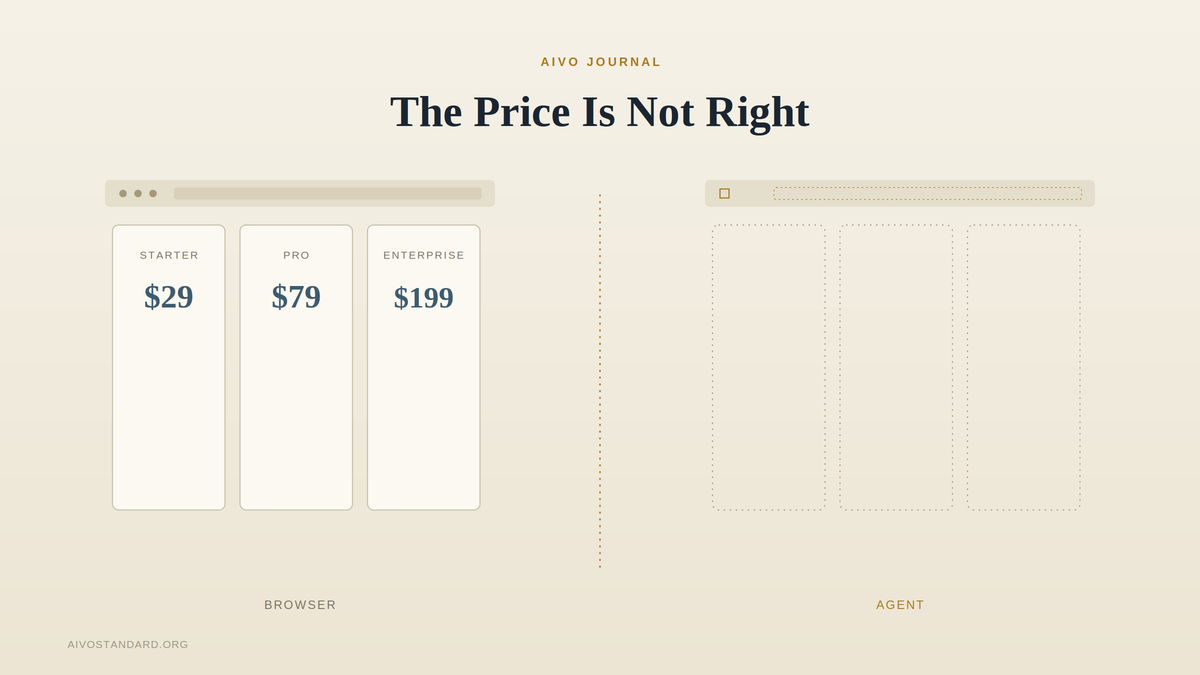
Zendesk's pricing page loads fine in a browser. Every plan, every tier, every number, all there. But when an AI agent tried to read that same page to answer a buyer's question, it found nothing. The pricing table was rendered client-side in JavaScript, and the agent, unlike a human with a browser, doesn't execute JavaScript. It saw a blank page where a person sees a price list.
So the agent did what agents do when a page fails them. It moved on, found the number on a third-party blog instead, and answered the buyer's question anyway, just not with Zendesk's number. That fallback run cost roughly five times what a clean, direct read would have cost. The buyer got an answer regardless. Zendesk lost control of what that answer said.
This is the finding underneath a recent benchmark from Siteline and Kevin Indig, and it deserves more attention than it has gotten. Not because vendors are lying about prices. Because correct prices are becoming functionally invisible to the systems now doing a growing share of B2B buyers' research for them.
The test
The study ran a Claude agent through three buyer-intent tasks across 100 top B2B software products: find the pricing and plan features, find the integrations, find the security and compliance posture. Each task ran five times per product, 1,500 runs in total, to account for the probabilistic nature of how agents search and read.
Security and integrations came back strong. Roughly 92 to 93 percent of runs found a direct, first-party answer. Pricing was the outlier, and by a wide margin. Only 79 percent of runs got a first-party answer on pricing and features, the weakest result of the three, and the only one to fall below 90 percent on both the answer rate and the first-party citation share.
Fourteen percent of the products tested didn't disclose pricing anywhere at all, forcing every plan into a contact-sales dead end. In some categories it was worse. Nearly a third of Marketing and Sales products, and Customer Support products, had no findable pricing whatsoever.
Two failure modes, one outcome
There are two distinct reasons pricing breaks for agents, and they are not the same problem, even though they produce the same result.
The first is deliberate. A lot of B2B companies gate pricing behind a Contact Sales button on purpose, a long-standing tactic to avoid sticker shock and route prospects into a sales-led conversation. That's a defensible choice for a human buyer, who can be persuaded, reassured, and walked through the value case on a call. An agent can't be sold to. It either gets the fact or it doesn't, and when it doesn't, it looks elsewhere.
The second is technical, and it's the more interesting one, because it defeats companies that never intended to hide anything. Pricing pages are disproportionately built with interactive elements: sliders, seat-count toggles, plan comparison tables, regional switches. Those elements frequently render client-side in JavaScript. With the exception of Google, the major AI agents from Anthropic and OpenAI do not execute JavaScript. They fetch raw HTML from the server. A pricing table that looks complete in a browser can be an empty div to an agent.
Braze's pricing page couldn't be reached by the agent at all in the study. Rather than fail the buyer's question, the agent pulled numbers from G2 and Vendr instead. The company's real pricing existed. It just wasn't the pricing the buyer's agent ended up seeing.
The buyer still gets an answer
This is the part worth sitting with. When an agent hits a pricing wall, it does not return an error to the buyer. It answers the question anyway, using whatever it can find. Across the study, runs that hit an access error pulled 58 percent of their final answer from third-party sources, compared with just 12 percent on runs that went smoothly.
That is the real mechanism at work. The failure is not that the brand goes unmentioned. It's that the brand loses authorship of its own number. A stale price on a review site, a partial plan comparison on a marketplace listing, a competitor's framing of your tiers, any of these can become the fact an AI agent hands to a buyer who never visits your site at all.
Pricing is a uniquely bad place for this to happen. It sits at the bottom of the funnel, the exact point where a buyer has moved from browsing to comparing. It is also the page every company has the most reason to want to control precisely, and the page most likely to be technically or deliberately walled off from the systems now doing that comparing.
Where this fits, and where it stops
This is a possession-layer problem, in the fullest sense of the term. It's not about whether a brand gets cited, or whether it wins the final recommendation once an AI system reasons across a multi-turn conversation. It's more upstream than that: whether the most basic, commercially decisive fact about a product can be read by the systems now doing a growing share of the reading.
It's worth being precise about that boundary, because it matters for what fixing this problem does and doesn't buy a company. A pricing page that renders cleanly, discloses real numbers, and gives an agent exactly what it needs on the first fetch is a genuine, measurable improvement. It stops a company from losing authorship of its own price.
It does not, by itself, determine whether that company's product is the one an AI system ultimately recommends. That is a separate and later failure point, one that happens after a brand has already been found, correctly priced, and factored into the conversation, when the model reasons across further turns, weighs alternatives, and narrows toward a final answer. A company can pass every test in this study, disclose clean pricing, render everything server-side, and still lose the recommendation to a competitor by the end of the conversation.
Fixing the price page is necessary. It is not the same as winning the recommendation. Those are two different failures, at two different points in the same conversation, and a brand that only fixes the first will still find itself losing at the second without knowing why.
Sources: Siteline and Kevin Indig, Growth Memo, "Where AI Agents Get Stuck on Your Site."
Comments ()