
The Acquisition Blind Spot: What $3.8B Didn't Buy at the AI Purchase Layer
Summary
On August 4, 2026, Procter & Gamble agreed to acquire Thorne, the 40-year-old science-backed supplement brand, from L Catterton for $3.8 billion in cash — a 5.6x return for L Catterton on its $680 million take-private acquisition less than three years earlier. Reported publicly as a premium-wellness consolidation play, the deal offers a live, current-market case study for a structural risk that standard M&A due diligence does not measure: a target brand's competitive standing inside AI purchase recommendation systems. Using AIVO Meridian's Reasoning Chain Score (RCS) methodology, we probed Thorne across ChatGPT, Gemini, and Perplexity in both directed and agentic conversation formats. The results show a brand with real, defensible equity in one dimension of AI-mediated commerce and a near-total gap in another — precisely the kind of asymmetry the LLM Equity Valuation (LEV™) framework (WP-2026-02) was built to surface before a transaction closes, not after.
Background
Thorne's commercial identity rests on a well-documented thesis: four decades of practitioner relationships — physicians, naturopaths, sports dietitians — combined with NSF Certified for Sport status and third-party clinical testing. That thesis, publicly reiterated by both companies at signing, treats practitioner trust as a moat competitors cannot buy with ad spend. It is a reasonable thesis. It is also, by construction, a thesis about how humans discover and validate brands — built for a media environment where discovery ran through search, editorial coverage, and word of mouth from a trusted professional. It says nothing about what happens when the discovery layer is an AI model synthesizing a purchase recommendation from whatever sources it can retrieve, with or without a human practitioner anywhere in the chain.
Method
We ran Thorne through Meridian's Full Suite audit: Directed Buying Journey Probes (four-turn scripted sequences, T1 Awareness through T4 Purchase) and Agentic Buying Journey Probes (AI-driven, up to eight turns, acceptance-phrase steered), each run in two conditions — Anchored, where the opening prompt names Thorne, and Generic, where it describes the consumer need without naming any brand. All six configurations ran across ChatGPT, Gemini, and Perplexity.
Findings
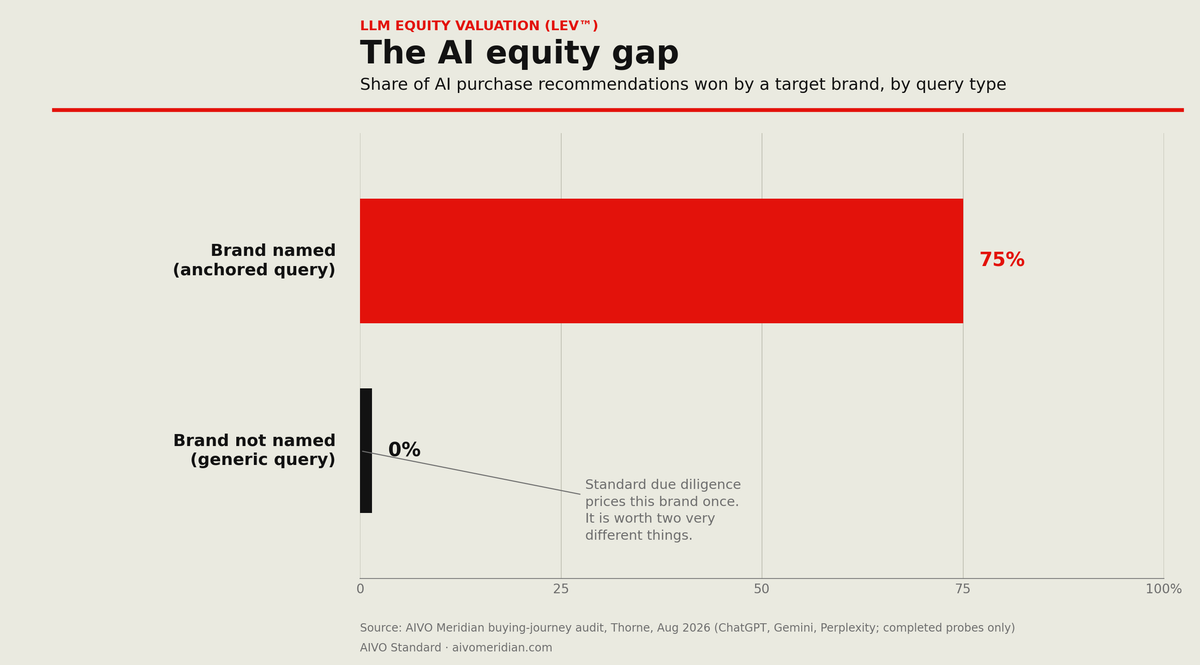
Anchored performance is strong. In four of six platform runs, Thorne held primary brand status through to the purchase recommendation. On Perplexity, both the Directed and Agentic anchored runs closed with Thorne as the uncontested T4/T8 winner, citing Thorne's own product pages as the authoritative dosing source and routing purchase intent to thorne.com, Amazon, and iHerb. On Gemini's Directed run, Thorne won explicitly on practitioner-network citation — the response invoked Fullscript's clinician network and language consistent with doctor, dietitian, and naturopath endorsement. This is the practitioner moat functioning as designed: once the AI has Thorne in view, the clinical and professional-trust signal converts.
Generic performance is close to absent. The moat does not extend to unprompted category discovery. Across three usable Directed Generic runs — the format built specifically to reveal spontaneous consideration-set inclusion — Thorne appeared in zero final purchase recommendations. ChatGPT's generic run closed with Kirkland Signature. Perplexity's closed with Nature Made in one probe and NOW Foods in another. In each case the full retail routing (multiple retailer citations, brand-site links, comparison sourcing) went to the winning incumbent; Thorne did not appear as a comparison brand, a citation source, or a fallback mention. The one extended Agentic Generic run that reached a purchase turn (Perplexity, eight turns) closed with Pure Encapsulations as the primary recommendation and Life Extension as a secondary, with Thorne fragmented into two narrow sub-use-case mentions rather than holding a default position.
The P&G ownership variable was present but inert. Because the anchored T1 prompts explicitly raised the P&G acquisition as a live consideration, this audit also tested — incidentally — whether "Big CPG" skepticism displaces AI purchase recommendations. It did not, in this instrument. No turn-level finding across either platform cited conglomerate ownership, trust-deficit reasoning, or brand-extension skepticism as a factor in displacement. Where displacement occurred, it was driven entirely by competing brands' citation strength, not by reasoning about who now owns Thorne. This is a narrow finding — the instrument was not designed to isolate the mechanism cleanly — but it suggests that, at least in the current information environment, acquisition-driven trust erosion is not yet a factor AI reasoning chains are picking up on. That could change once the deal closes and consumer-facing coverage of the transaction accumulates.
Composite RCS across the audit: 47/100 — "advertise with caution." Thorne enters the AI consideration set reliably but frequently loses the purchase decision itself, which is the commercially determinative turn.
Reading the Deal Through This Lens
None of this changes the fundamental value of what P&G acquired. Forty years of practitioner relationships, NSF certification, and a genuine premium-wellness brand identity are real assets, and this audit confirms they convert cleanly into AI purchase recommendations when a consumer already knows to invoke them. What this audit adds is the piece a revenue multiple, a brand equity survey, or a retail distribution metric cannot see: Thorne's advantage is conditional on prior awareness, and its position collapses at the exact layer — unprompted category discovery — where, per BCG's 2024 research, AI now influences an estimated 29 to 55 percent of purchase decisions in health, wellness, and beauty categories specifically.
For L Catterton, that timing looks close to ideal: an exit priced on a moat that was real and measurable, ahead of any market pricing-in of the discovery gap beneath it. For P&G, the acquisition brings a defensible niche and an unpriced liability in the same transaction. Closing that gap — winning Thorne a spontaneous position in generic AI health and wellness queries, not just a strong answer when named — is now integration work, and the clock on it started at signing, not at close.
Why This Matters Beyond Thorne
No standard due diligence framework currently includes a structured assessment of a target brand's standing inside AI purchase recommendation systems. As AI-mediated discovery continues to grow as a share of purchase behavior, that omission becomes a recurring, quantifiable risk across every consumer brand acquisition — not just this one. LLM Equity Valuation (LEV™) was built as the additive instrument to close that gap: a structured pre-transaction assessment of a target's AI purchase recommendation equity, run before terms are set rather than discovered after close.
Full methodology: WP-2026-02, DOI 10.5281/zenodo.19512805.
AIVO Meridian audit conducted August 8, 2026. Full turn-by-turn Journey Maps and Reasoning Chain Evidence Maps available on request.
Comments ()