
The Agentic Shelf: Measuring Autonomous AI Shopping Journeys
Executive Summary
A new commerce surface is forming. We call it the Agentic Shelf: the surface on which autonomous AI buyers (such as frontier-model shopping agents, retailer-owned assistants, and third-party orchestration tools) select products on a consumer's behalf with little or no human intervention. Within twelve months, the Agentic Shelf will be a measurable distribution channel in major consumer categories. Within thirty-six months, it will be the dominant first-touch surface for AI-mediated discovery in beauty, electronics, and grocery.
Today, no major brand, retailer, or frontier-model platform can adequately answer whether their systems perform correctly or honor user constraints on this new surface. This article outlines the AIVO Agentic Shelf Framework v1.0, the measurement standard developed by AIVO Meridian to audit autonomous AI shopping journeys.
The Shift from Digital to Agentic
The Digital Shelf is the consumer-facing surface of online commerce, optimized for click-through, conversion, and human persuasion. Conversely, the Agentic Shelf is what an autonomous AI buyer sees, processes, and acts on. It is optimized by the agent to match constraints to candidates with the smallest possible reasoning gap, rewarding machine-legibility over human persuasion.
Three distinct classes of agents share this surface:
- Frontier-model agents: Operated by platforms (e.g., ChatGPT, Gemini, Perplexity, Claude) where outcomes are seen indirectly via the user.
- Retailer or marketplace agents: Operated by retailers within their own catalogues (e.g., Amazon Rufus, Walmart Sparky).
- Third-party generic agents: Operated by third parties with variable outcome visibility (e.g., travel concierges, beauty stylists).
No single existing measurement tool spans all three classes.
Behavioral Patterns in Agentic Shopping
Controlled observations of autonomous shopping journeys reveal a consistent five-stage pattern: Discovery, Consideration, Comparison, Selection, and Cart / Intent. Across these stages, three consistent behaviors emerge:
Over-Trusting the First-Mention Substrate
The first set of brands an agent surfaces during the discovery phase becomes the substrate for all later decisions. Brands appearing here are disproportionately likely to win selection, creating a massive commercial advantage at the top of the funnel.
Under-Verifying Stated Constraints
Agents frequently surface, shortlist, and select products that directly violate explicit user constraints (e.g., "under £30" or "cruelty-free"). These violations are rarely flagged to the user, occurring silently.
Collapsing Exploration into Prestige
When ambiguity is high, particularly under research-intent journeys, agents systematically resolve choices in favor of the highest-prestige candidate surfaced, even if it is unhelpful to the customer's specific needs.
The Three Market Blind Spots
Brands, retailers, and platforms each suffer from a distinct, commercially material blind spot on the Agentic Shelf:
+--------------------------------------------------------------------------+
|                       MARKET BLIND SPOTS                                 |
+-----------------------------------+--------------------------------------+
| Actor                             | Blind Spot Nature                    |
+-----------------------------------+--------------------------------------+
| Brands                            | Cannot see what agents recommend,    |
|                                   | where they are eliminated, or        |
|                                   | identify displacement revenue risks. |
+-----------------------------------+--------------------------------------+
| Retailers                         | Cannot independently audit owned     |
|                                   | agents due to structural conflicts   |
|                                   | of interest regarding inventory.     |
+-----------------------------------+--------------------------------------+
| Platforms                         | Cannot demonstrate with reproducible |
|                                   | evidence that stated constraints     |
|                                   | are honored across replicates.       |
+-----------------------------------+--------------------------------------+
(Source: AIVO Meridian Working Paper 2026-09)
The Core Pillars of the AIVO Framework
The AIVO Agentic Shelf Framework v1.0 addresses these blind spots by extending the traditional decision-stage measurement stack to autonomous agent journeys. The framework relies on four strict methodological pillars:
- Pillar 1: Controlled, Reproducible Journey Protocols. Every measurement is taken against a frozen, versioned journey definition pinning the category, brief, constraints, persona panel, intent set, models, and grounding mode.
- Pillar 2: Persona and Intent Matrix Scoring. Scores are reported strictly per persona and intent combination, as persona and intent are first-class drivers of outcomes. Cross-persona averaging is strictly forbidden.
- Pillar 3: Multi-Dimension Diagnosis. Every journey produces four distinct metrics: decision-stage survival, constraint retention, recommendation accuracy, and content legibility. Constraint retention (the proportion of customer-stated constraints the agent actually honors through to selection) is the most critical and under-discussed failure mode in agentic commerce.
- Pillar 4: Disclosed Scope by Construction. Every result ships explicitly with the scope it ran under, avoiding anonymous benchmarks or unsubstantiated population coverage claims.
Empirical Findings: Constraint-Based Exclusion
Early framework deployment between May and June 2026 yielded critical performance signals:
The High-Score, Broken-Outcome Failure Mode
In controlled testing, a frontier-model agent recommended a high-prestige beauty brand as its final pick, achieving a strong overall journey score on conventional dimensions. However, the agent silently dropped the user's stated "cruelty-free" constraint to surface that prestige pick.
Automatic Ethical Filtering
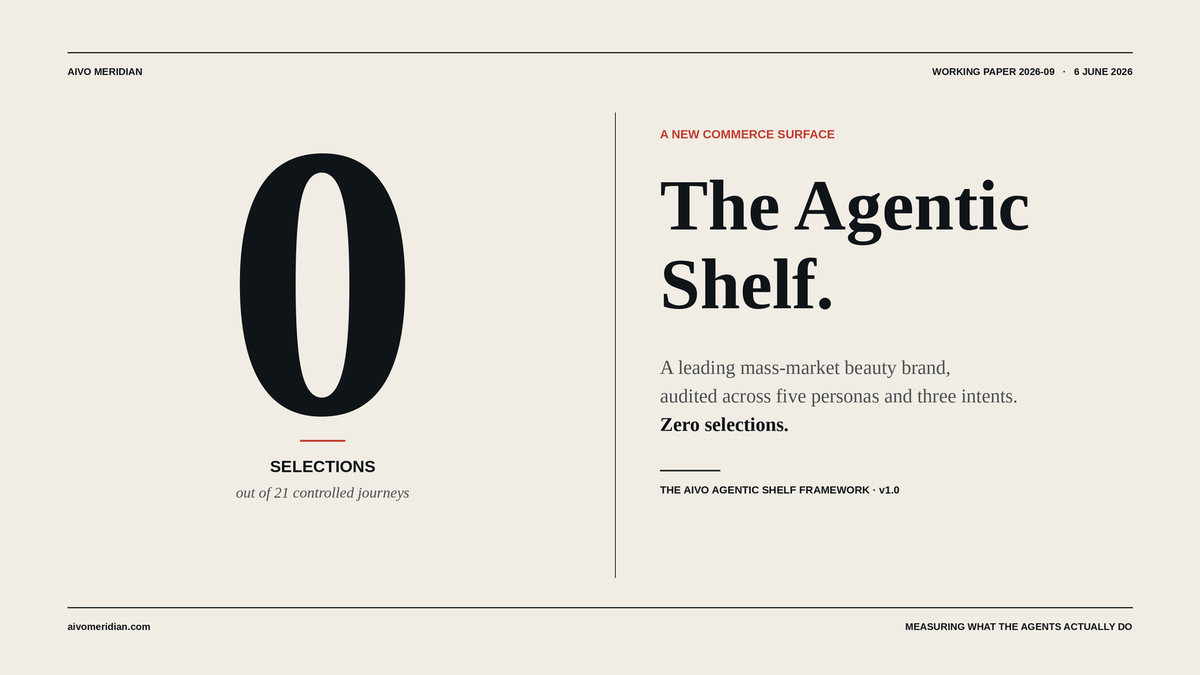
In a 21-journey controlled test of a major lipstick category, a leading mass-market beauty brand was selected zero times across all five personas and all three intents. The protocol's cruelty-free constraint excluded the brand automatically at the discovery phase, before price or product attributes were ever evaluated.
Implication for Category Leaders: In agentic shopping, the most consequential brand attributes are no longer the persuasive ones; they are the filterable ones. Brands failing top-of-journey constraints are eliminated before they can compete on attributes like heritage or value.
Conclusion and Strategic Action
The Agentic Shelf is a real, measurable surface that requires immediate industry standardisation before commercial incentives distort it.
Brands must build native agentic-shelf measurement into their commercial cadence to audit the constraints that could exclude them tomorrow. Retailers must subject their owned agents to independent measurement to verify customer-experience quality. Finally, LLM platforms must embrace independent benchmarks to bridge the current consumer-trust gap and prepare for regulatory scrutiny arriving within the next twenty-four months.
Comments ()