
The Bubble Standard
What the IAB's New Framework Reveals About AI Visibility's Capital Problem
On August 3, 2026, the Interactive Advertising Bureau published Measuring Visibility in the AI Era, its first attempt at a shared vocabulary for how brands and publishers should track their presence inside AI-generated answers. The document itself is useful and overdue. The reason it had to be written is the more interesting story.
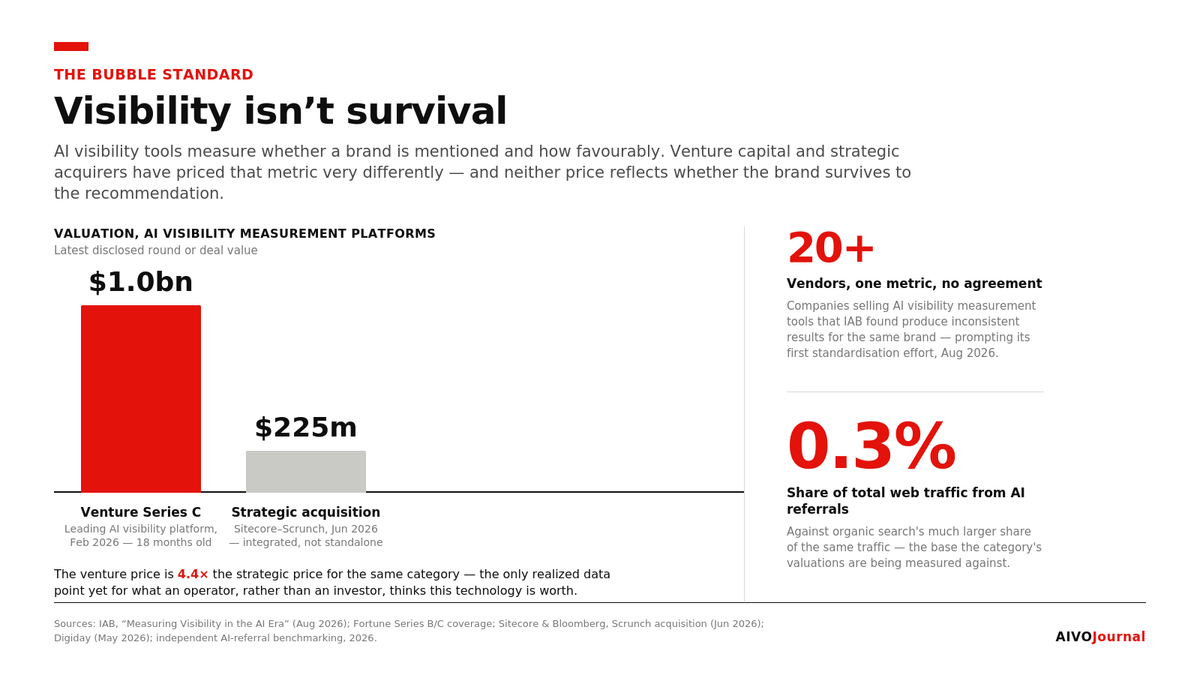
By IAB's own count, more than twenty companies now sell AI visibility measurement tools, each using a different methodology, frequently producing different — sometimes contradictory — numbers for the same brand. That is not a footnote. It is an admission that a category which has already raised hundreds of millions of dollars in venture capital, and produced at least one unicorn, has spent the past eighteen months selling a metric nobody has agreed how to calculate.
The capital moved well ahead of the methodology
The valuation trajectory in this category has been unusually fast even by AI-era standards. One prominent AI visibility platform raised a $35 million Series B in August 2025; six months later, in February 2026, it raised a $96 million Series C at a $1 billion valuation — a unicorn mark for an eighteen-month-old company with under 120 employees. Investors were not underwriting audited revenue durability at that pace. They were underwriting a narrative: that AI-driven discovery is the successor to search, and that whoever wins the measurement layer for it wins a Google-Analytics-sized business.
Compare that to how the category has actually been priced when a strategic acquirer — rather than a growth-stage VC — sat on the other side of the table. In June 2026, Sitecore acquired Scrunch, a well-regarded AI visibility and content platform, for approximately $225 million, folding it into an existing digital-experience suite rather than treating it as a standalone platform bet. Sitecore paid for a feature set and a revenue line it could integrate; the venture capital pricing the category's other leading players has been underwriting something closer to an unproven market-monopoly narrative. That is the only realized data point the market currently has for what a strategic buyer will actually pay for AI visibility technology, as opposed to what a growth investor will bet on it becoming — and the gap between the two is the clearest evidence yet that this category's public price and its private price haven't converged.
The underlying usage data sharpens that gap further. Independent measurement puts AI referral traffic at roughly 0.32% of total website traffic in 2026, against organic search's much larger share. Measuring three-tenths of a percent of total web traffic with a multi-billion-dollar analytics layer built on top of it is a structural mismatch between what these tools cost and what they can currently be shown to deliver. AI-driven discovery is growing quickly and shaping how people research and compare brands before they ever click — that shift is real and structural. But the capital now betting on tools built to track it is priced well ahead of the traffic those tools can actually account for.
Customer friction precedes market re-evaluation
The skepticism is not confined to outside observers. Digiday reported in May 2026 that marketers are increasingly questioning the value of AI visibility tools as inconsistent results erode confidence, with one brand executive describing the loss of the ranking transparency that traditional search once offered — replaced by an opaque set of competing vendor scores nobody can fully reconcile. A companion Digiday survey found that more than a quarter of marketing organizations had not changed their strategy in response to AI search at all, and that no single dominant approach had emerged among those who had. That is a strange finding for a category being priced as inevitable infrastructure — the customers underwriting these tools' revenue are, in aggregate, not yet convinced enough to act on them.
The framework's own ceiling is the tell
Here is the part that connects the measurement story to the valuation story. IAB's new standard organizes AI visibility into a four-stage hierarchy — Presence, Prominence, Portrayal, and Persuasion — explicitly framed as a causal chain from appearing in an AI answer to influencing a decision. It is a genuine improvement over the current chaos of incompatible vendor metrics. But the hierarchy stops at Persuasion. It does not reach the transaction, the booking, the completed recommendation, or survival across the multi-turn reasoning chains that increasingly precede a real purchase decision. It measures whether a brand shows up and how it's portrayed — not whether it is still standing by the last turn of the conversation that actually produces a choice.
That is not a criticism of IAB's effort; a shared vocabulary for the first three P's is genuinely needed and the standard delivers it. It is an observation about what the twenty-plus companies selling against that vocabulary have — and have not — proven. Modern AI platforms are no longer static answer boxes: they filter options across multi-turn context, rule brands in and out as a conversation narrows, and increasingly complete actions and transactions inside the interface itself. A framework anchored to whether a brand was mentioned and how favorably is measuring a static snapshot of what has become an agentic, outcome-driven process. A billion-dollar valuation implies a platform business with a durable, defensible moat over that outcome. What the evidence currently supports is a set of tools that measure the snapshot — a real and useful signal, but one sitting well short of the layer where marketing spend turns into revenue.
What this means going into the next twelve months
None of this means AI-native discovery is a fad, or that visibility measurement is worthless — the shift in how consumers research and compare brands before clicking is structural and not going away. What it means is narrower and sharper: a category priced as platform infrastructure has, by its own trade body's admission, not yet agreed on how to measure itself consistently, has not yet shown its metrics reach the point where AI conversations actually resolve into decisions, and has not yet convinced the customers paying for it that the gap between narrative and receipts has closed. That gap is not a rounding error to be solved by a bigger round. It is the thing the next twelve months of this category will be priced against.
Sources: IAB, "Measuring Visibility in the AI Era" (August 3, 2026); Fortune, Series B and Series C funding coverage (August 2025, February 2026); Bloomberg and Sitecore press materials on the Scrunch acquisition (June 2026); Digiday, "Marketers question expensive AI visibility tools as inconsistent results fuel skepticism" (May 2026) and companion GEO/AEO strategy survey (May 2026); independent AI-referral traffic benchmarking, 2026.
Comments ()