
The model knows. It doesn't choose.
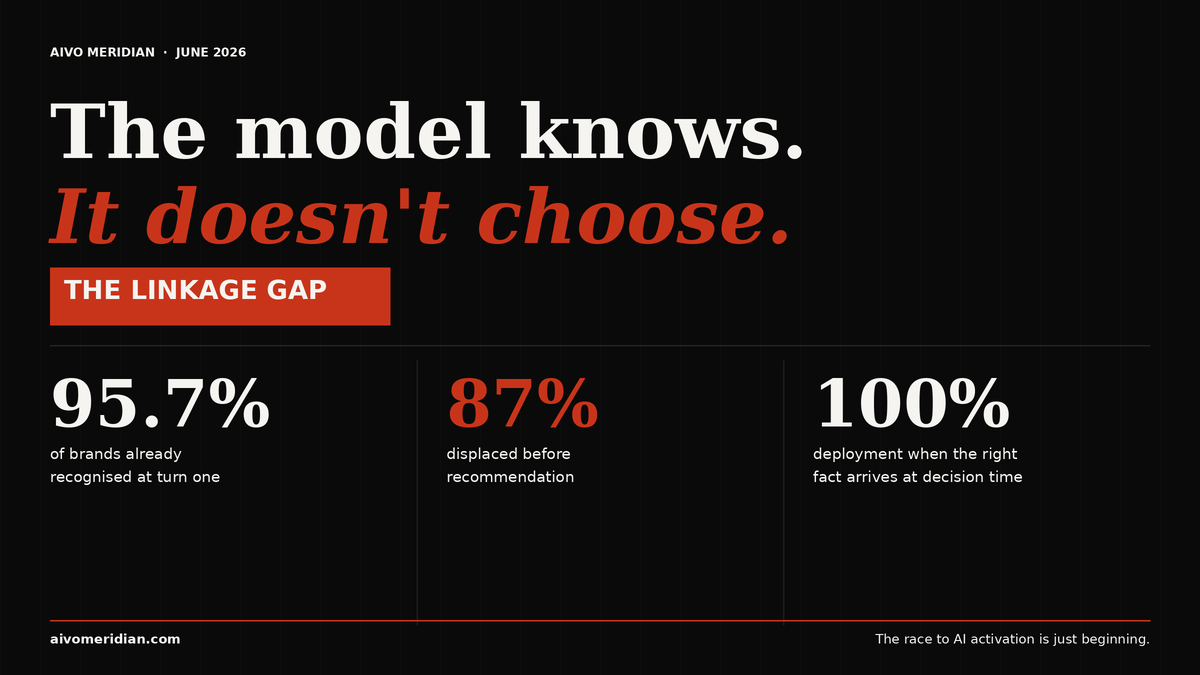
Introducing the Linkage Gap: the structural divide between AI knowledge and AI recommendation, measured across 1,427 brand probes in ten industries.
AIVO Meridian Research · doi.org/10.5281/zenodo.20761232
Across 1,427 brand probes spanning ten industries, 95.7% of brands are already recognised by large language models at first turn — without any AI strategy investment at all. The knowledge problem has largely solved itself.
The gap that remains is not a knowledge gap. It is an activation gap. And it is large.
87% of brands explicitly anchored at turn one are displaced by a competitor before the model makes its recommendation
This paper introduces the Linkage Gap — the structural divide between what AI systems possess about a brand and what they deploy at the moment of recommendation — and sets out the empirical evidence that underpins it.
Methodology
The core measurement protocol operates in two separate conversations. In the first, we ask the LLM directly what it knows about a given brand. The model returns a detailed description: products, features, pricing, positioning. We capture and score every fact it returns. This is the possession inventory.
In the second conversation — entirely separate, with no carry-over context — we present the model with a realistic consumer decision scenario. A real customer situation, a real budget, a real category. No brand is named in the question. We ask the model to recommend.
We then compare the two outputs. Of the facts the model stated it possessed, how many appeared in the recommendation it produced?
The primary corpus spans 1,427 brand-anchored probes across ten industries: Beauty, Wellness, Retail, SaaS, Financial Services, Travel, Consumer Electronics, Food and Beverage, Fashion and Apparel, and Automotive. The deeper diagnostic study covers 22 brand-SKUs across Beauty, Financial Services, and Travel, scoring 592 individual brand facts across 66 paired possession-deployment cells, run across three platforms: ChatGPT, Gemini, and Perplexity.
Findings
The expectation, going in, was that the model would deploy most of what it had said it knew. A reasonable model, asked to recommend, should draw on the knowledge it had just described. The result was otherwise.
Across 22 brand-SKUs and 592 specific brand facts: 75.7% of possessed facts were not deployed at the recommendation turn. The model knew. It did not reach.
The pattern is consistent across categories. Travel shows the highest gap rate at 89.6%. Financial Services at 85.4%. At scale across the full 1,427-probe corpus, 87% of brands anchored at turn one are displaced by a competitor by turn four.
The displacement is brand-asymmetric. In 85.8% of gap cells, a competitor wins the recommendation the subject brand should have won. In Financial Services, Fidelity wins where BlackRock, Charles Schwab, Robinhood, and SoFi all fail. In Travel, Booking.com wins where Expedia, Hopper, Tripadvisor, Skyscanner, and Trip.com all fail. In Beauty, Olay Regenerist wins where Clarins and L'Oréal Revitalift fail.
The model is not failing to deploy facts in general. It is failing to deploy the subject brand's facts. Some other brand's facts are being used.
The Linkage Gap
We call this the Linkage Gap: the structural divide between what a large language model possesses about a brand and what it deploys when making an actual purchase recommendation.
The gap is not incidental or platform-specific. Per-platform gap rates show the pattern holds across architectures: Gemini at 86.1%, ChatGPT at 81.7%. Perplexity at 56.7% is the revealing exception — and the architectural argument for the solution.
Perplexity performs web retrieval at the moment of response generation. It surfaces current content into the reasoning context before the model produces its output. The brands that win on Perplexity win because their content was retrievable and well-structured at the conversational moment — not because it was trained into the model. Perplexity's lower gap rate is the empirical fingerprint of what runtime content activation produces. It is an accidental existence proof.
An activation problem, not a knowledge problem
The counterfactual test is the most important finding in this research programme.
In a separate test series, we pre-loaded a specific possession fact into the user's question at the moment of decision. We did not add context, change the scenario, or prompt the model to use the brand. We surfaced a single relevant fact — one the model had already told us it possessed — at the conversational turn where the recommendation was being formed.
Across every cell where we ran the injection test, the model deployed the fact in its response 100% of the time. Zero exceptions.
The model was not incapable of reasoning with the brand's knowledge. The knowledge had not decayed or become inaccessible. When the right fact arrived at the right moment, the model used it. Every time.
This is the structural conclusion: the Linkage Gap is not a knowledge problem. The model has the knowledge. The gap is in activation — in whether the right fact is present in the reasoning context at the conversational moment of recommendation. Training-time investment addresses a layer upstream of this. The gap lives downstream.
Why current approaches don't close the gap
Knowledge graphs, NLWeb adoption, schema markup, and training-time partnerships are all investments in what the model can possibly know at training time or ingestion time. They are upstream of activation. They do not, in themselves, determine what the model reaches for at the conversational moment of recommendation.
The named Microsoft NLWeb early adopter in our Travel cohort has a 100% Linkage Gap rate across all three platforms measured. Its content is maximally readable by AI systems. It underperforms the non-adopter cohort mean. If Layer 2 readability adoption closed the activation gap, this brand would be the strongest performer in the cohort. It is among the weakest.
The L'Oréal x OpenAI Beauty Knowledge Graph — announced June 2026 — represents a serious commitment of resources and has real value for the brands involved. But the training-time component addresses the layer our data shows has largely already closed. 95.7% of brands are already recognised without such partnerships. The activation gap is not addressed by training-time data inclusion. It requires a different layer of investment entirely.
Two kinds of gap
Not every gap is an activation gap. The research distinguishes two structural types.
The Linkage Gap is an activation problem. The model has the knowledge; the gap is in surfacing the right fact at the right moment. This type of gap closes cleanly when the right runtime content is in place. It is the dominant pattern in our cohort and the focus of this paper.
The Reasoning Gap is a different problem. It occurs when the model has formed a structural judgement that a brand is not the right fit — and where surfacing additional facts does not change that judgement. In our injection test, two of ten cells did not respond: Skyscanner, because the model held a structural view of it as a comparison platform rather than a holiday provider; Trip.com, because the model maintained a budget-fit judgement the injected fact did not override.
The Reasoning Gap is not closable by runtime activation. It requires repositioning — a longer-arc content and narrative investment to change the model's structural opinion of the brand.
The diagnostic question — what kind of gap do I have? — must be answered before either type of investment is committed. Misdiagnosing one as the other wastes the budget that should have gone to the other.
The strategic window
The brands investing in AI strategy in the next twelve months face a choice between two investment theses. The first — make sure AI systems know the brand — addresses a problem the data shows has largely already closed. The second — make sure AI systems reach for the brand at the moment of recommendation — addresses the gap that remains and that no current infrastructure investment is closing.
The measurement imperative is urgent for a specific reason. Brands are about to commit significant budgets to AI-strategy investments. Many of those investments will be directed at the wrong layer. An independent measurement instrument — one that separates Linkage Gaps from Reasoning Gaps and tracks whether recommendation rate is moving — is a precondition for the spending being effective.
The race to AI visibility is winding down. The race to AI activation is just beginning.
Source research
AIVO Meridian Research. (2026). Beyond Visibility: The Linkage Gap and the Case for a Third Layer of AI-Native Brand Infrastructure. AIVO Meridian White Paper, June 2026.
The Linkage Gap, Three-Layer Architecture, and Machine Knowledge Infrastructure are conceptual frameworks developed by AIVO Meridian. Brand names cited are public research subjects, not commercial endorsements.
 Sheals, Paul and de Rosen, Tim
aivomeridian.com · AIVO Journal · June 2026
Comments ()