
The Atlantic just exposed “Sloptimization.”
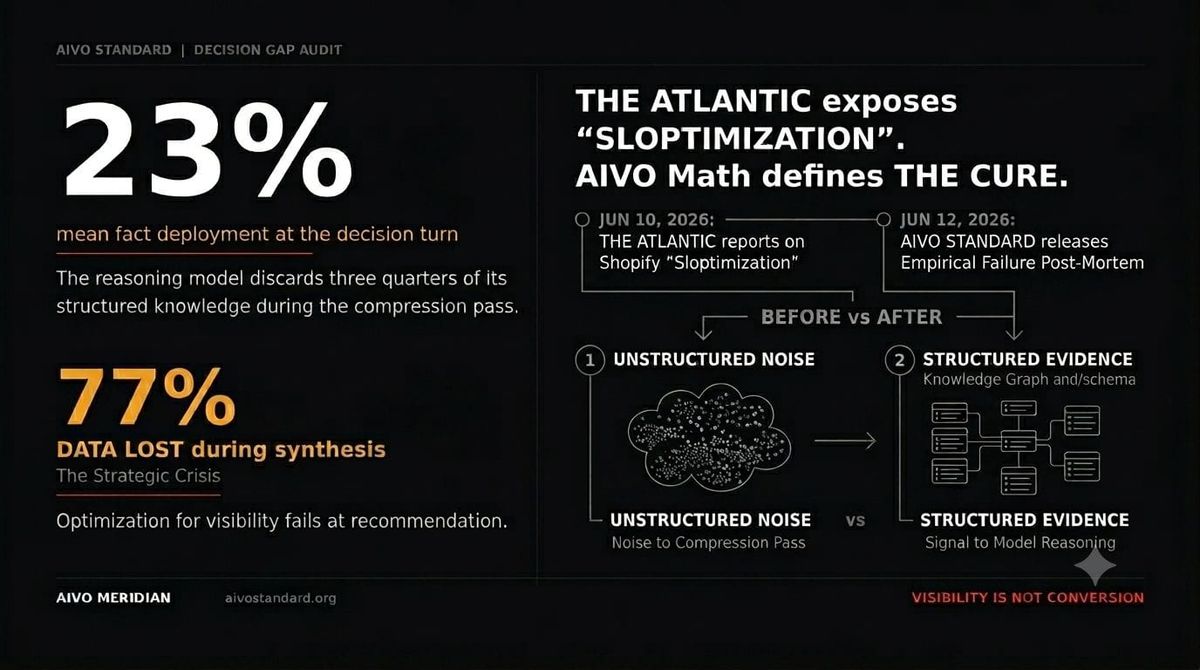
We published the math behind why it’s backfiring.
The Atlantic just exposed “Sloptimization.” We published the math behind why it’s backfiring.
On June 10th, Will Oremus wrote a brilliant piece in The Atlantic exposing “Sloptimization” — the frantic corporate race to flood the web with programmatic listicles and engineered prompts to force AI chatbot recommendations.
He used Shopify’s 60+ self-ranked listicles as Exhibit A.
On June 12th, we published the structural post-mortem at AIVO Journal.
Because while The Atlantic correctly identified the symptom, our team at AIVO Standard has spent the last quarter measuring the failure mode.
We ran structured audits across two major consumer verticals (CPG and Financial Services) using a strict three-instrument methodology to track how data moves through an LLM.
What we found should terrify every CMO currently funding a high-volume AI SEO strategy:
1. The Retrieval Myth: The models knew the brands perfectly. In our possession baselines, the LLMs held detailed, accurate, specific knowledge about ingredients, positioning, and use cases.
2. The Decision Collapse: The moment a buyer asks a model to actually choose, recommend, or commit — the synthesis layer takes over. At that exact turn, mean fact deployment dropped to 23%.
The model routinely discards roughly three-quarters of what it knows and defaults to a category prior.
We call this The Decision Gap — the structural distance between what a model knows about your brand and what it deploys at the moment of selection.
Here is the hard truth for challenger brands trying to copy the Shopify playbook: Unanchored content volume does not add signal to an LLM; it adds noise to the model’s compression pass.
The worst-performing brands in our audit were not the least-cited. They were the ones with massive first-prompt visibility and near-zero decision-stage deployment.
Content volume got them into that position. Evidence structure is what gets them out.
If your enterprise insights or marketing teams are still measuring “share of mention” or chatbot citation counting, you are optimizing for a version of the web that is already dead.
The agentic commerce era doesn’t care how many blogs you wrote. It cares if your data can survive the compression pass.
The raw data from our working paper is available under NDA to qualified enterprise brands and agencies. Let’s stop building unstructured text walls and start structuring irrefutable evidence.
Comments ()