
The Influence Layer: Why "AI Isn't Buying Much Yet" Is the Wrong Reason to Wait
AIVO Journal · companion piece to AIVO Standard working paper, "The Influence Layer."
Ask most people what "AI in commerce" means right now and they will describe some version of an agent quietly buying things on a shopper's behalf. Ask them how much of retail actually works that way today, and the honest answer is: not much. By the narrowest, most verifiable measure available — transactions that both start and finish inside an AI platform — autonomous AI checkout accounts for something like 1.5% of US ecommerce in 2026. That is a real number from a real forecast, not a rounding error, and it is nowhere near the scale the "AI agents are shopping" headlines imply.
It is also, on its own, a bad reason to deprioritize AI-visibility work. A new AIVO Standard working paper, "The Influence Layer," lays out why: the small number describes transaction mediation, and mediation is not the same thing as influence. Conflating the two is the single most common mistake in how AI commerce gets discussed, and it leads directly to the wrong strategic conclusion.
Two different questions, one blurred answer
"Did an AI complete this purchase?" and "did an AI shape this purchase?" are different questions with different answers, and most of the statistics circulating this year answer one while appearing to answer the other.
Referral-traffic growth is genuinely explosive — Adobe reports AI-referred traffic to US retail sites up 393% year over year in Q1 2026, and 693% over the 2025 holiday period. Shopify's independently sourced data points the same direction. Those are real, fast-moving numbers. But they measure visits, not revenue, let alone which fraction of that revenue an AI actually transacted.
Meanwhile, the eye-catching dollar estimates that get quoted as evidence of agentic commerce's imminent scale — McKinsey, Bain, and others project US figures ranging from roughly $300 billion to over $1 trillion — are, on inspection, measuring AI-influenced and AI-mediated purchases together, bundled into one number. They are not measuring the same thing as the 1.5% autonomous-checkout figure, even though the two get discussed in the same breath constantly.
Once these get separated, the picture is coherent rather than contradictory: the fast-growing metric isn't a revenue metric, the metric that most precisely measures AI-mediated transactions is small, and the very large numbers in circulation are measuring something broader than mediation alone. None of this is inconsistent. It's just three different rulers being read as one.
The layer that referral data can't see
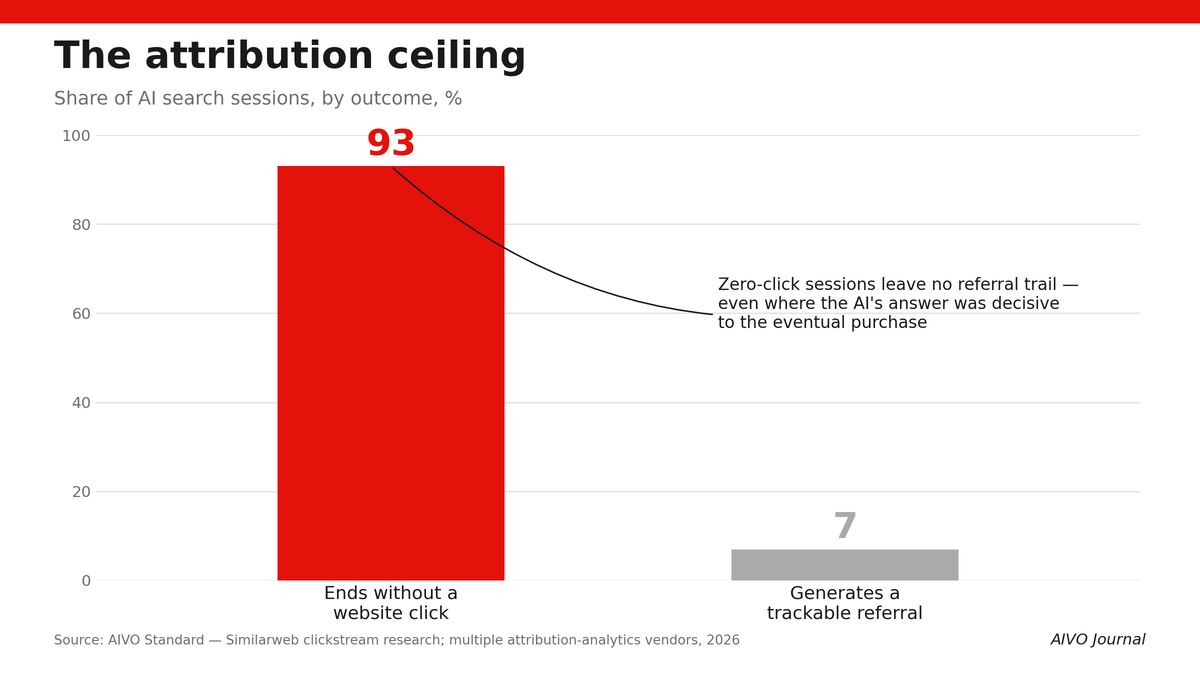
There's a second, more structural reason small referral-attribution numbers understate what's actually happening: most AI influence never generates a referral event at all. Roughly 93% of AI search sessions end without a click-through to any website — a figure corroborated by Similarweb's clickstream research, not just survey recall. A person can ask a conversational AI to compare two treatments, form a preference, and later act on that preference at a pharmacy counter, a bank branch, or in a phone call with a broker. No link, no pixel, no UTM parameter ever fires. The purchase lands in a merchant's logs as "direct" or "organic," and the AI conversation that actually decided it disappears from the data entirely.
This isn't a measurement bug that better analytics will eventually fix. It's a structural property of how high-consideration decisions get made, and it means referral-based attribution — the very data underlying most of the small percentage figures — is a conservative floor, not a representative estimate, for exactly the categories where the stakes are highest.
Why some categories will never "graduate" to agentic checkout
The more interesting argument in the paper isn't about attribution gaps, though — it's about which categories can never close them, regardless of how good AI gets.
Mediation requires more than a capable model. It requires a standardized transaction, a checkout path an agent can complete without a human decision-maker, and a category where "the AI decided and the AI bought it" is both legal and acceptable to the buyer. Four distinct barriers routinely block this even where influence is running at full strength:
Regulatory barriers — a prescription drug, under US law, can only be dispensed against a licensed practitioner's prescription. That's not a technology limitation; it's a statute (21 U.S.C. § 353(b)), and it doesn't loosen because a model gets smarter.
Liability barriers — no enterprise buyer is going to let an agent autonomously commit six or seven figures of company spend, because the accountability for a bad call stays with the human who authorized it, not the tool that executed it.
Identity-verification barriers — a mortgage requires income verification and underwriting sign-off that exist independent of how well an AI could otherwise evaluate the borrower.
High-consideration identity barriers — some purchases (a home, a piece of luxury fashion) are ones people want to decide themselves, technology constraints aside.
Prescription pharmaceuticals sit closest to a limit case. There is no checkout flow an AI agent can complete end-to-end for a controlled prescription under current law, at any level of model sophistication, because the constraint isn't capability — it's the statute. In that category, AI-influenced commerce (which drug a patient asks their doctor about) isn't a preview of something bigger coming later. It's the entire commercially addressable layer, for as long as that regulatory structure holds.
Influence is upstream, not "before"
Here's the reframe worth sitting with: influence isn't a step that happens before mediation in some technology roadmap. It's upstream of both possible paths a purchase can take.
A person can ask an AI to compare options, form a preference, and have a human complete the purchase. Or they can ask an AI to compare options and then instruct an AI to transact on their behalf. The second path adds a mediation step on top of the first — it doesn't replace it. Influence is present either way. That means AI-mediated commerce becoming enormous someday wouldn't make AI-influenced commerce disappear. Measuring influence isn't a bet that agentic commerce fails to happen. It's a bet that the decision layer matters regardless of which path a given purchase eventually takes.
What this means in practice
For brand and measurement teams, three things follow directly.
First, a revenue-at-risk figure that leans on "AI's share of decisions" is a modeled estimate of influence exposure, not a claim about AI-transacted revenue today — and it should say so explicitly. The paper proposes a three-tier vocabulary (Observed, Attributed, Modeled) precisely so a sophisticated buyer asking "how do you know" gets an answer that matches the actual evidentiary basis, rather than a term that implies more certainty than the underlying data supports.
Second, for regulated or high-consideration categories, the structural argument — that no agentic checkout is even legally possible — is a stronger and more durable claim than any current-state revenue number. It's worth leading with, not burying.
Third, the case for measuring reasoning-chain survival now isn't a prediction about the future of agentic commerce at all. It's closer to the argument brands have made for share-of-voice monitoring for two decades: visibility today is decision-relevant regardless of what fraction of it converts inside this quarter's attribution window. Reasoning Chain Score is that argument applied to the layer where AI systems actually reason through a comparison, rather than where they merely rank a keyword.
The full argument, including the four-barrier taxonomy, the evidence underpinning each figure cited above, and the open research questions the paper does not yet claim to have answered, is available on the AIVO Standard Zenodo archive.
 AIVO Standard and de Rosen, Timothy
This article summarizes findings from an AIVO Standard working paper. Figures cited are sourced to Adobe Analytics, Shopify, eMarketer, Similarweb, and other named third parties as detailed in the working paper; several are single-source or vendor-reported estimates and are flagged as such in the original. Two of the working paper's arguments — regarding reasoning-chain persistence across model retraining, and category-conditional influence share in regulated verticals — are explicitly unproven hypotheses in the source paper and are described as such here, not as established findings.
Comments ()