
AIVO's Forecast: TikTok Shop Will Rival Amazon in Its Best Categories Within Three Years
Summary
Most predictions about TikTok Shop compare it to Amazon on Amazon's terms: fulfillment speed, catalog depth, trust infrastructure built over two decades. On those terms, Amazon wins comfortably, and will for years.
That comparison asks the wrong question. Amazon and TikTok Shop are not competing to be the best version of the same thing. They are built on opposite theories of how a purchase decision begins.
Amazon is a pull system. The customer arrives already knowing, in some form, what they want, and the platform's entire architecture exists to remove friction between that intent and a completed order. Search, reviews, one-click checkout, Prime shipping — every layer optimizes the same variable: speed from known intent to fulfillment.
TikTok Shop is a push system
The customer has no prior intent. The algorithm surfaces a product before the viewer has formed a want, and the platform closes the purchase inside the same scroll, without the viewer ever leaving the app to search, compare, or reconsider. Discovery and conversion happen in one motion, at the moment attention is highest and deliberation is lowest.
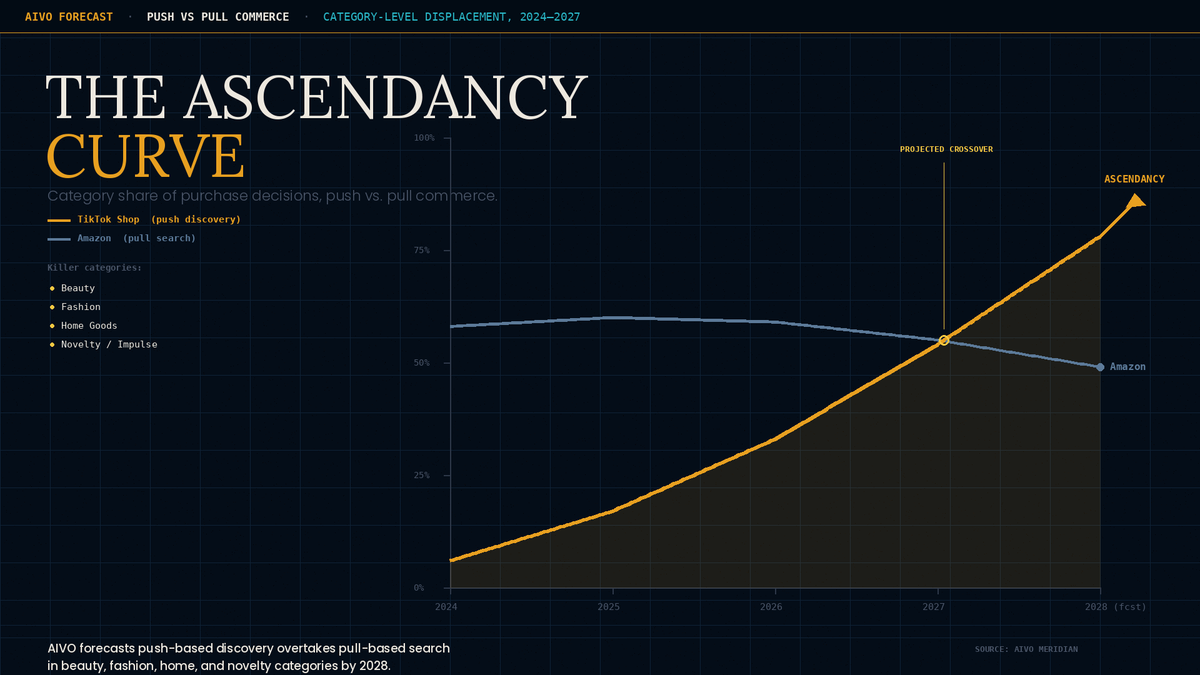
These are not two versions of e-commerce. They are two different theories of demand, and AIVO's forecast is that the push model is going to take real, durable share from the pull model over the next three years, concentrated hard in a specific set of categories rather than spread evenly across retail.
The mechanism is not mysterious.
Pull commerce depends on the customer already having a need articulated well enough to search for it. That works well for categories defined by function and specification: electronics, appliances, anything with a warranty attached, anything where the customer is comparing features before committing.
It works far less well for categories where the purchase decision is emotional, visual, and impulsive, where the customer did not know they wanted the product until they saw it in motion, worn, applied, or demonstrated. Beauty, fashion, home goods, novelty items, anything that sells on how it looks and feels rather than what it specifies. That is exactly the terrain a push system is built to dominate, because it does not need the customer to search. It creates the search.
The objection
The obvious objection is that this overstates the threat, because plenty of consumers discover a product on TikTok Shop and still complete the purchase on Amazon, drawn back by Prime loyalty or a saved payment method already on file.
That objection misreads where the value actually sits. The platform that creates the want owns the decision, regardless of where the transaction technically resolves. Amazon may still capture the order in these cases, but it captures it as a fulfillment layer executing a decision that was already made elsewhere. That is a fundamentally weaker commercial position than making the decision in the first place, and it is a position that erodes over time as TikTok Shop's own checkout closes more of that gap natively.
The friction difference is where the advantage compounds fastest. A traditional path from discovery to purchase, whether that discovery happens through search advertising or a brand's own D2C site, requires the customer to leave one context, form an intent, navigate to another destination, and complete a separate checkout flow.
Every one of those steps is a point where the customer can abandon. TikTok Shop collapses discovery and checkout into a single uninterrupted scroll, with no context switch and no separate destination. That is not a marginal conversion improvement. It is the removal of nearly every friction point legacy commerce depends on absorbing, which is exactly why D2C sites and search-driven ad spend are losing ground fastest in the categories most exposed to push-based discovery.
AIVO's forecast
This is why AIVO's forecast is not that TikTok Shop overtakes Amazon broadly. It is that TikTok Shop becomes the default discovery and purchase layer in the categories where algorithmic push has structural leverage over the decision, while Amazon retains dominance in the categories where considered, spec-driven purchasing still governs. The two platforms are not converging into one winner. They are dividing commerce along the axis of how a purchase decision actually forms, and that division will look far more decisive in three years than it does today.
There is a second layer to this forecast that connects directly to AIVO's own discipline. What we measure inside AI conversational engines, whether a brand survives from being mentioned to being the model's final recommendation, is a smaller-scale version of the exact dynamic now playing out between these two platforms.
Whoever controls the layer between a customer's attention and their purchase decision controls the outcome, regardless of whether that layer is a chat interface reasoning through a recommendation or a For You page surfacing a product mid-scroll. The mechanism generalizes. Push-based discovery is winning wherever it appears, because it removes the one variable pull systems have always required: a customer who already knew what to ask for.
Evaluation
Boards evaluating retail and consumer strategy over the next three years should audit their portfolio by intent-type, not by channel spend. The relevant question for each category is not how much budget goes to search versus social. It is whether that category's purchase decision is typically pulled by an already-formed need or pushed by discovery the customer did not know they wanted. That single distinction will predict commercial exposure to this shift more accurately than any existing channel-mix report on the table today.
Comments ()