
Is There a Human Linkage Gap?
A vendor sits down with a prospect and hears something familiar. I've seen something like this before, the prospect says. Spent a lot of time on it. Couldn't sell it internally.
The vendor asks what would actually work. Not a resale arrangement, the prospect says. That structure doesn't fit how we operate.
The vendor explains why this is different. A closed loop, not just a diagnosis. The prospect nods, unmoved. The original objection is still standing in the room.
Then the vendor shows something concrete. A live demo, built for a different use case entirely. The prospect looks at it and redirects the whole conversation. What we'd actually need, they say, is a version of this mapped to our own requirements. Not the thing you walked in with. Something else, introduced almost by accident.
A meeting gets booked. The thing that won the meeting wasn't the thing that opened it.
Anyone who has sat through enough procurement conversations has watched some version of this happen. An early idea gets named, gets tested, gets defended, and gets replaced by something that shows up later and lands harder. It happens often enough that it barely registers as strange.
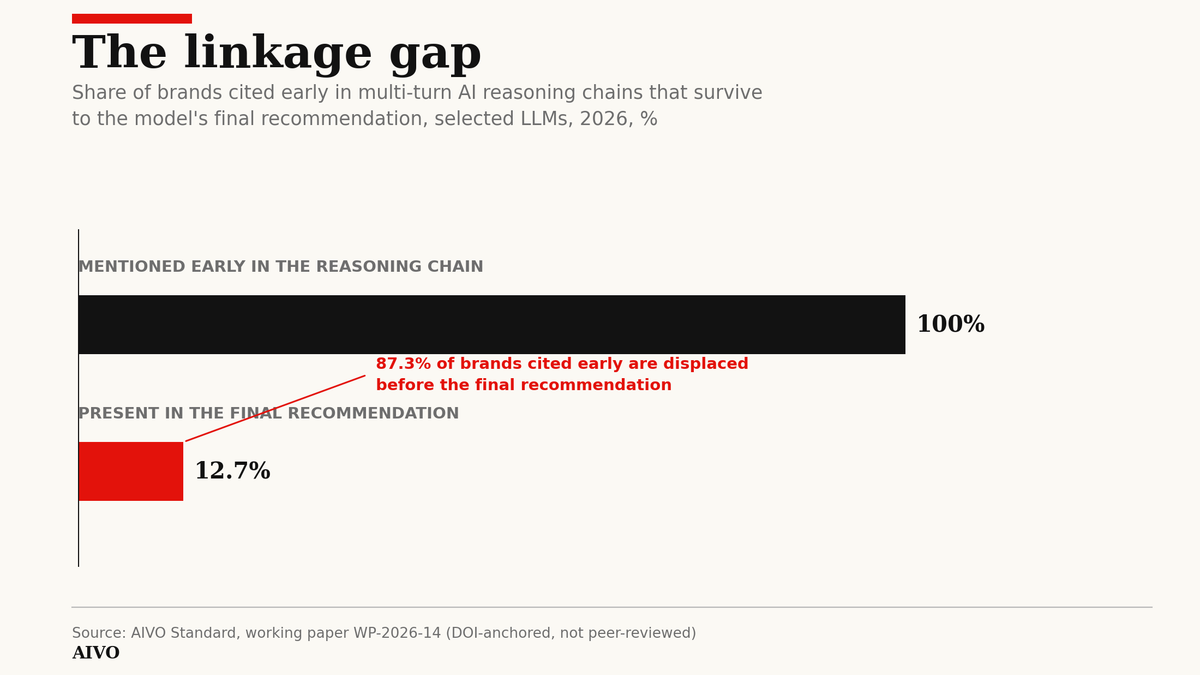
It should register as strange, because it is the same pattern AIVO's research keeps finding inside AI conversations. A brand gets mentioned early in a multi-turn exchange with an AI model. By the time the model gives its actual recommendation, that brand is gone eighty seven percent of the time. Something else has taken its place, often something that wasn't part of the early exchange at all.
The instinct is to treat this as a quirk of how language models work. Unstable reasoning, an artifact of next-token prediction, a technical failure mode worth fixing. That instinct might be only half right. Decision science has been describing a version of this same pattern in human buyers for over fifty years, long before anyone was asking a chatbot for a recommendation.
The idea is called a consideration set. Howard and Sheth named it in 1969. A buyer is aware of many brands. They actually consider only a few. Being known and being considered were never the same thing, and the gap between them was already large enough that one early model built entirely around it explained most of the variation in what people actually bought.
McKinsey's research on the consumer decision journey, published in 2009, went further. Consideration sets were assumed to narrow steadily toward a final choice. The data said otherwise. Buyers added brands mid-evaluation as often as they dropped them, pulled in by a review, a comparison, a friend's mention, something the original brand never controlled. Two out of three of the moments that actually swayed a buyer during evaluation had nothing to do with the brand's own marketing.
None of this required an AI model. It was already true of how people decide things, one piece of information at a time, with the field of candidates shifting under their feet as new information arrived.
There is also a body of research on why the vendor's second move worked and the first one didn't. Sales research built on data from six thousand reps found that defending an existing frame is the weakest thing a seller can do. Arguing your case harder within the frame the buyer already has rarely moves them. What moves them is being handed a different, more concrete way of seeing the problem. The reps who did this consistently were the strongest performers measured. The reps who tried to win by reinforcing their original pitch were the weakest.
Put together, this is not a new phenomenon wearing an AI costume. It is an old phenomenon, finally happening somewhere it can be watched turn by turn.
What AI conversation adds is not the pattern. It is visibility. A human buyer's shifting consideration set has always been invisible, buried in a mind nobody can observe directly. A multi-turn exchange with an AI model is not invisible. Every turn is a record. The moment a brand gets displaced, and the reason it gets displaced, is sitting right there in the transcript, measurable in a way a human buyer's internal deliberation never was.
That raises a real question nobody has answered yet. If displacement is a general property of how sequential decisions get made, does it happen at anything like the same rate in human conversations as it does in AI ones. Nobody knows. No one has taken a real corpus of human sales calls or negotiation transcripts and measured it the way multi-turn AI probes measure it now. It would take a way of marking, cleanly, what counts as an early mention and what counts as a final choice in a human conversation, which is a harder problem than it sounds. This is an open question, not a finding, and it should stay that way until someone actually does the work.
What the question does change is how to think about the number that AIVO's research already has. An eighty seven percent displacement rate reads differently depending on what caused it. If it is unique to how language models generate text, the fix is to make the model behave differently. If it is a property of sequential decision making generally, something people have always done and AI conversation simply exposes, the fix looks different too. Not making the AI act less like an AI. Giving a brand the kind of durable presence across a decision, human or otherwise, that decision science has been describing since before anyone built a chatbot.
The vendor in that meeting never got to relitigate the first pitch. The thing that won the room was concrete, arrived late, and had nothing to do with the original frame. That is not a story about AI. It might be the oldest story in selling. AI conversation just started writing it down.
Comments ()