
The Other AI Failure Rate: Why "It Worked" Isn't the Same as "It Sold"
A number everyone is quoting, and mostly misreading
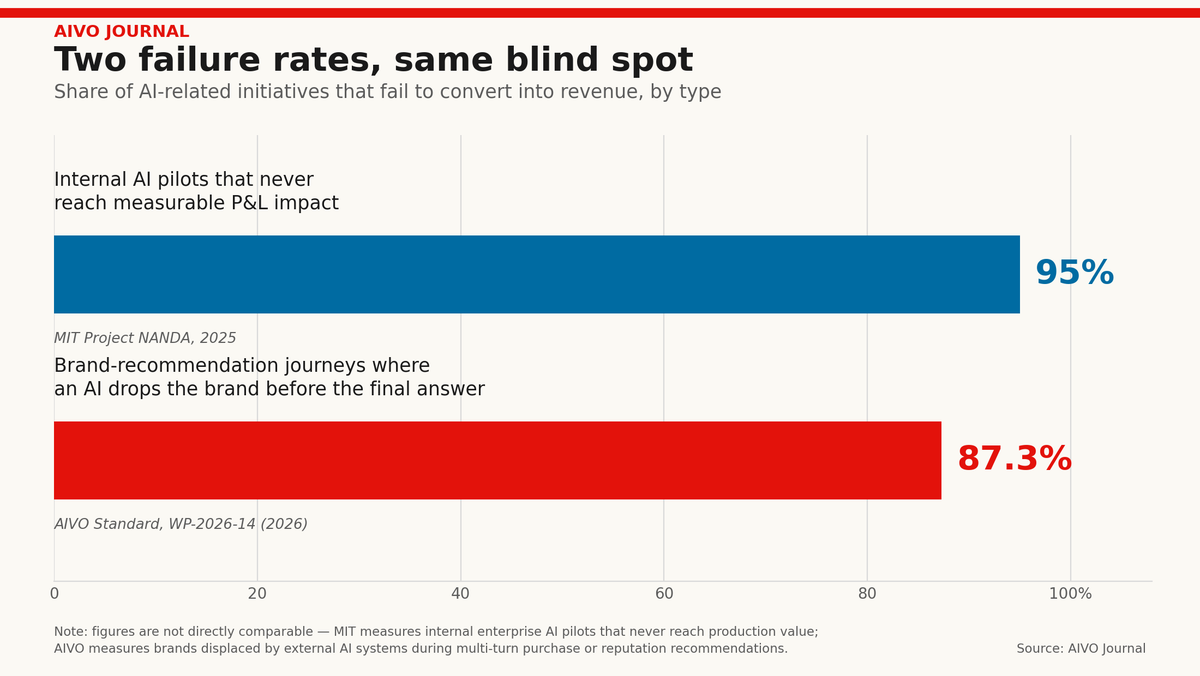
Over the past year, one statistic has become shorthand for enterprise AI skepticism: 95% of generative AI pilots fail to deliver measurable P&L impact. It comes from MIT's Project NANDA, in a study titled The GenAI Divide: State of AI in Business 2025, built on over 50 executive interviews, more than 150 leader surveys, and an analysis of roughly 300 public AI deployments. Only about 5% of pilots, the researchers found, made it to production with measurable value — the rest stalled, not because the underlying models were weak, but because of what the report calls a "learning gap": tools bolted onto workflows they were never built to fit, with no mechanism to retain context or adapt over time.
Gartner and RAND have published parallel findings, generally putting AI project failure in the 80% range — roughly double the failure rate of a standard IT project. The pattern that emerges across this research is consistent: vendor-led, narrowly scoped, workflow-integrated AI succeeds at meaningfully higher rates than broad, internally-built, novelty-driven deployment.
This is useful, credible research. It is also about the wrong AI.
Two different questions wearing the same word
The 95% figure describes internal AI adoption failure — whether a company's own generative AI tools ever reach production and move a P&L line. It's a question about build quality and organizational integration. It has nothing to say about what happens to a brand once it's already generating that revenue, out in the world, being evaluated by someone else's AI.
That second question is the one AIVO exists to answer. A brand can have zero internal AI initiatives — no copilots, no pilots, no chatbots, nothing MIT would ever survey — and still be losing revenue to AI every day, because the AI making the purchase or reputation recommendation isn't the brand's AI. It's ChatGPT, Gemini, Perplexity, Copilot — systems the brand doesn't own, control, or measure, reasoning through a multi-turn conversation on a consumer's or researcher's behalf, deciding who gets recommended and who gets quietly dropped along the way.
We call the point where that drop happens the Linkage Gap: the space between a brand being cited by an AI system and a brand actually being chosen at the end of the reasoning chain. Picture a typical sequence: "Show me the top enterprise CRMs" surfaces a brand cleanly in turn one. "Filter for healthcare compliance" narrows the field, and the brand is still there. "Which of these integrates with our legacy database?" — and by turn three, a competitor with clearer documentation has quietly taken its place. Nothing about the brand's visibility failed. It simply didn't survive the reasoning.
Across our published probe research (WP-2026-14, n=1,427 probes, DOI-anchored on Zenodo), brands that were visible and accurately represented early in a conversation were displaced from the final recommendation in the large majority of multi-turn sequences we tested. Visibility was rarely the failure point. Survival to the decision turn was.
Two failure rates, same root cause
Read side by side, MIT's failure rate and AIVO's displacement data are describing mirror-image blind spots — and the underlying cause the MIT researchers name for internal AI failure is close kin to the one we track externally.
MIT's report is explicit that the core problem isn't model capability — it's a "learning gap," where tools are deployed without clear, workflow-specific goals and without a mechanism to track whether they're actually working. That is, in plain terms, a measurement failure: most enterprise AI initiatives never had an instrument capable of telling them the difference between "the AI is running" and "the AI is producing outcomes."
That is exactly the gap between what most of the current AI-marketing research industry measures — citation frequency, share of voice, sentiment, "visibility" — and what actually determines revenue. Sophisticated, well-resourced research from McKinsey and others has mapped how often brands get cited in AI answers. Semrush's July 2026 analysis with Kevin Indig went further, showing that AI category ownership is far more contested than assumed — in a study of over 1,000 US categories, more than half were still fully unsettled, while categories with a clear owner saw that owner retain the top position from month to month roughly 90% of the time. That's genuinely important work. It also stops at the same boundary McKinsey's research stops at: citation and visibility. Neither answers the question a CFO actually cares about — did the brand survive to the recommendation that led to a transaction.
Internally, companies are failing to measure whether their own AI tools work. Externally, brands are failing to measure whether other people's AI tools are still recommending them. Both failures share the same shape: activity mistaken for outcome, visibility mistaken for value.
But the two failures don't cost the same way, and that difference is what should worry a CFO more, not less. A stalled internal AI pilot shows up as a visible line item — a budget spent on software and integration work that never shipped, the kind of loss a retrospective can name and close out. External displacement doesn't generate a line item at all. It's unattributed pipeline decay: revenue lost to a recommendation the brand was never told it lost, in a candidate set it never knew it was competing in. One failure gets a post-mortem. The other just quietly compounds.
What "laser-focused on revenue" actually means for Meridian
This critical distinction forms the foundation of the Meridian architecture. Meridian is not another surface-level visibility tracker, nor is it designed to repair internal enterprise workflow tools. It exists to answer one precise, bottom-of-the-funnel question: does your brand survive the AI's reasoning chain to the final recommendation, or does a competitor displace it?
That's the logic behind the architecture:
- RCS (Reasoning Chain Score) — the composite measure of whether a brand survives a multi-turn reasoning sequence, not just whether it appears in one.
- DIT (Displacement Initiation Turn) — pinpointing where in the conversation a brand gets dropped, which is the difference between a vague "we should improve our AI visibility" directive and an actionable fix at a specific reasoning step.
- Agentic Ready Score — a forward-looking measure of whether a brand's public information architecture (structured data, brand.context, llms.txt-class signals) gives an AI agent enough to carry the brand through, rather than defaulting to a better-documented competitor.
None of this requires a brand to have "AI initiatives" of its own, succeed or fail, MIT-style. It requires the brand to be the subject of other systems' decisions — which every consumer and B2B brand already is, right now, whether or not they've built a single internal pilot.
The pitch this supports, not the pitch this replaces
The MIT and Gartner numbers are a legitimate, useful entry point for a conversation — they tell a CMO or CFO something they already suspect: that "doing AI" and "getting value from AI" are not the same claim, and that most organizations conflate them. That's a fair way to open a door. It is not evidence for AIVO's own displacement findings, and the two statistics should never be cited in the same breath as if they were measuring the same thing — one is about internal build failure, the other about external representation failure, and collapsing them would undercut the credibility both are built on.
The honest version of the pitch is narrower and, we think, more durable: most of the current AI-failure conversation is about whether companies can get their own AI to work. Almost none of it is about whether the AI already deciding your customers' next purchase still knows you exist by the time it matters. That second failure rate doesn't show up in an IT project retrospective. It shows up in a P&L, quietly, without a root-cause meeting — which is precisely why it needs its own instrument to measure it.
Sources: MIT Project NANDA, "The GenAI Divide: State of AI in Business 2025" (2025); Gartner and RAND Corporation AI project failure research; AIVO Standard Working Paper WP-2026-14, "The Linkage Gap" (Zenodo, DOI-anchored); Semrush / Kevin Indig, "AI Visibility Is a Topic-Level Game" (July 2026).
Comments ()