
The Selection Layer Is Missing From the Agentic Commerce Stack
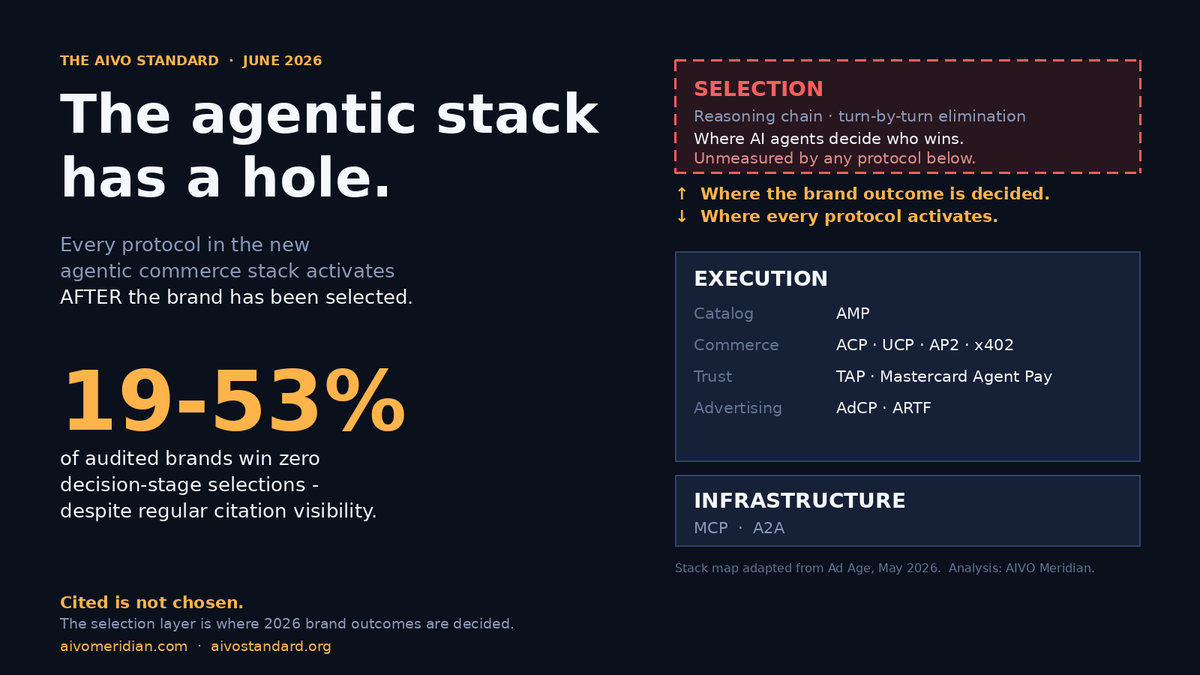
Kendra Barnett's recent guide in Ad Age to the new agentic protocols is the clearest map yet of what's been built over the last eighteen months. MCP at the infrastructure layer. A2A for agent-to-agent communication. AdCP and ARTF for media buying. ACP, UCP, AP2, x402, TAP, Mastercard Agent Pay for commerce. AMP for brand catalog governance.
It is a remarkable amount of infrastructure assembled in a short period. And reading the piece end to end, one omission is conspicuous.
Every protocol in the catalog activates after selection has already happened.
UCP, ACP, AP2 — these are payment and order-completion rails. TAP and Mastercard Agent Pay verify that the agent transacting is authorized and trusted. x402 is a payment-required HTTP code reimagined for stablecoins. AdCP and ARTF govern how agents negotiate media buys. AMP — the closest adjacency to anything decision-stage — is a brand governance layer that lets merchants establish a central source of truth about products for agents to consume during transactions.
All of these are execution-layer protocols. They assume the agent has already decided which brand to transact with, which product to surface, which inventory to buy. They make that transaction faster, safer, more verifiable, more efficient. They do not influence or measure the reasoning chain that produced the selection.
This matters because of a pattern we have now documented across hundreds of brand audits. Between 19 and 53 percent of brands we audit achieve zero decision-stage wins in AI reasoning chains despite regular citation visibility. Being cited is not being chosen. The gap between citation and selection — measured in turns of reasoning before the agent commits to a recommendation — is where most brand outcomes are now decided.
If you lose at turn two or turn three in the reasoning chain, your AP2 integration never fires. Your AMP feed is never consulted. Your TAP credentials are never checked. The most carefully governed product catalog in the world produces no commerce if the agent eliminated you several turns earlier on a sentiment signal, an evidence gap, or a competitor's stronger reasoning resilience.
This is the layer the current protocol stack does not address. None of these standards measure what happens inside the reasoning chain. None of them give a brand a signal about whether they survive to the transaction at all.
AMP is the most interesting case because it gets closest. Azoma's framing — that platform-tailored standards like ACP and UCP can score product data incorrectly, and that brands deserve a central source of truth about how they are represented to AI — is the right diagnosis at the execution layer. Mars, Unilever, Reckitt, and L'Oréal as early adopters suggests that enterprises have accepted that catalog representation in the agentic stack is a category that needs owning.
But AMP is supply-side. It is the feed that says: here is my product data, represent it correctly when the agent transacts with me. It does not answer the prior question: does the agent ever get to the transaction with me?
That question lives at the selection layer, and it requires a different artifact. The brand.context standard we published earlier this year (WP-2026-04) was built for exactly this gap — an evidence layer for AI agents to consume during reasoning, not a catalog feed for execution. The distinction matters because the two layers fail differently. AMP failure looks like a misrepresented product at checkout. Selection-layer failure looks like a product that never gets to checkout in the first place.
For CMOs and digital leaders mapping their agentic readiness, the implication is that protocol adoption is necessary but not sufficient. Connecting to UCP, integrating with AP2, signing up for TAP, feeding a clean catalog into AMP — all of these are now becoming table stakes. They guarantee that when an agent transacts with you, the transaction works cleanly. They guarantee nothing about whether the agent transacts with you at all.
The selection layer is where 2026 brand outcomes are being decided. The protocols Barnett catalogued are the rails, and the rails matter. But brands that build only at the rails will discover, as a growing share of our audits already show, that they are perfectly equipped to handle transactions that never arrive.
Comments ()