
Media Transparency Couldn't Be Delegated. Neither Can This.
Why GEO and AEO are necessary but insufficient, and why the decision belongs to the CMO, not the practitioner who built the current dashboard
A decade ago, marketing leaders faced a version of this problem already, and most of them got it wrong for years before a handful of them got it right. Digital media had become the largest line item in the marketing budget, and almost none of it was independently verified. Brands trusted agency-reported numbers because the alternative, actually auditing the supply chain, was slow, technical, and uncomfortable. The people closest to the numbers had little incentive to volunteer that the numbers were soft. It took a small number of marketing leaders publicly refusing to delegate the question any further, insisting on independent standards, before the industry moved.
AI-mediated discovery is creating the same structural problem, on a faster timeline, and most CMOs are handling it the way most marketers handled media transparency in 2015: by asking the team already closest to the tool whether the tool is working.
What GEO and AEO actually measure
Generative Engine Optimization and Answer Engine Optimization have become the default response to AI-mediated discovery, and the instinct behind them is correct. If a brand's content isn't structured, complete, and legible to an AI system, it won't be cited at all, and that's a real, measurable, fixable problem. Most GEO and AEO tools do this well: tracking citation frequency, sentiment, share of voice, and source attribution across the major AI assistants.
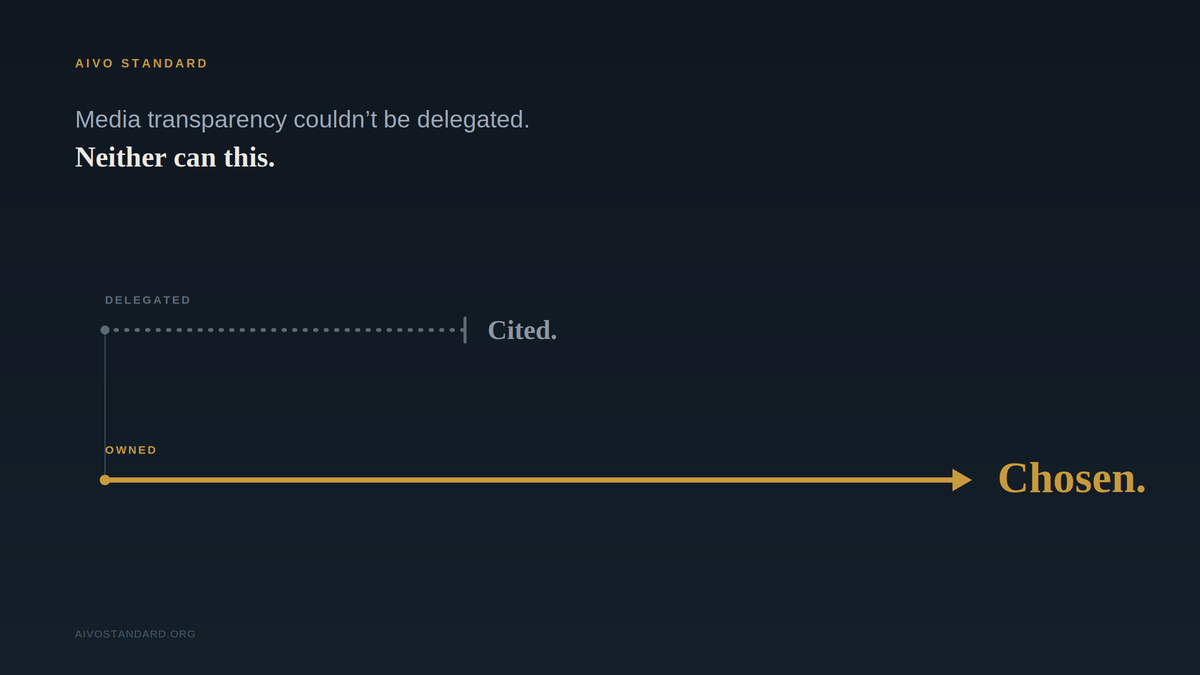
What none of them measure is what happens after a brand is cited. An AI system doesn't stop reasoning once it has named a brand. In a real, multi-turn conversation, a buyer refines what they're asking for, the system compares alternatives, weighs trade-offs, and narrows toward a single answer. A brand can be cited accurately, favorably, and repeatedly, and still lose that final narrowing to a competitor. Citation is necessary. It is not the same thing as being chosen.
Across more than 1,427 multi-turn brand probes, we've measured that gap directly: brands get displaced between citation and final recommendation 87% of the time. That number holds regardless of how strong a brand's GEO or AEO performance already is. A clean citation dashboard can sit directly on top of a badly leaking recommendation funnel, and nothing in most current tooling would show a CMO the difference.
Why this can't be delegated to the people who built the dashboard
This is the part worth saying plainly, because it's the part most organizations are quietly getting wrong. The team currently responsible for GEO and AEO, usually an extension of the SEO function, has a completely rational, human reason to describe the current tooling as sufficient. Admitting there's a layer past citation that isn't being measured is, functionally, admitting the current mandate is incomplete. That's not a failure of competence. It's an entirely predictable response to being asked to evaluate whether your own work has a gap in it.
A CMO who asks their own GEO team whether AI visibility is under control is asking the one group in the building least equipped to answer that question honestly, not because they're being dishonest, but because they're structurally the wrong people to be marking their own homework. This is exactly the dynamic that delayed media transparency reform for years: leaders trusted reporting produced by the people whose performance the reporting reflected. The fix wasn't better reporting from inside that same relationship. It was leadership insisting on an independent standard nobody inside the existing chain controlled.
The same fix applies here. This doesn't require the CMO to become technically fluent in reasoning-chain measurement personally, any more than media transparency required every CMO to become an ad-tech engineer. It requires refusing to let the question of whether AI-mediated discovery is working be answered exclusively by the team whose mandate depends on the answer being yes.
Why the timeline is shorter than it looks
Right now, most AI-mediated buying journeys still end with a human clicking through and completing a purchase themselves, which means a gap between citation and recommendation costs a brand a degraded conversion rate, real, but recoverable, and easy to miss inside broader marketing noise.
That's changing. As AI agents move from researching and recommending toward actually completing transactions on a buyer's behalf, sometimes with a final human approval, increasingly without one, the cost of losing at the recommendation stage stops being a soft, hard-to-attribute drag on conversion and becomes a hard, binary loss of the sale. A brand that isn't measuring whether it survives the recommendation today is, in practice, choosing to find out only once the stakes have already become severe. The organizations that build the measurement discipline now, while the cost of being wrong is still recoverable, will be the ones with real data and real process by the time it isn't.
What CMOs should actually own
None of this requires abandoning GEO and AEO. It requires placing them correctly, as the entry requirement, not the finish line, and refusing to let the question of what happens after citation go unmeasured simply because it's harder to answer than the question of whether a brand got mentioned at all.
The AI-mediated buying journey, from first mention through comparison to final recommendation, and soon to the transaction itself, is a single, connected system. Right now, most organizations are measuring the first step of it closely and the rest of it not at all. That gap won't stay invisible for long. The brands that close it early will be the ones setting the standard everyone else eventually has to answer to.
Published by AIVO Standard
Comments ()