
What People Say About AI Recommendations, and What They Do
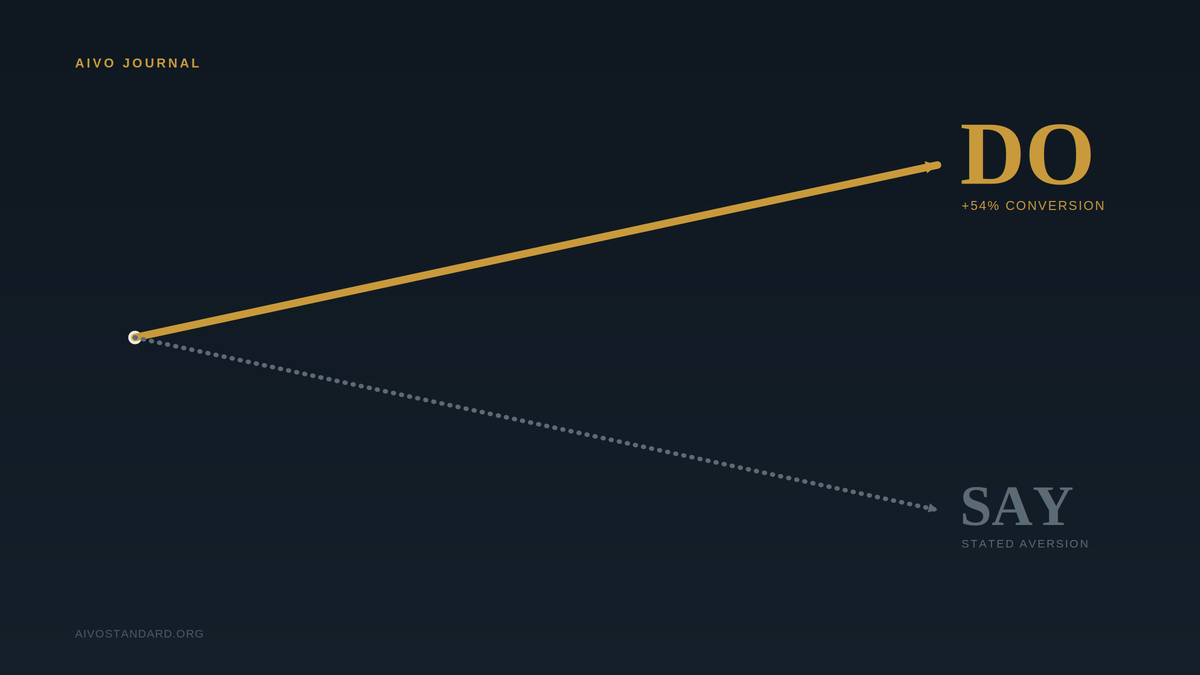
Two recent studies point in opposite directions, and the gap between them is the interesting part
Ask travelers directly, and they say they don't trust AI to recommend where they should stay. A study published this month in Tourism Management, built on interviews, focus groups, and validated survey data across Korean and U.S. samples, found that travelers consistently rate human travel agents above AI agents, and identified five reasons why: AI is perceived to lack lived experience, emotional engagement, contextual understanding, domain-specific knowledge, and the ability to proactively ask follow-up questions. The researchers call this AI aversion, and it held up across rigorous testing, factor analysis, confirmatory analysis, a full structural model.
Now look at what people actually do. Adobe's analysis of over a trillion visits to U.S. retail sites found that shoppers arriving from ChatGPT or Gemini converted 54% higher and spent 53% more per visit than shoppers arriving through traditional channels, and AI referral traffic to retail sites is up 138% year over year.
Both findings are real. Both are well-sourced. And they don't describe the same behavior.
Stated preference and revealed preference are different instruments
The tourism study measures what people say when asked directly to compare AI and human recommendations, a stated preference. The Adobe data measures what people actually do after an AI system has already influenced their path to a purchase, a revealed preference. These two methods frequently diverge, and not just in this case. People routinely say one thing about a technology and do another once it's embedded in their actual routine, and the gap itself is usually more informative than either number alone.
Here, the divergence is sharp enough to be worth sitting with. If travelers genuinely distrust AI recommendations as much as the stated-preference research suggests, the conversion and spending data from actual AI-referred visits should look worse than average, not meaningfully better. It doesn't. Something is resolving that tension before the purchase happens, and the tourism study, built entirely on hypothetical, stated-preference items, was never positioned to see it.
A few honest possibilities, not a conclusion
We don't think one study is simply right and the other wrong. A few explanations seem plausible, and they're not mutually exclusive.
People may distrust AI in the abstract while still acting on its output in practice, the same way many people distrust advertising in general while still buying advertised products. Stated attitudes toward a category and behavior toward a specific, already-encountered instance of that category often don't match.
The aversion may be concentrated earlier in the journey than the moment Adobe is measuring. A traveler might be skeptical of an AI itinerary generator making the whole decision for them, exactly the framing used in the tourism study's interview questions, while being perfectly comfortable clicking through from a single AI-generated suggestion to a page where a human-feeling brand, real photos, real reviews, a real price, takes over and closes the trust gap on its own. If that's what's happening, the AI isn't overcoming aversion. It's handing the moment of trust back to the brand at exactly the point the brand has a chance to earn it.
Or survey answers about AI recommendations may simply lag behind how people are actually starting to use these tools, especially in fast-moving categories like travel search. Stated attitudes about a technology often take time to catch up to lived, repeated use of it.
Why this matters more than picking a side
If the second explanation holds even partly, it reframes what a brand should actually be optimizing for. It's not enough to win the AI's recommendation and assume the trust problem is solved. The AI referral gets a brand to the door. Whatever happens on the other side of that door, the page, the offer, the proof of legitimacy, may be doing the real work of overcoming the aversion the tourism research documents so carefully. A brand that wins the recommendation and then fails to reassure a skeptical human on arrival could still lose the booking, not to a competitor this time, but to hesitation.
That's a different failure point than citation, and a different one again from the execution and booking-path failures we've written about elsewhere. It's worth naming plainly: winning an AI's recommendation doesn't retire the trust question. It just moves it to a different room.
Sources: Kim, H., Shin, H.H., Yoon, H., & Shin, H. (2026). Why travelers prefer humans over artificial intelligence (AI): Developing and testing an AI aversion model in tourism. Tourism Management, 118. Adobe Analytics, cited via industry reporting on AI referral traffic and conversion, 2026.
Comments ()