
The Attribution Gap Isn't a Measurement Problem. It's a Definition Problem.
Digiday reported this week that CMOs cannot link AI visibility to sales. The piece, published August 13, surveyed marketers and agency leaders across the industry. The conclusion was consistent. Every team is triangulating. Nobody has a clean line from AI presence to revenue.
Roast managing partner John Barham put it plainly. There is no one tool that can paint the whole picture. Rippling's head of growth described stitching together visibility tools, paid conversion data, and a custom media mix model just to approximate an answer. Peach & Lily's CEO called it triangulation. Demandbase's CMO called it an attribution problem that has plagued marketers for years.
These are not new complaints in marketing. What is new is the object being measured. AI assistants do not show a brand an ad and wait for a click. They compare, reason, and recommend inside a single conversation. The attribution problem in this environment is not a tracking problem. It is a definition problem. Most tools on the market answer the wrong question well.
Share-of-model tools measure whether a brand appears. They sample a model's response to a prompt and report presence, sentiment, or citation frequency. This is useful information. It is not the information that predicts revenue.
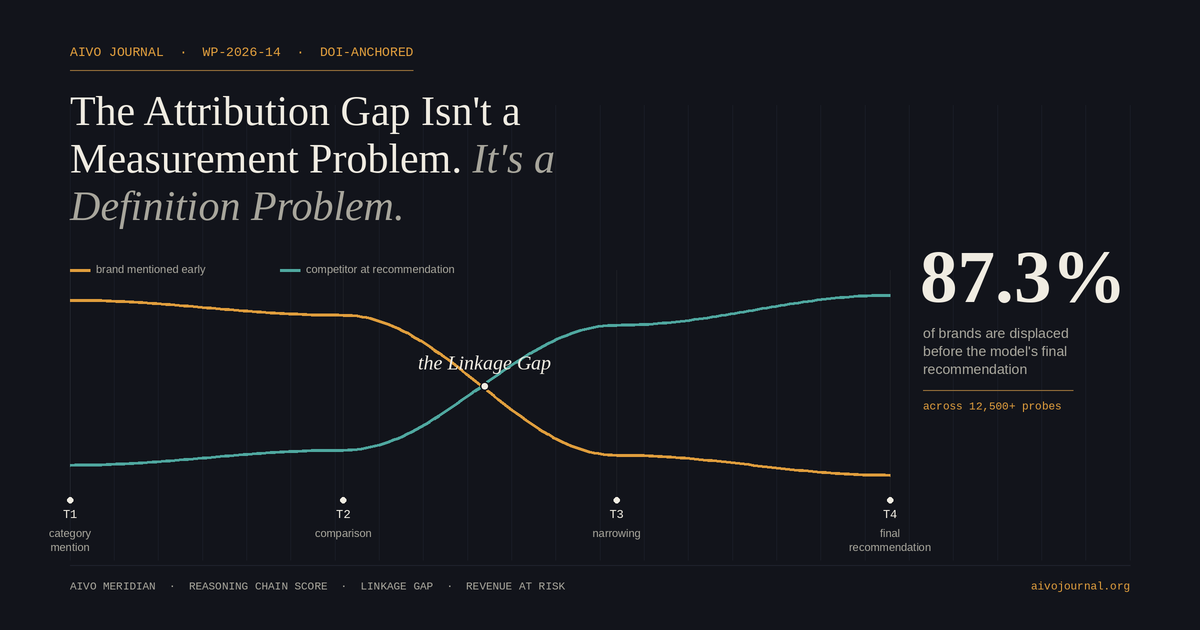
We call the gap between those two things the Linkage Gap. Across more than 12,500 probes, we track what happens to a brand across a full reasoning chain, from a model's first mention of a category through its final purchase recommendation. The finding is consistent across categories. In 87.3 percent of conversations, a brand mentioned early in the exchange is displaced by a competitor before the model reaches its final recommendation. This is documented in WP-2026-14, DOI-anchored and publicly available.
The Linkage Gap explains why visibility and sales have felt disconnected. A brand can be cited constantly and still lose the purchase decision almost every time. Citation and recommendation are two different events inside the same conversation. Measuring one does not tell you about the other.
This distinction is what makes attribution tractable rather than probabilistic. If the unit of measurement is the full reasoning chain rather than a single prompt response, it becomes possible to isolate where a brand is lost, not just whether it appeared. That location, the specific turn where a competitor takes over the recommendation, is a fixed and repeatable point in the conversation.
In practice, closing that gap means addressing what a model is missing at that specific turn. That can be a comparison point the model has no evidence for, a category claim the brand has never substantiated in machine-readable form, or structured product data a model cannot find when it reaches the decision stage. The remediation is targeted at the turn, not at visibility in general.
Once a brand knows where it loses the recommendation, that point can be tracked before and after remediation. It can be expressed as a dollar figure, a Revenue at Risk calculation grounded in where displacement is actually occurring, not in a raw visibility score.
This does not eliminate every attribution challenge marketers face. A user can still read an AI recommendation on one platform and complete a purchase on another, and that path is genuinely hard to capture in full. But it narrows the open question considerably. Instead of asking whether AI visibility correlates with sales in general, a brand can ask a more precise question. At which turn in the reasoning chain are we losing the recommendation, and does closing that gap change the outcome.
That is a testable claim, not a modeling exercise. We are running it now against real audits, real brands, and real remediation work, and publishing the methodology as we go.
The industry does not need a better dashboard. It needs a different unit of measurement. The reasoning chain, not the single prompt, is where the sales decision actually happens.
Methodology and full findings for WP-2026-14 are published and DOI-anchored via Zenodo.
Comments ()