
The Car Rental Company That Does Not Exist. It Still Gets Recommended.
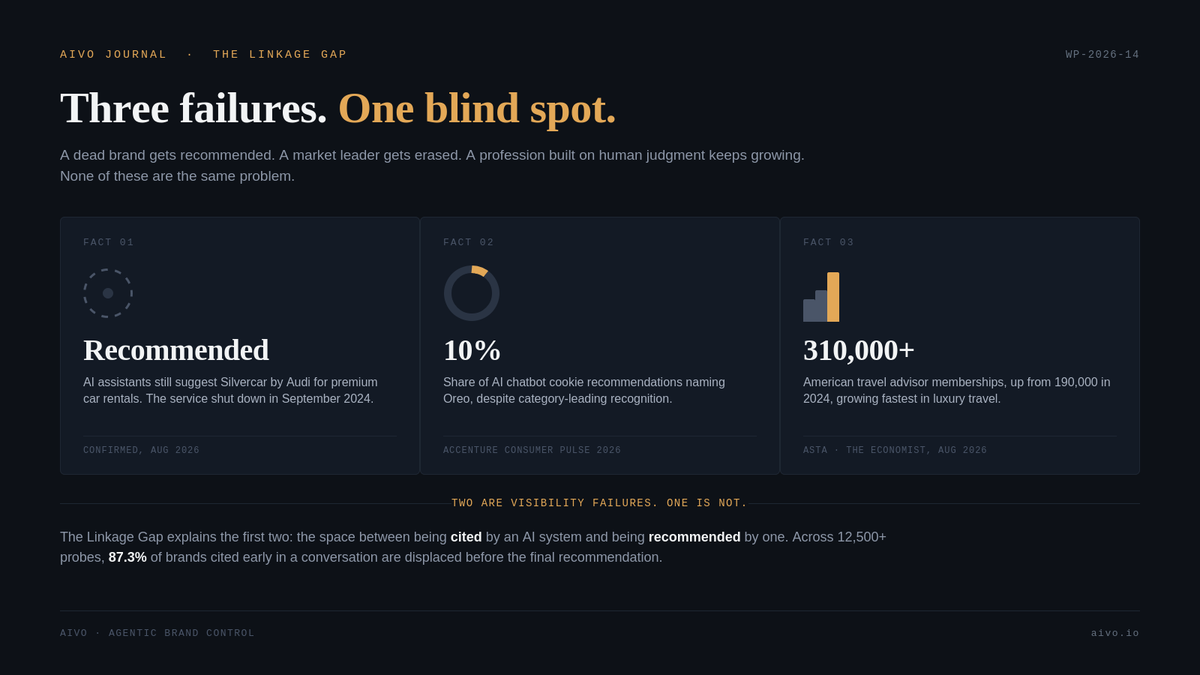
Ask an AI assistant for a premium car rental in a major US city and there is a good chance it will suggest Silvercar by Audi. The service does not exist. Audi shut it down in September 2024. The model recommends it anyway, often ahead of several live, bookable competitors sitting right there in the same market.
That is not a glitch anyone flagged and fixed. It is still happening.
Now hold that next to a second fact. Oreo is one of the most recognized brands on earth. Mondelez recently discovered it was showing up in only 10 percent of AI chatbot recommendations for cookies, a category Oreo has led for over a century. The finding came from Accenture's Consumer Pulse Research 2026, a survey of 25,590 consumers across 16 countries. Mondelez's response was to unblock its crawlers and restructure its site. Its VP of global digital commerce summed up the fix in one line. If they can't crawl our site, nothing else matters.
Sit with both facts for a moment. A dead brand gets recommended with total confidence. A thriving, category-leading brand gets left out entirely. Whatever is happening inside these systems, it is not simple visibility, and it is not simple accuracy either. It is something closer to memory without judgment, confidence without verification.
There is a third fact, and it points the opposite direction. Despite everything AI can already do for travel planning, human travel agents are growing, not shrinking. Membership in the American Society of Travel Advisors has climbed from 190,000 in 2024 to more than 310,000 today. In Britain, roughly a third of travelers booked their last holiday through a human specialist. The growth is sharpest at the top end, among clients who spend heavily on travel that carries real personal meaning: the view from the room, the timing of an anniversary trip, the judgment call only a person seems willing to make. People do not appear to distrust AI here so much as they trust it exactly as far as the decision stops mattering to them personally.
Three facts. A dead company recommended as if it were alive. A market leader nearly erased. A profession built entirely around the choices people still refuse to delegate. These are three different failures, and they deserve three different names.
The first two are the same failure wearing different masks. AIVO calls it the Linkage Gap: the space between being cited by an AI system and being recommended by one. Across more than 12,500 probes, AIVO found that 87.3 percent of brands present at an early stage of an AI conversation are displaced before the model reaches its final recommendation. The brand was seen. The brand was named. The brand still lost, sometimes to a real competitor, sometimes, it turns out, to one that no longer exists.
This is why visibility fixes only go so far. A brand invisible at the citation stage needs structured, machine-readable data, which is what Mondelez did and what most crawlability audits are built to catch. A brand cited but displaced later in the conversation needs something else. Displacement usually is not random. A model resolves competing constraints as a conversation unfolds, weighs a new trade-off the user surfaces, or defaults to whichever option looks safest to recommend, and any of those can quietly drop a brand that was named just two turns earlier. AIVO tracks the pattern with the Reasoning Chain Score, a composite measure of how a brand survives across a full conversation rather than a single response. It rests on five signals. How many contexts the brand holds up in. How deep into the reasoning it survives. How well it resists displacement. How favorably it is framed when it does survive. How quickly that standing decays over repeated turns. A crawlability audit answers whether a brand showed up. The Reasoning Chain Score answers whether it lasted. A brand can pass every crawlability check Mondelez ran and still fail at the one moment that actually decides the sale, the same moment that let a defunct rental company outrank three real ones.
Accenture's broader numbers explain why this stage will only matter more. Seventy four percent of consumers surveyed said they would trust a personal AI agent more than their best friend to make a purchase on their behalf. Thirty two percent are already comfortable letting an agent decide outright. Fifty six percent would instruct their agent on which brands to even consider, and among consumers who call themselves loyal to a specific brand, 37 percent said they would still let their agent switch them away from it for a better fit. Loyalty has not disappeared. It has become conditional, adjudicated by a reasoning process most brands cannot see inside, the same process that is still, right now, recommending a company that no longer exists.
The third failure, the one behind the travel agents, will not be solved by better data feeds. It is not a machine-readability problem. It is a category where the decision itself carries meaning the consumer wants to hold onto, and no amount of structured markup changes that. The category-by-category shape of this matters as much as the average. Some categories will be won by making a brand legible to machines. Others will be won by staying irreplaceably human at the exact moment a model would otherwise take over. Knowing which fight you are actually in is the first strategic decision, and most brands have not made it yet.
Being crawlable gets a brand into the conversation. It doesn't keep the brand in the room until the recommendation is made, and in some categories, it was never going to be the thing that mattered most.
Comments ()