
The Question the Instrumentation Can't Answer
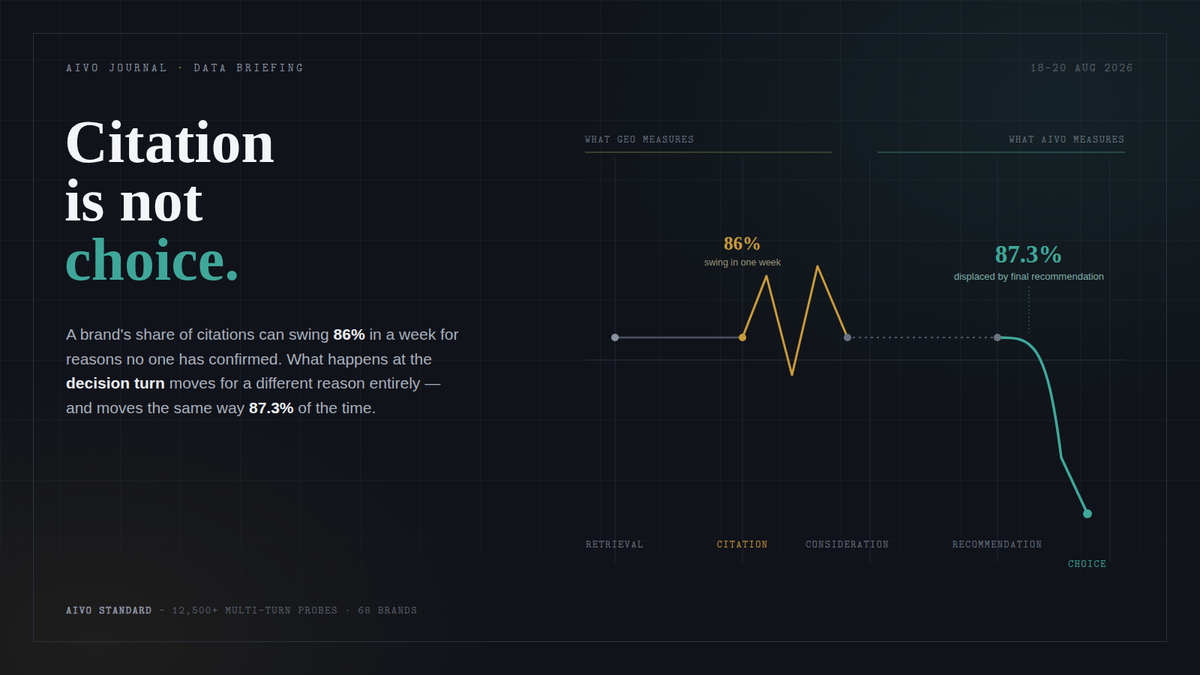
Citation share fell 86 percent in a week. Nobody can say with confidence why. That gap is the story.
Reddit held a steady 3.83 percent share of ChatGPT Search citations from mid-July through early August. In the space of a week it fell to 0.52 percent — an 86 percent relative decline. G2 and Capterra reportedly dropped from a combined 7 percent to zero. Wikipedia and first-party documentation pages picked up the difference.
The GEO industry noticed immediately, because tracking citation share is what the GEO industry does. What it could not do, several days on, is explain the movement with any confidence.
There is what was observed: the distribution of citation share across sources changed sharply and quickly. There is what is unknown: why. And there are competing explanations sitting in between, none confirmed. One argument is that the model deliberately deprioritized forums and review sites.
Another points to a Google search-parameter change made months earlier, which quietly narrowed what any outside retrieval system could see in the first place. A third holds that it is simply cheaper for a model to draw from a stable, well-structured page than to re-crawl a sprawling comment thread.
And beneath all three sits a fourth possibility that is easy to skip past: the firm that surfaced the data has flagged its own numbers as provisional, which means the measurement itself may not yet be stable enough to explain.
Treating those as four equivalent theories is too generous to the discourse. It is one observed phenomenon, one open question, and several unconfirmed candidates for an answer — and a great deal of confident commentary sitting on top of that uncertainty.
We wrote last week that a standard for citations is not a standard for outcomes, and that conflating the two is how sophisticated research keeps stopping at the same boundary. This is that boundary, in real time. But the honest version of the claim is narrower than "the industry can't answer the question."
The industry can't explain a sudden movement in citation share with confidence — because the instrumentation it built was never designed to hold the variables that would resolve it. That is not primarily a failure of analysis by the people doing the work. It is structural. You cannot explain a change you don't have the layer to observe.
Here is what the citation-share number cannot tell you, no matter how precisely it is measured, and no matter how the August anomaly is eventually explained: whether the brands that lost citation share were ever being recommended in the first place, or whether the brands gaining share are converting that presence into anything.
A source can vanish from the citation layer entirely and change nothing about who wins the recommendation. A source can dominate the citation layer and still lose the decision turn every time. That is true independent of which of the four explanations above turns out to be correct — which is what makes it a critique of the construct, not of the measurement.
We have been measuring the gap between those two events since July 2025. Across more than 12,500 multi-turn purchase-decision probes spanning 68 brands, a brand present at the first turn of a conversation is displaced by a competitor at the moment of final recommendation 87.3 percent of the time. Citation is not the same event as being chosen. It never was.
That statistic deserves scrutiny, not just citation — what counts as "present," what counts as "displaced," how many turns, how categories and models were controlled, whether 87.3 percent is an aggregate or a weighted figure. We think the finding holds up, and the underlying methodology is documented in the AIVO Standard working papers on Zenodo for anyone who wants to test it rather than take it on faith.
None of this is a reason to stop tracking citation share — knowing which sources a model draws from still matters, and it remains necessary. It is a reason to stop treating a citation-share chart as sufficient on its own, or as a verdict on brand performance.
A brand's position in that chart can move 86 percent in a week for reasons that have nothing to do with whether it is winning or losing the sale, because retrieval, citation, consideration, recommendation, and choice are five different events, not one.
The market spent this week asking which sources ChatGPT trusts. The more consequential question is which brands survive the conversation once that trust has already been granted — and that question is not answered by watching where the citations land. It is answered by watching what happens after them.
Comments ()