
The Zero-Click Blind Spot
Why the biggest source of AI-influenced revenue doesn't show up in any analytics dashboard, and what we're proposing to do about it
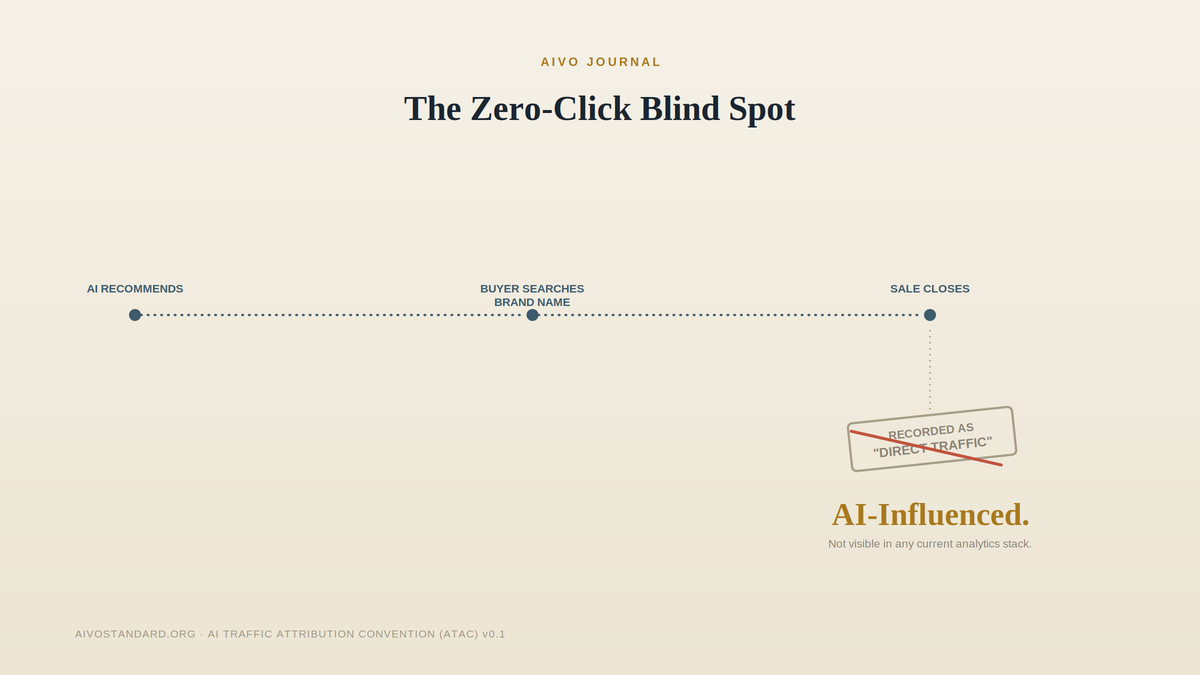
A buyer asks an AI assistant for a recommendation. The assistant reasons through the comparison, names a brand, and the buyer, a few minutes or a few hours later, opens a new tab and searches that brand's name directly, or simply types the URL from memory. The sale closes. Every analytics platform involved records it as branded search, or direct traffic, and credits it to brand strength.
The AI recommendation that actually drove the purchase is invisible in that record. Not underweighted, not approximated, invisible. And this is not the smaller part of the problem. It's the majority of it.
Three ways the current measurement stack breaks
Web analytics was built for a click-based web: referrer headers, UTM parameters, session models that assume a human clicking a link in a browser. AI-mediated discovery breaks that stack in three distinct ways.
Traffic that AI assistants do refer, a user clicking directly from a chat interface to a website, is classified inconsistently. Referrer headers are stripped by some platforms, rewritten by others, present without warning on some and absent on others. Identical journeys get classified differently depending on which site, which day, which analytics stack is doing the counting.
Traffic from AI agents acting on a buyer's behalf, reading a pricing page or comparing product data without a human present, has no common classification at all. It isn't conventional bot traffic, since it represents live commercial intent. It isn't human traffic either, since behavioral metrics like bounce rate or session duration don't mean anything applied to it. Most measurement stacks either miss it entirely or silently count it as human.
And the largest category, the one described at the top of this piece, produces no deterministic signal whatsoever. It arrives looking exactly like a brand-strength success story, when the actual cause was a recommendation the analytics stack never saw.
Why this matters more than it looks like it should
Any measurement approach limited to deterministic signals, referrer headers, UTM tags, click paths, measures a visible minority of AI's actual commercial effect and quietly omits the majority. That's not a rounding error in a report. It's brands making budget decisions based on a number that's structurally missing its largest component, and analytics vendors publishing AI-influence figures without any way to show their work, because the underlying convention was never built to ask them to.
This is a real, current gap, not a hypothetical one. The Media Rating Council's own interim guidance on AI in media measurement, published this July, explicitly named agentic activity and zero-click measurement as areas existing standards don't yet cover.
What we're proposing
We've published a draft specification, the AI Traffic Attribution Convention (ATAC v0.1), open for public comment, free to adopt, requiring no relationship with or license from us. It does three limited things.
It defines a shared vocabulary: three classes of AI-mediated traffic, AI-Referred, Agentic, and AI-Influenced, each carrying an explicit confidence value rather than being reported as a single blended number. A brand publishing "12,400 AI-referred sessions" under this convention has to state what share of that figure is high-confidence deterministic evidence versus low-confidence inference. Blended figures without disclosed composition aren't conformant.
It defines a declaration mechanism. ai_ref is a simple parameter AI platforms can append to outbound links, declaring provenance the way utm_source already does informally for some platforms, standardized into something structured and platform-neutral rather than ad hoc. Alongside it, an extension to the brand.context resource lets site operators declare exactly where their machine-readable pricing, product, and availability data lives, so an agent doesn't have to guess whether a page's real answer is trapped behind JavaScript rendering it can't execute.
And it defines minimum honesty requirements for the hardest category, AI-influenced revenue, the zero-click effect described above. Any published estimate of this kind has to be built from at least one input independent of the traffic data it's explaining, disclosed as a range with a confidence statement, and never presented as a bare point estimate. Citation frequency or first-prompt visibility specifically don't qualify as that independent input, because they're not an established proxy for whether a brand actually gets recommended once a real, multi-turn comparison plays out. Presence at the first mention and presence at the final decision are different events, and this convention requires them to be recorded as different variables.
What it deliberately doesn't do
It doesn't mandate a methodology, a product, or a vendor. It doesn't tell anyone how to build a model of AI-influenced revenue. It defines only what a published estimate has to disclose if someone else is going to be able to check it. It's designed to sit alongside existing and emerging work rather than duplicate it: it treats cryptographic agent authentication, HTTP Message Signatures and the IETF's Web Bot Auth effort, as its highest-confidence tier rather than reinventing identity verification, and it draws its declared-versus-suspected classification split directly from the Media Rating Council's own Invalid Traffic framework.
Why we're publishing it this way
The honest reason a convention like this is worth having is the same reason most measurement categories eventually need one: once a number acquires commercial value, someone has an incentive to make it look better than it is. That's true of AI-influenced revenue specifically, and it will keep being true regardless of who's doing the measuring, us included. A shared, versioned, publicly commentable convention is a better answer to that problem than any single company's assurance that its own numbers can be trusted.
This is v0.1, a draft, published for comment, not a finished standard. We'd genuinely like to hear where it's wrong.
The full specification, AI Traffic Attribution Convention (ATAC) v0.1, is published under CC BY 4.0 on Zenodo. Comments are invited at tim@aivostandard.org or paul@aivostandard.org.
 Sheals, Paul and de Rosen, Tim
Comments ()